

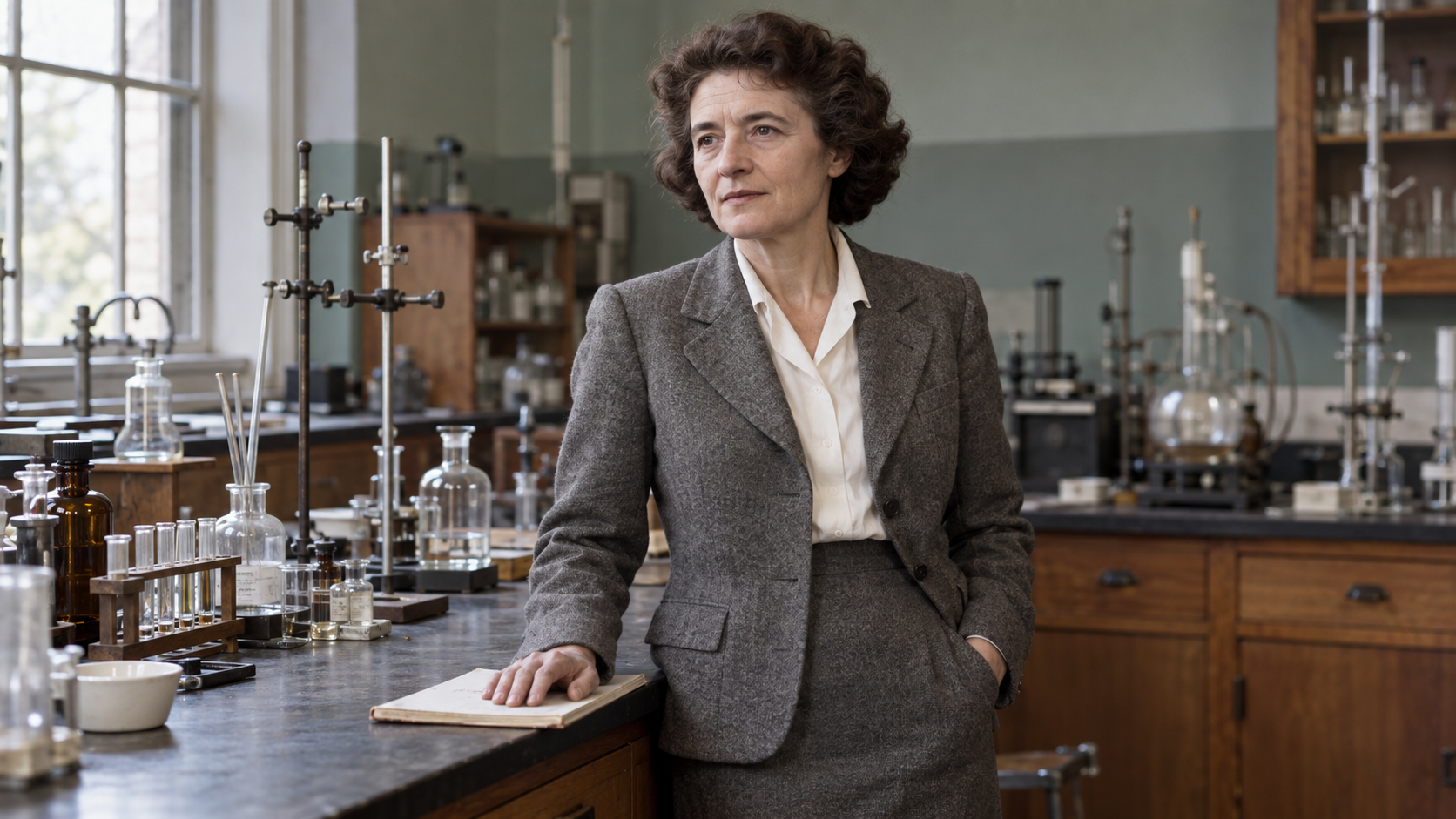
“Modern medicine, aided by chemistry, has decreased human suffering.”
Gerty Cori’s sentence gives medical progress a human measure: whether suffering has been reduced. In her personal essay preserved by Washington University’s medical library, the biochemist placed this observation within a wider reflection on art, science and responsibility. She could value scientific achievement while recognizing that knowledge could also be used destructively. Her statement therefore invites a more thoughtful response than simple admiration for everything new. Chemistry matters here because it can help explain processes that once remained obscure and make useful interventions possible. Cori’s own investigations, undertaken with Carl Cori and other colleagues, explored how the body handles carbohydrate stores and the enzymes involved. That work illustrates the distance between a question at a laboratory bench and its eventual significance for medicine. Understanding a mechanism can change what investigators are able to recognize and examine, even before an immediate treatment follows.
The connection is easy to overlook when research is discussed only in the language of discoveries and prizes. A measured reaction, a better method or a carefully characterized enzyme may seem remote from someone experiencing illness. Yet those details can provide the foundations on which later explanations depend. It is useful to think of research as building a more accurate map. A map does not itself carry a traveler to safety, but it can show why a route repeatedly fails and where a more promising path might lie. This analogy has limits: living systems are complex, and knowing more does not ensure that every clinical problem will be solved. Still, it helps distinguish a valuable contribution from an instant cure. Precision can serve compassion by reducing uncertainty about what is happening, while compassion keeps the purpose of that precision in view.
Cori’s words also offer a question for people outside laboratories. When we hear about a medical advance, what practical difference might it make for those who need care? The answer involves more than whether a technique is impressive. Its benefits must be understood, its limitations examined and its use connected to the circumstances of actual patients. People may need an explanation they can follow, help obtaining care or a professional willing to discuss what remains uncertain. These are parts of turning knowledge into a human benefit. In the wider essay, Cori associated intellectual achievement with virtues including honesty and kindness, a combination that prevents scientific confidence from becoming indifference. For March 14, the quotation reminds us that rigorous inquiry and concern for others can belong to the same endeavor. The enduring goal is knowledge that helps people live with less avoidable suffering, supported by care in how that knowledge is interpreted and used.
It appears in Gerty Cori’s essay “Glories of the Human Mind,” preserved in Washington University’s medical library exhibit. The sentence also occurs in her personal statement reproduced by the National Academy of Sciences.
The Academy memoir dates submission of that statement to 1954, while the university associates the essay with an earlier radio series. A precise original broadcast date is not asserted for this quotation.
Gerty and Carl Cori investigated carbohydrate metabolism, including the storage and breakdown of glycogen. Their work helped clarify mechanisms and enzymes important to understanding how the body uses energy.
That history shows why foundational research deserves attention alongside treatments. A clearer account of a biological process can support later medical understanding without amounting to an immediate cure for every related condition.
Ask how a claimed advance might help people and what must happen for that benefit to reach them. Scientific novelty alone does not answer questions about evidence, limitations, communication or access.
Cori’s broader essay recognizes both the value of science and the dangers of its misuse. Honesty and kindness give its achievement direction: the purpose remains human well-being rather than admiration for technique alone.
Explore more "Quotes of The Day"
Discover more notable quotes from influential voices across politics, science, business, technology, sports, and culture. Each quote offers insight into how ideas, beliefs, and decisions shape the world around us.