

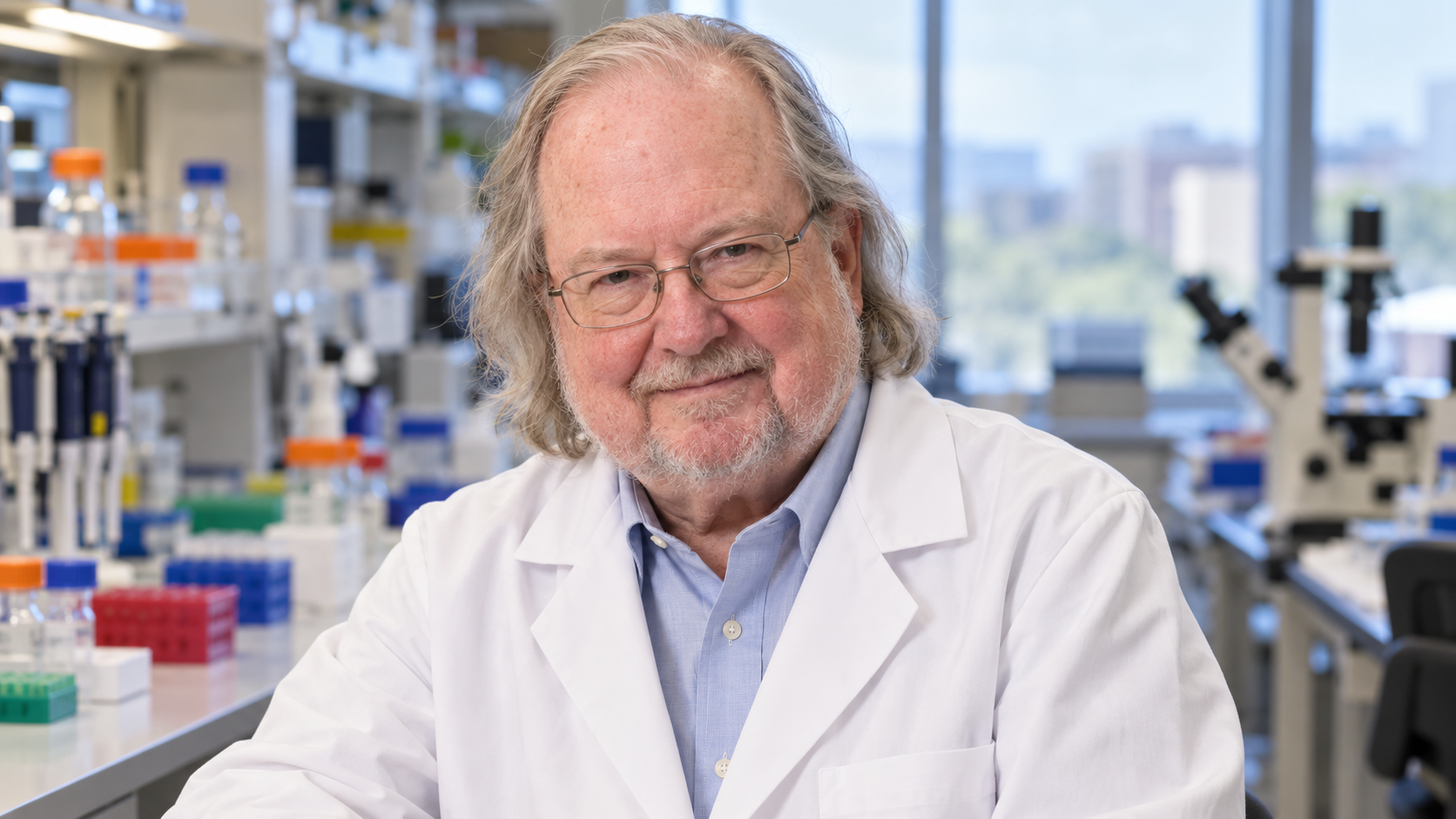
“A driving motivation for scientists is simply to push the frontiers of knowledge.”
James P. Allison made this statement when MD Anderson announced the 2018 medicine Nobel awarded to him. The institution’s news release records his explanation that he had begun by studying T cells rather than setting out to investigate cancer. His interest in how the immune system works eventually contributed to a different approach to cancer treatment. The quotation therefore describes a connection between basic questions and practical consequences that was visible in his own research career. Its account leaves the eventual uses of an observation open when an investigation begins. An investigation can begin with a problem in biology and later acquire a significance beyond the original question. Allison’s statement gives that uncertainty a constructive place in the story of medical discovery. Curiosity is part of the work that can make a later application conceivable.
The distinction between understanding a system and using that understanding is especially useful here. MD Anderson describes Allison’s work on a protein that restrains T-cell activity and the development of an antibody that blocks it. This helped establish immune checkpoint blockade as a cancer treatment approach. The news release also makes clear that benefits did not reach every patient and that important questions remained. Those limits belong alongside the achievement. A successful application does not mean the underlying biology has been fully explained, and an incomplete explanation can still support a carefully tested intervention. The relationship runs in both directions: laboratory work can open a clinical possibility, while clinical experience can expose a new question for the laboratory. Allison’s account resists the idea that useful science must always begin with a fully specified product. It also leaves no basis for assuming that every exploratory finding will become a treatment.
The sentence can help readers assess how research is discussed. A study that improves understanding may be valuable before it changes care, but that value should be explained precisely rather than described as an imminent breakthrough. Conversely, a promising concept still needs the testing required for its proposed use. These are applications of Allison’s statement, not a guarantee about any particular research program. Imagine a laboratory discovering an unexpected signal in a cell experiment. The immediate task is to determine whether the observation is reliable and what it means, not to declare that patients will soon benefit. Repeating the experiment, examining alternative explanations, and sharing results can move the question forward. The example shows how patient relevance can coexist with patience about what is actually known. Research support also needs room for teams whose work clarifies mechanisms without producing a headline. Allison’s experience offers a reason to take that work seriously while preserving a distinction between discovery, development, and care. The frontier is reached through evidence, not through the excitement of an announcement alone.
MD Anderson recorded the sentence in its October 2018 announcement of Allison’s Nobel Prize. He connected it to his original interest in T-cell biology.
The institution’s Nobel page reproduces the statement, and a contemporary newspaper edition also preserves its wording.
Allison’s research helped establish a way to remove a restraint on immune activity in cancer treatment. His account begins with a biological question.
The announcement also acknowledges unanswered questions and uneven patient benefit. The achievement did not eliminate the need for further investigation.
An exploratory result can deepen knowledge before it has a practical use. Its significance should be described at the level the evidence supports.
A promising application needs appropriate testing. Curiosity and caution can belong to the same research process.
Explore more "Quotes of The Day"
Discover more notable quotes from influential voices across politics, science, business, technology, sports, and culture. Each quote offers insight into how ideas, beliefs, and decisions shape the world around us.