

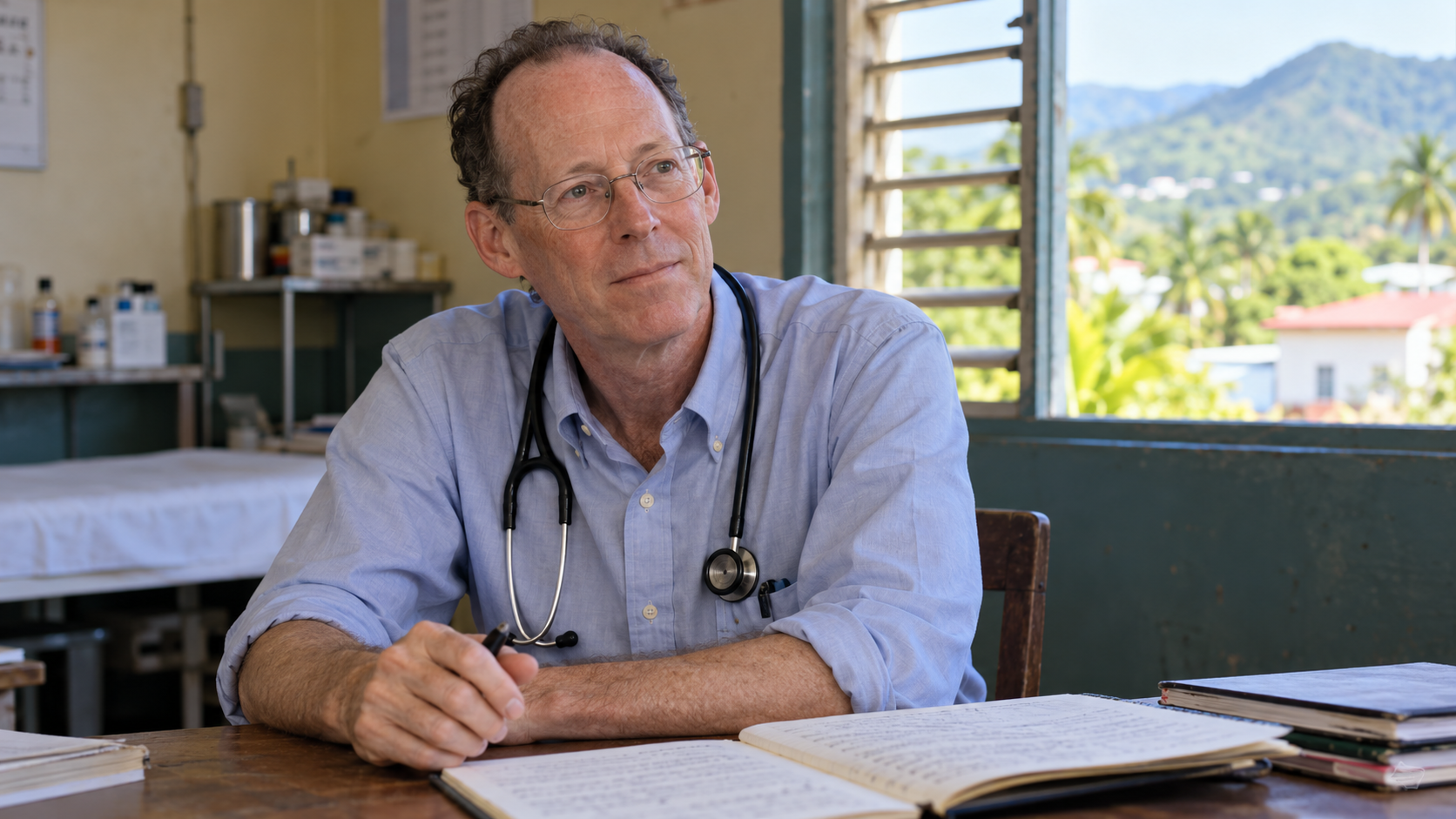
“The idea that some lives matter less is the root of all that’s wrong with the world.”
Paul Farmer repeated this sentence in a 2018 Harvard Gazette interview while discussing his route from anthropology and medicine to long-term work in Haiti, Rwanda, and other settings marked by severe inequality. It compresses an argument that ran through his writing and practice: avoidable suffering is often explained as unfortunate scarcity when it also reflects choices about whose needs receive attention. Farmer studied what he called structural violence, the social and economic arrangements that place illness, risk, and limited care unevenly across populations. The quote names the moral assumption beneath those arrangements. Once some lives are treated as less valuable, lower standards can be rationalized as realistic, and preventable deaths can disappear into the language of inevitability. Farmer used clinical stories and anthropological observation together, arguing that a treatment can fail when transportation, food, shelter, or political exclusion is omitted from the explanation.
The line is deliberately absolute, so it needs careful application. Not every difference in outcome proves that a decision maker consciously valued one person less. Disease burdens vary, evidence can be incomplete, and health systems must allocate finite staff, time, and money. Farmer’s challenge is to examine how those constraints were produced and whose hardship is accepted without the effort applied elsewhere. He rejected the idea that poor communities should automatically receive a thinner version of care. That did not mean ignoring cost or logistics. His organizations worked on delivery systems, local partnerships, community health workers, and the material conditions that allow treatment to succeed. Moral equality had to become operational rather than remain a declaration. His insistence on accompaniment described long-term presence rather than a short intervention, with teams staying beside patients as practical and clinical obstacles changed.
A present-day reading asks what standard a health program would use if the people most affected had real authority in its design. Are distances, fees, language, housing, nutrition, and reliable follow-up treated as central parts of care or as someone else’s problem? Are outcomes reported in a way that reveals who is being missed? Farmer’s sentence does not supply a budget, a clinical protocol, or one universal model. It supplies the reason to keep testing those tools against equity. Declaring that every life matters equally is easy at the level of principle. The demanding work is to notice where systems behave otherwise and to redesign them with the same seriousness brought to technical problems. In that sense, the quote is both an accusation and a practical standard for health institutions. Programs can honor that idea by budgeting for follow-up and social support at the start, instead of treating them as optional additions after a medical plan breaks down.
Farmer linked avoidable illness to social arrangements that distribute risk and care unequally.
His work challenged explanations that present preventable suffering as a natural feature of poverty.
The same value assigned to every life must shape delivery, staffing, follow-up, and the conditions that make treatment possible.
Cost and logistics remain real, but they should be solved rather than used to justify permanently lower standards.
Who helps define the problem, which barriers are counted, and whose outcomes disappear in an average?
Equity becomes measurable when systems reveal who is missed and change the path that keeps missing them.
Explore more "Quotes of The Day"
Discover more notable quotes from influential voices across politics, science, business, technology, sports, and culture. Each quote offers insight into how ideas, beliefs, and decisions shape the world around us.