

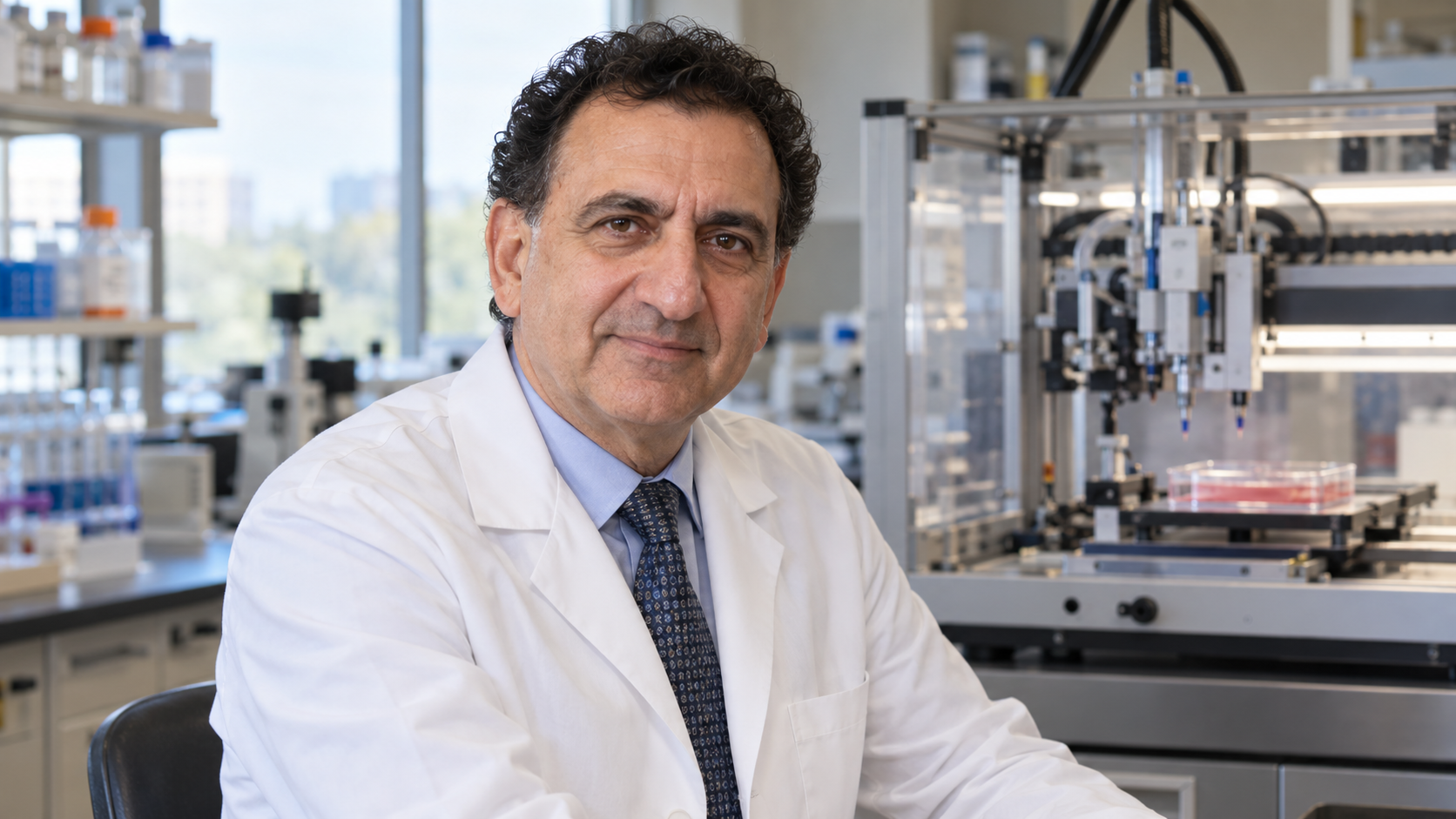
“We can use biomaterials alone, cells alone, or your own cells combined with biomaterials.”
Atala described several strategies for repairing or replacing tissue, from scaffolds that guide healing to cells grown with biomaterials. The stage demonstration illustrated a research direction rather than a transplant-ready printed kidney. The primary record for Anthony Atala identifies Atala’s 2011 TED talk demonstrating approaches in regenerative medicine and tissue engineering. Reading Atala’s source beside Atala’s words separates Atala’s verified context from Atala’s later paraphrase. September 12 orders Atala’s series; September 12 does not tie Atala’s statement to Atala’s historical anniversary for Atala. The paired references let Atala’s readers compare Atala’s wording with Atala’s institutional record and Atala’s biography. That documented trail for Atala preserves Atala’s audience, Atala’s purpose, and Atala’s necessary limitation. Editors can quote Atala while keeping Atala’s original question visible to Atala’s readers.
The quote shows that regenerative medicine is a toolkit, not a single invention. Different tissues require different combinations of structure, living cells, blood supply, maturation, and surgical integration. Laboratory demonstrations can be visually persuasive long before safety and effectiveness are established. Engineered tissues face challenges in vascularization, immune response, scale, manufacturing, regulation, cost, and long-term follow-up. For Atala, the line becomes Atala’s interpretive lens rather than Atala’s complete clinical guidance. Applying Atala’s idea requires Atala’s current evidence, Atala’s affected communities, and Atala’s suitable outcomes. In health reporting, Atala should guide Atala’s inquiry before Atala supports Atala’s conclusion. A careful reading of Atala separates Atala’s descriptive findings from Atala’s moral judgment and Atala’s policy choice. Each layer around Atala needs Atala-specific support plus Atala-specific accountability. That structure keeps Atala’s memorable words connected to Atala’s documented scope and limits.
Researchers now pair biomaterials, organoids, bioprinting, and patient-derived cells for models and potential therapies. Public communication should state whether an application is experimental, approved, or used only to study disease. Atala’s formulation makes the field’s design choices visible. Its lasting promise depends on disciplined translation from a compelling prototype to reproducible patient benefit. The continuing question from Atala is practical for Atala: which decision embodies Atala’s principle? Readers can test Atala’s relevance when Atala’s practical questions for Atala ask who gains, where Atala’s risk falls, and how Atala’s improvement gets measured. Organizations honor Atala by assigning Atala-specific responsibility, Atala-specific resources, Atala-specific timelines, and Atala-specific public feedback. Individuals may use Atala for Atala-specific reflection while qualified care addresses Atala’s personal relevance. That distinction lets Atala inspire Atala-specific action without turning Atala’s editorial context into Atala’s medical advice. A transparent Atala review lets Atala’s principle face Atala’s real outcomes and necessary correction.
Atala’s 2011 TED talk demonstrating approaches in regenerative medicine and tissue engineering.
The primary record anchors Anthony Atala’s wording and prevents the September calendar from being mistaken for an anniversary.
The quote shows that regenerative medicine is a toolkit, not a single invention.
Its value is strongest when surrounding evidence, affected people, and practical conditions remain visible.
Laboratory demonstrations can be visually persuasive long before safety and effectiveness are established.
Apply the insight with consent, equity, current evidence, and a willingness to revise decisions when outcomes differ from expectations.
Explore more "Quotes of The Day"
Discover more notable quotes from influential voices across politics, science, business, technology, sports, and culture. Each quote offers insight into how ideas, beliefs, and decisions shape the world around us.