

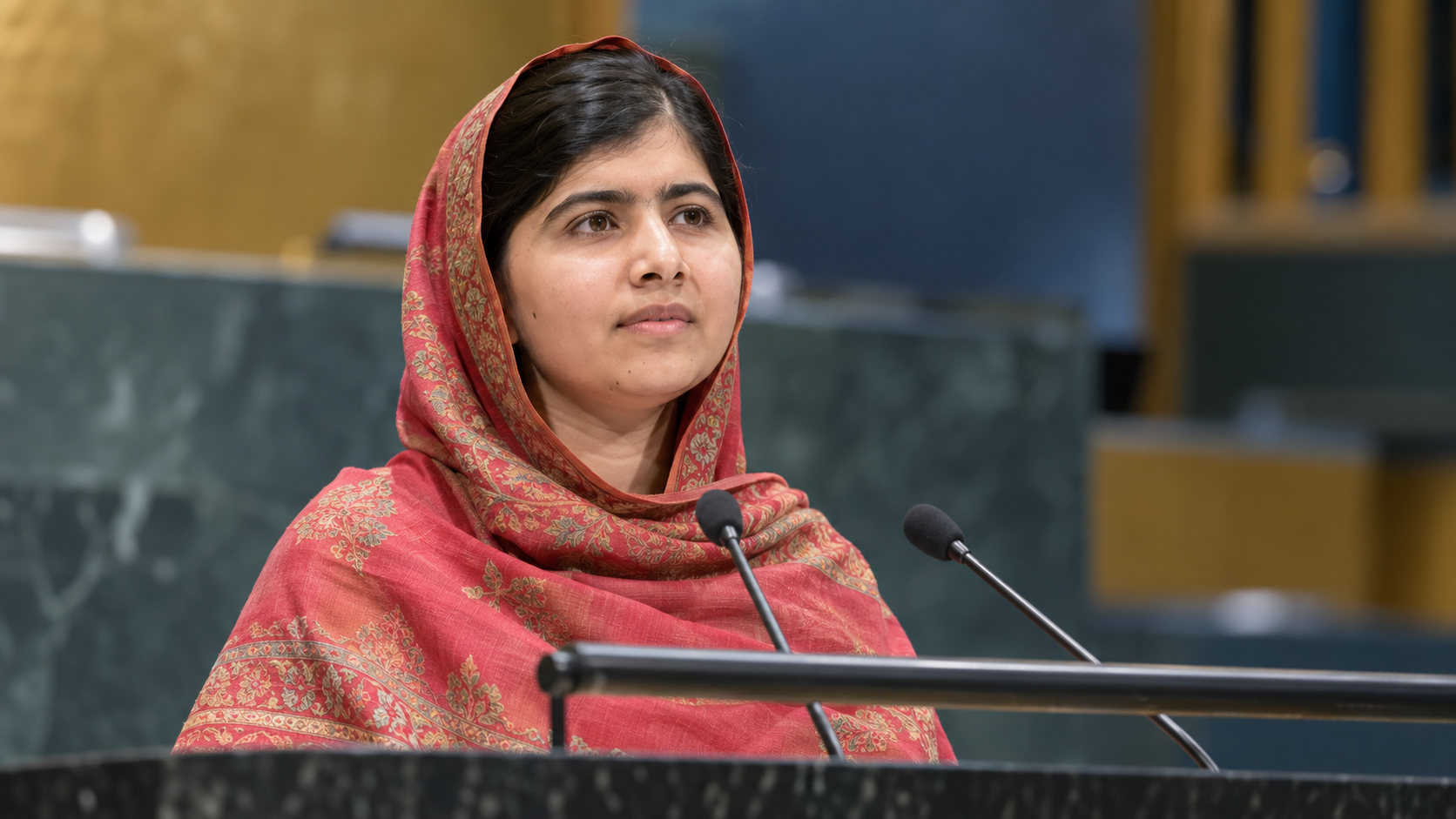
“Let us pick up our books and our pens. They are our most powerful weapons.”
Malala Yousafzai spoke these words at the United Nations Youth Assembly on July 12, 2013, her sixteenth birthday. The address came after she had been targeted for advocating girls’ education in Pakistan and had undergone extensive medical treatment in the United Kingdom. At the United Nations, she did not frame the occasion as a story of individual revenge or exceptional courage. She called for a global struggle against illiteracy, poverty, and terrorism, then named books and pens as the tools of that struggle. The line’s force comes from the contrast: objects associated with classrooms and writing are presented as powerful because they help people learn, speak, question, and act together.
Calling books and pens weapons is a metaphor, not a celebration of violence. Yousafzai’s speech places education in opposition to the logic that uses fear to control who may learn or speak. A book can preserve knowledge and introduce a reader to lives beyond their immediate setting. A pen can record a fact, make an argument, sign a petition, write a letter, or create a story that refuses silence. Neither object works by itself. Their power depends on access to schools, teachers, libraries, safety, language, and the public freedom to use what one learns. The quote therefore points beyond individual inspiration toward the institutions and relationships that make education real.
The line also resists the narrow idea that education is valuable only because it produces credentials. Yousafzai linked learning to dignity, equality, and the ability to participate in public life. That connection matters when schools are underfunded, when girls or other marginalized students face barriers to attendance, or when books are treated as dangerous merely because they expand a reader’s understanding. Education does not guarantee justice, and knowledge can be used badly. But denying people the opportunity to learn makes informed choice and collective self-government harder. The quotation asks readers to see literacy as a civic resource as well as a personal achievement.
For an individual reader, the sentence can make advocacy feel less remote. The next step may be reading carefully, supporting a school or library, writing to a representative, teaching a child, asking whose voices are missing from a syllabus, or using one’s own words with greater responsibility. These actions are not substitutes for policy or funding, but they participate in the world Yousafzai described: one in which learning equips people to shape the conditions of their lives. Her words remain powerful because they turn familiar tools into a reminder that ideas, when shared and protected, can challenge fear without imitating it.
Yousafzai delivered the quotation at the United Nations Youth Assembly on July 12, 2013. The UN Web TV record and later UN coverage preserve the wording and the address’s focus on education.
February 5 is an editorial date in this daily series. It does not claim a historical connection to the 2013 address.
Books and pens are metaphorical weapons in Yousafzai’s argument: tools for learning, expression, and collective civic action. The phrase rejects violence rather than endorsing it.
Education needs more than individual determination. Schools, teachers, safety, access to materials, and the freedom to learn all make the metaphor meaningful in practice.
The quotation is relevant wherever students face barriers to learning or where public debate treats knowledge as a threat. It frames literacy as a condition of agency.
A reader can apply the idea by protecting access to books, listening to young people, supporting educators, and using language responsibly in public life.
Explore more "Quotes of The Day"
Continue exploring how writers, thinkers, artists, and advocates have described the choices that shape an everyday life.