

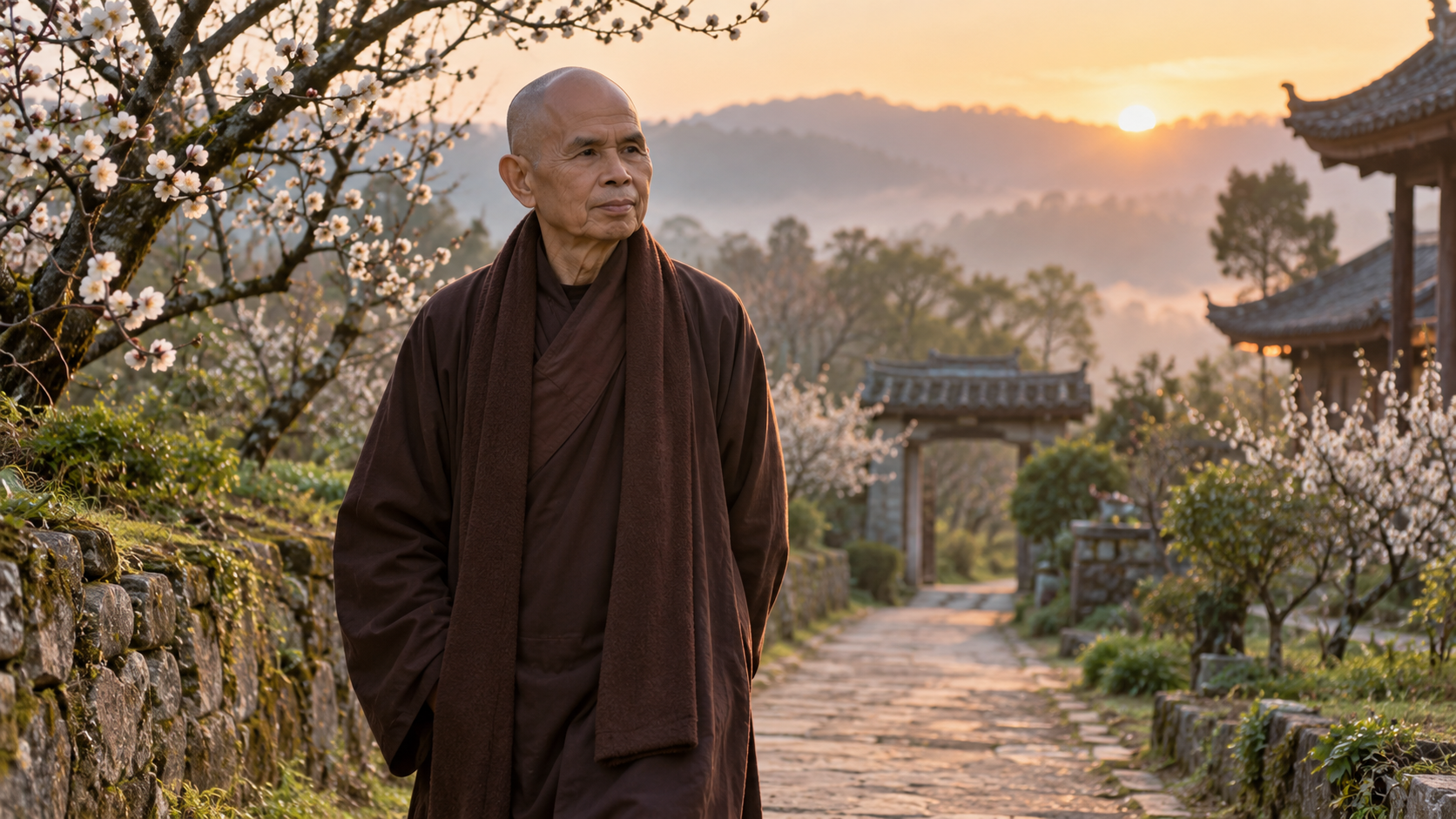
“The present moment is filled with joy and happiness. If you are attentive, you will see it.”
Thich Nhat Hanh used this idea in Peace Is Every Step, associated here with 1991. Thich Nhat Hanh teaches mindfulness through ordinary acts such as breathing, walking, washing dishes, and noticing conditions of well-being already present. The source setting matters because a compact quotation can travel farther than the reasoning that first gave it force. Returning to the original work verifies authorship, keeps 1991 distinct from this series date of May 10, and clarifies the human problem under discussion before a modern reader borrows the words.
The sentence does not manufacture happiness; it trains perception to include available ease, beauty, and connection that fear or hurry can obscure. Read this way, “The present moment is filled with joy and happiness. If you are attentive, you will see it.” is less a decorative slogan than a lens for judgment. It asks what changes when the sentence is taken seriously in a home, classroom, workplace, institution, or public decision. The useful question is not whether the language feels inspiring for a moment, but whether it helps a person see a relationship, habit, limit, or responsibility with greater precision.
Present-moment practice should not deny pain, danger, trauma, or material need, and mindfulness is not a reason to leave harmful conditions unchanged. That qualification prevents the quotation from becoming a universal command. Famous lines are often repeated as though context, power, health, resources, and consent were minor details, yet those conditions determine whether advice helps or harms. A responsible reading preserves the central insight while leaving room for contrary evidence, different capacities, and the voices of people who would experience the consequences.
Continuous alerts and anticipatory worry can pull awareness toward the next demand while a day’s actual textures pass largely unregistered. A practical response can begin at a scale small enough to observe: Take three slow breaths and identify one sound, one physical support, and one relationship that is helping this moment be livable without insisting that it be perfect. Then review what happened. Did the action increase clarity, dignity, connection, or agency, and whose judgment supports that conclusion? Share the result with a trusted person who can notice what enthusiasm or habit may have hidden. If the first attempt fails, treat that failure as information about conditions and method, not as proof that the underlying value is empty. The quotation remains alive when it becomes a method of attention rather than a badge of agreement. Its value lies in the quality of the next choice, the willingness to revise, and the ability to carry a memorable sentence back into the complicated life from which memorable sentences are usually simplified.
“You may not control all the events that happen to you, but you can decide not to be reduced by them.”
Maya Angelou included this line in Letter to My Daughter, published in 2008 as a collection of essays addressed to the many women she regarded as daughters in spirit. The sentence reflects themes running through her autobiographical work: violence, racism, displacement, art, humor, work, and the recovery of voice. Angelou begins with a sober limit. Many events enter a life without permission, and confidence does not make a person their author.
The second clause preserves a different kind of agency. Not being “reduced” means refusing to let an event become the only meaning of the self. A loss can change a future without canceling every capacity; an insult can wound without defining worth; a failure can require repair without becoming a permanent identity. The decision may be expressed through testimony, therapy, art, education, community, faith, boundaries, or the ordinary act of continuing.
Decision should not be confused with instant emotional control. Trauma affects the body and mind, and recovery may be nonlinear, slow, or dependent on safety and professional support. People cannot simply choose away grief, disability, poverty, or discrimination. The quote is most humane when it protects dignity without blaming someone for the effects of what happened. Refusing reduction can include admitting the full scale of harm and requesting the care it requires.
Angelou’s line remains valuable because public narratives often prefer simple identities: victim, failure, survivor, success. A whole life is larger than any one of them. Name the event accurately, then list what it did not take—values, relationships, knowledge, humor, skill, or the right to imagine a future. Choose one act that belongs to that larger self. Control may be partial, but authorship can resume in small sentences. The month closes with a durable distinction: what happened matters, and it still does not exhaust who a person can become. Let the next act be proportionate to present strength. It may be a phone call, a boundary, a page, a meal, a return to treatment, or a request to be accompanied. Do not confuse a modest step with a modest life. Identity is rebuilt through repeated evidence that the event is part of the story, not the only voice allowed to narrate it. Others can help by refusing to speak of a person as though the event were their only tense or title. A wider story becomes possible when dignity is treated as present, not postponed until recovery looks complete.
Thich Nhat Hanh used the line in Peace Is Every Step, associated with 1991. Thich Nhat Hanh teaches mindfulness through ordinary acts such as breathing, walking, washing dishes, and noticing conditions of well-being already present.
The source year identifies the documented work; May 10 is only this Quote of the Day series position, not the date on which the words were first spoken or published.
The sentence does not manufacture happiness; it trains perception to include available ease, beauty, and connection that fear or hurry can obscure.
Present-moment practice should not deny pain, danger, trauma, or material need, and mindfulness is not a reason to leave harmful conditions unchanged.
Continuous alerts and anticipatory worry can pull awareness toward the next demand while a day’s actual textures pass largely unregistered.
Take three slow breaths and identify one sound, one physical support, and one relationship that is helping this moment be livable without insisting that it be perfect.
Explore more "Quotes of The Day"
Continue exploring how writers, thinkers, artists, and advocates have described the choices that shape an everyday life.