

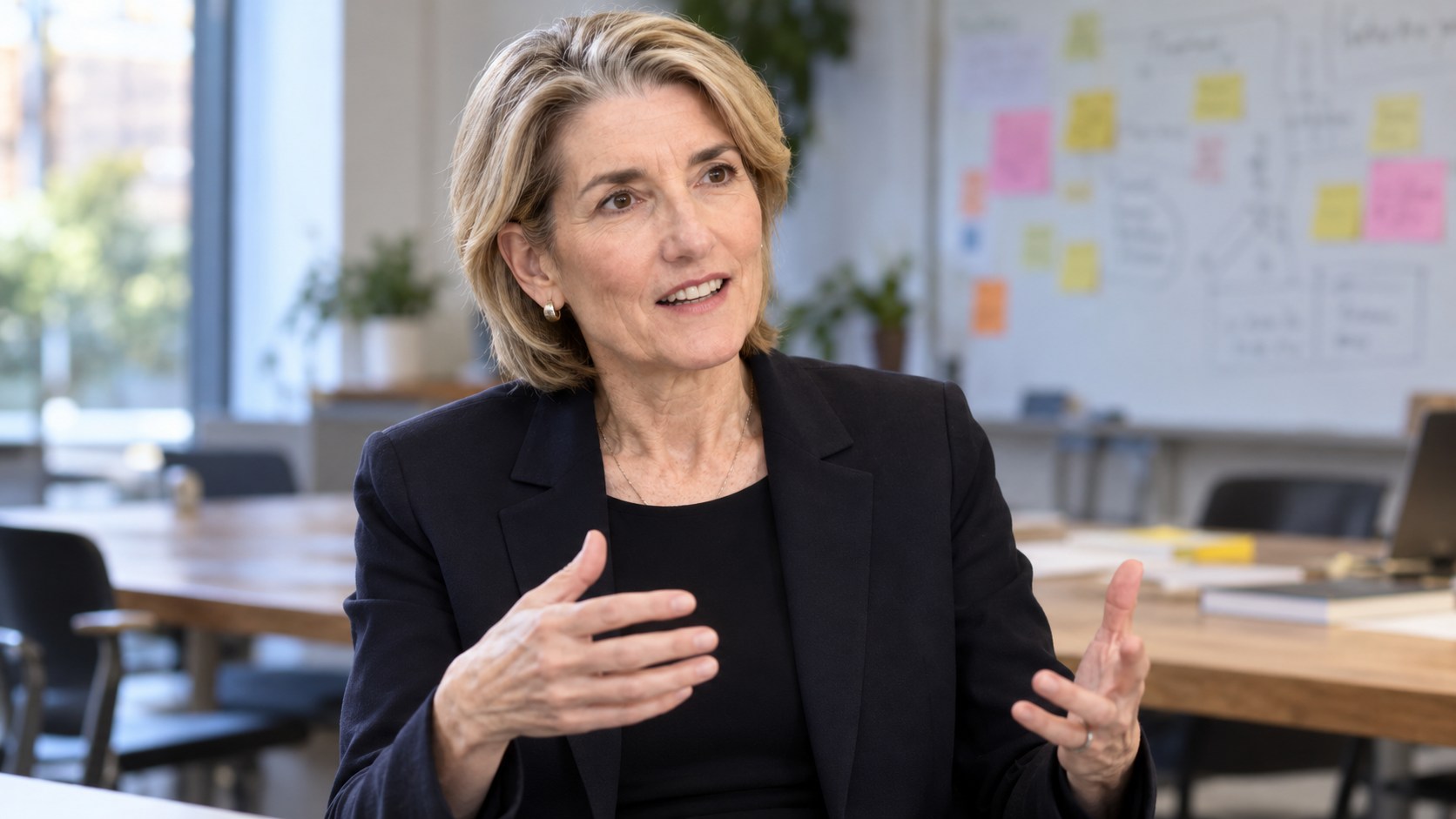
“Teaming is teamwork on the fly.”
July 1 uses How to Turn a Group of Strangers into a Team (2017) as Amy C. Edmondson's documented setting. Edmondson defines teaming while examining situations in which specialists must coordinate quickly without the stability or practice of a traditional team. The talk is built around teams that form in motion: clinicians, responders, and specialists who cannot rely on years of shared habit. Edmondson is describing a discipline of speaking up, asking, and updating while the work is already underway, not simply celebrating speed or improvisation. July 1 is NewsStreets placement for Amy C. Edmondson; 2017 is Amy C. Edmondson's date for How to Turn a Group of Strangers into a Team.
The line names collaboration as a live process of learning across expertise, distance, status, and unfamiliar roles rather than a label attached to a fixed group. The featured wording—“Teaming is teamwork on the fly.”—compresses that distinction for Amy C. Edmondson. That distinction changes the unit of attention. A roster may exist on paper, but teaming happens only when knowledge moves across boundaries and uncertainty can be admitted without punishment. Coordination becomes a behavior people repeatedly create, especially when rank or professional language would otherwise keep useful information trapped.
Rapid collaboration still needs clear responsibility, psychological safety, and standards; improvisation is not permission to neglect preparation or accountability. For Amy C. Edmondson, the boundary guards How to Turn a Group of Strangers into a Team from overreach. A rushed group can also improvise badly. Expertise, protocols, preparation, and final accountability remain essential when mistakes carry real costs. Psychological safety supports candor; it does not remove performance standards or turn every disagreement into an equally sound judgment.
Hospitals, emergency responses, creative projects, and distributed workplaces increasingly depend on people who have never worked together before. The idea matters wherever temporary groups inherit permanent consequences. Its best everyday test is whether the least powerful knowledgeable person can surface a concern early enough to change the plan. That is more demanding than friendliness, but far more useful than calling strangers a team and hoping coordination appears. A useful review asks whether information moved sooner, uncertainty became speakable, and expertise crossed rank instead of waiting for a crisis. Those observations keep teaming measurable. They also expose a common failure: leaders may invite candor in principle while rewarding silence in practice, leaving the temporary group with a name but not the conditions required to learn. For Amy C. Edmondson, a practical July 1 trial is this: At the start of one shared task, state what you do not know, ask what each person uniquely brings, and agree on the next point for checking assumptions. On July 1, readers can test How to Turn a Group of Strangers into a Team through Amy C. Edmondson's guidance.
Amy C. Edmondson used the line in How to Turn a Group of Strangers into a Team, associated with 2017. Edmondson defines teaming while examining situations in which specialists must coordinate quickly without the stability or practice of a traditional team.
The source year identifies the documented work; July 1 is only this Quote of the Day series position, not the date when the words were first spoken or published.
The line names collaboration as a live process of learning across expertise, distance, status, and unfamiliar roles rather than a label attached to a fixed group.
Rapid collaboration still needs clear responsibility, psychological safety, and standards; improvisation is not permission to neglect preparation or accountability.
Hospitals, emergency responses, creative projects, and distributed workplaces increasingly depend on people who have never worked together before.
At the start of one shared task, state what you do not know, ask what each person uniquely brings, and agree on the next point for checking assumptions.
Explore more "Quotes of The Day"
Continue exploring how writers, thinkers, artists, and advocates have described the choices that shape an everyday life.