

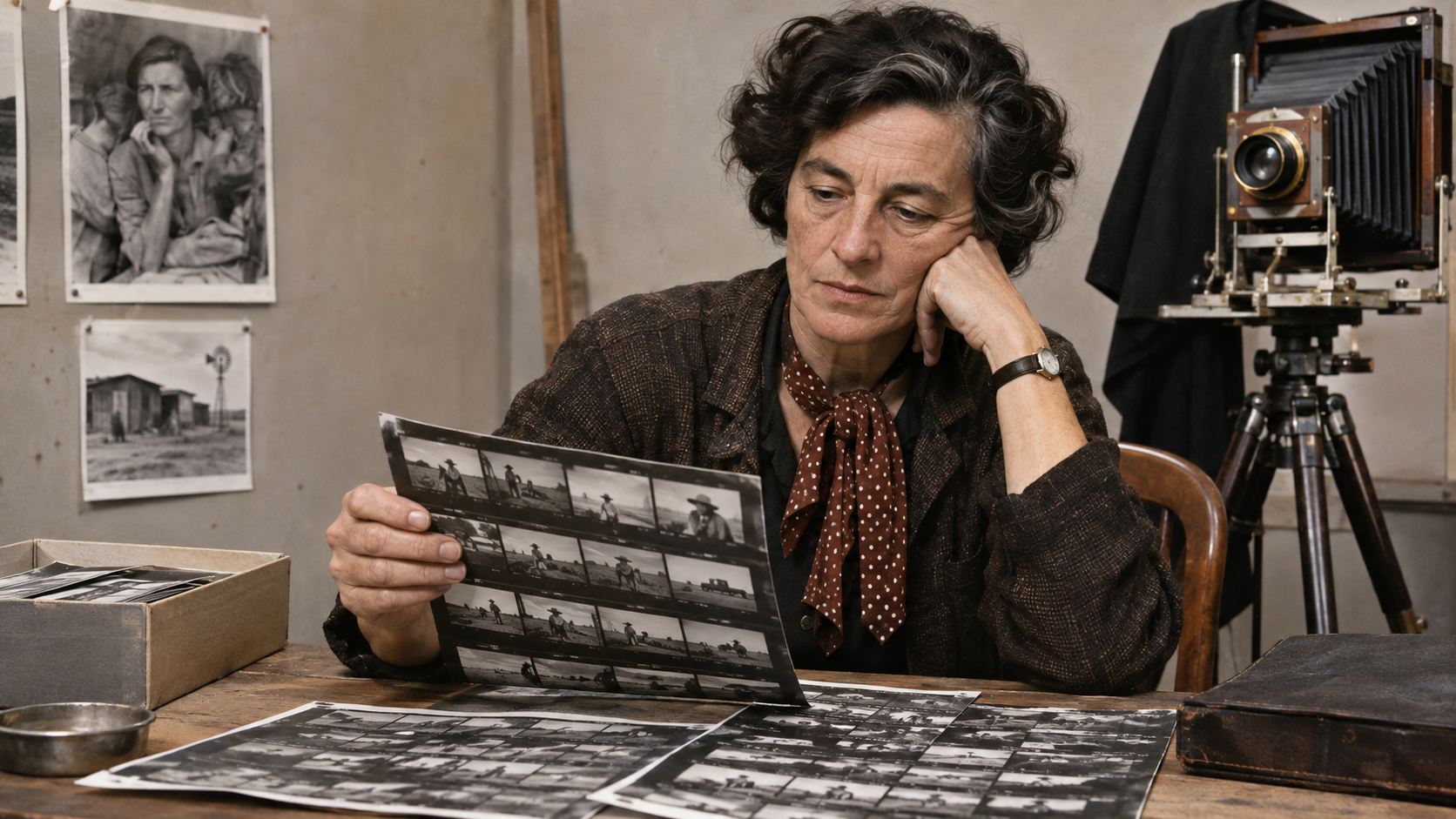
“The camera is an instrument that teaches people how to see without a camera.”
Dorothea Lange’s documentary photographs taught generations to notice the human consequences of economic crisis, migration, racism, and government policy. Her statement describes photography as training in attention. A strong image does more than record one moment; it can change what viewers recognize in ordinary life after they look away.
Seeing, however, is shaped by selection. The photographer chooses where to stand, when to release the shutter, and which frame will represent a larger reality. Lange’s own work invites questions about captions, consent, editing, and the relationship between an iconic subject and the complex life outside the frame.
For visual journalism, the camera should deepen observation rather than substitute for it. Reporters need names, dates, locations, documents, and follow-up reporting that explain what an image cannot. Editors should preserve provenance and avoid crops or captions that create a stronger claim than the evidence supports.
In a world saturated with images, Lange’s lesson is newly demanding. Synthetic pictures and decontextualized clips can imitate the authority of witness. Responsible visual literacy asks viewers to slow down, verify origins, study what is excluded, and carry the habit of careful seeing into encounters beyond the screen.
Dorothea Lange’s documentary photographs taught generations to notice the human consequences of economic crisis, migration, racism, and government policy. Her statement describes photography as training in attention. A strong image does more than record one moment; it can change what viewers recognize in ordinary life after they look away.
Seeing, however, is shaped by selection. The photographer chooses where to stand, when to release the shutter, and which frame will represent a larger reality. Lange’s own work invites questions about captions, consent, editing, and the relationship between an iconic subject and the complex life outside the frame.
In a world saturated with images, Lange’s lesson is newly demanding. Synthetic pictures and decontextualized clips can imitate the authority of witness. Responsible visual literacy asks viewers to slow down, verify origins, study what is excluded, and carry the habit of careful seeing into encounters beyond the screen.
Explore more "Quotes of The Day"
Discover more notable quotes from influential voices across politics, science, business, technology, sports, and culture. Each quote offers insight into how ideas, beliefs, and decisions shape the world around us.