

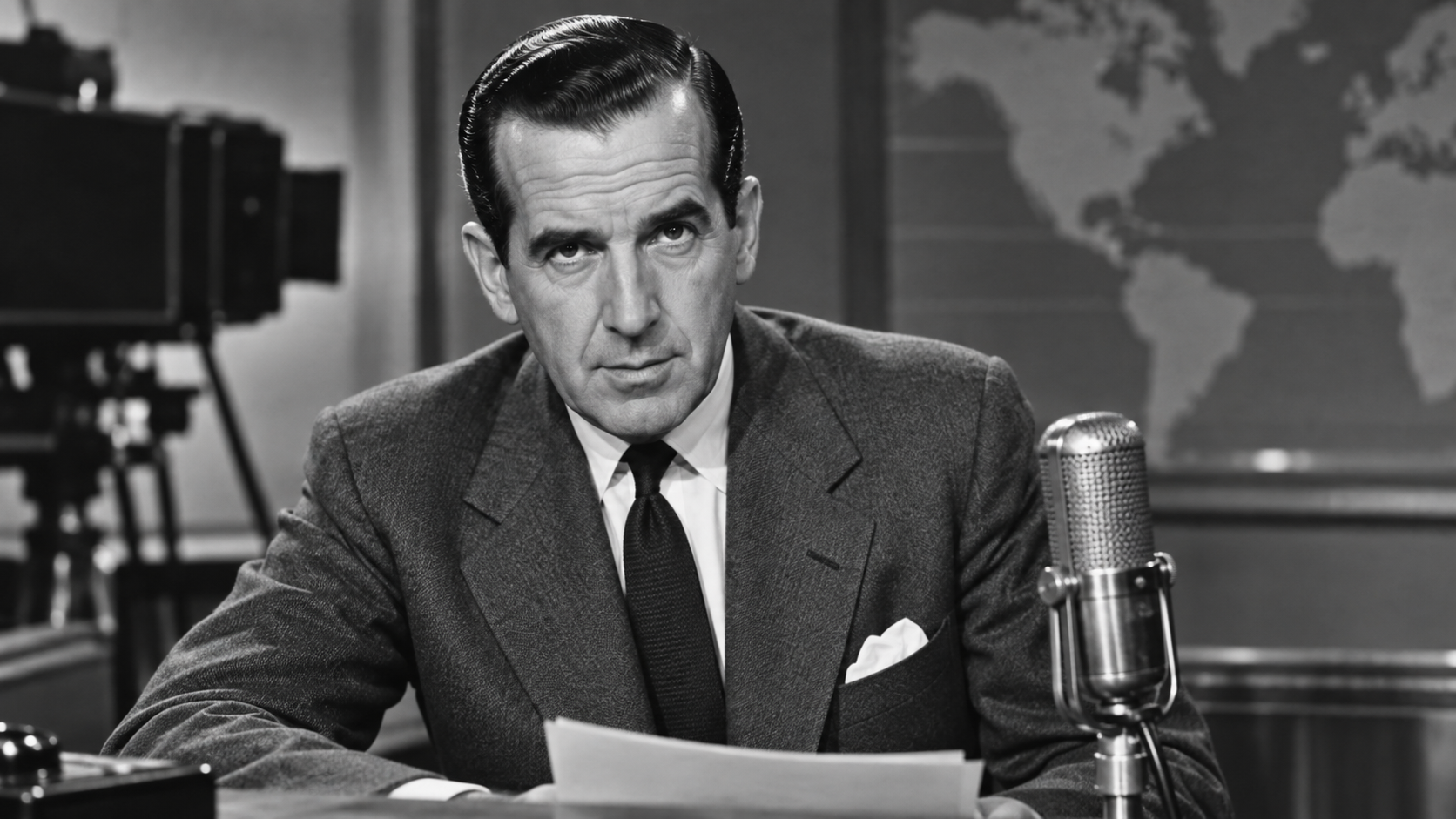
“We must not confuse dissent with disloyalty.”
Edward R. Murrow delivered this warning at the conclusion of a March 9, 1954 episode of the CBS program See It Now examining Senator Joseph McCarthy’s methods. The broadcast assembled McCarthy’s own recorded statements and placed them in sequence, allowing viewers to assess the senator’s accusations, contradictions, and treatment of witnesses. Murrow paired the line with reminders that accusation is not proof and that conviction depends on evidence and due process. His subject was larger than one politician: how fear can erode democratic judgment when criticism of government is recast as evidence of betrayal.
The sentence establishes an essential distinction for political reporting. Dissent challenges a policy, institution, or prevailing belief; disloyalty alleges a breach of obligation. Collapsing those categories lets officials avoid answering criticism by attacking the critic’s identity or motives. A newsroom should therefore ask what conduct is actually alleged, what rule or law applies, and what evidence supports the charge. Labels such as extremist, traitor, subversive, or enemy may be newsworthy when public figures use them, but repetition without scrutiny can turn rhetoric into an assumed fact. Murrow’s example shows the value of presenting original statements alongside verified context.
The broadcast should not be mythologized as a lone journalist single-handedly ending McCarthyism. Legal challenges, Senate investigations, other reporters, political opposition, and McCarthy’s own conduct all shaped the outcome. Murrow also worked within a powerful network and made editorial choices that deserve examination like any others. The lesson is not that a famous anchor should decide who is right. It is that reporting can test public claims using evidence, chronology, and fair opportunity to respond. The stronger the allegation, the more visible those standards should be.
The warning remains timely when protest, leaks, whistleblowing, and sharp criticism are quickly framed as threats to national unity. Genuine security risks exist, and reporters should not dismiss them; they should require officials to define the risk and show the basis for consequential claims. Coverage should separate protected speech from unlawful conduct, identify uncertainty, and avoid anonymous insinuation that cannot be tested. It should also track what happens to people after the accusation leaves the headline. Murrow’s formulation is a guardrail against guilt by association. It asks journalism to preserve the space in which disagreement can be heard while evidence—not fear—determines the public record.
Murrow used the line in a March 1954 See It Now broadcast that examined Senator Joseph McCarthy largely through McCarthy's own recorded words and public conduct.
The principle does not deny real security threats. It requires reporters and officials to distinguish protected disagreement from provable misconduct and to respect due process.
Current coverage can apply the standard by defining allegations precisely, showing original evidence, scrutinizing loyalty rhetoric, and following the consequences for those accused.
Explore more "Quotes of The Day"
Discover more notable quotes from influential voices across politics, science, business, technology, sports, and culture. Each quote offers insight into how ideas, beliefs, and decisions shape the world around us.