

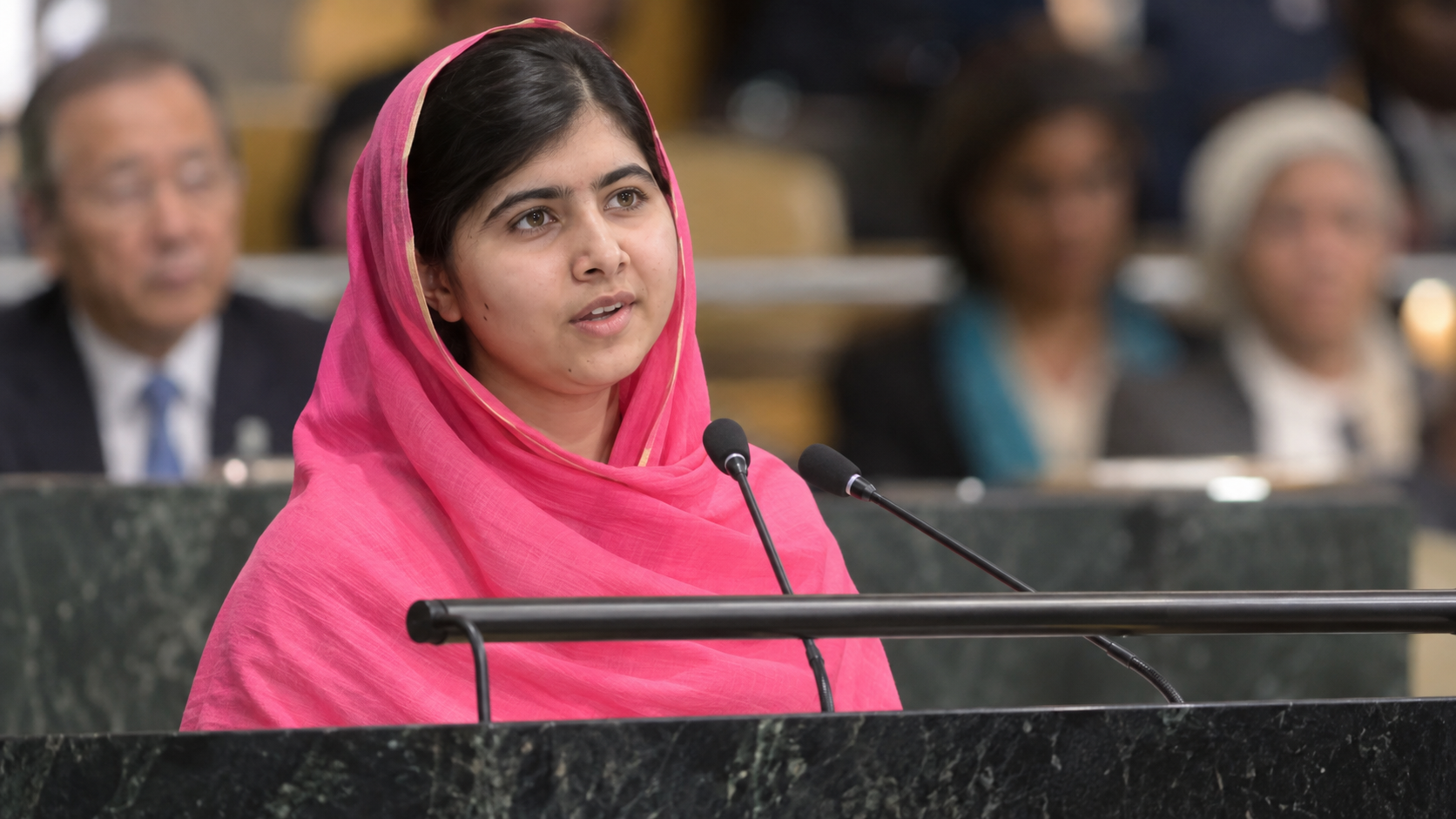
“One child, one teacher, one pen and one book can change the world.”
Malala Yousafzai delivered this line at the United Nations on July 12, 2013, her sixteenth birthday and her first major public address after surviving an assassination attempt by the Pakistani Taliban. Her speech called for free, compulsory education for every child and emphasized books and pens as tools against extremism. The sentence became the address’s most widely repeated line because it condensed a global policy demand into a memorable image. Its force came from context: a student targeted for attending school was insisting that education belonged to children everywhere, including the children of those who attacked her.
The quote names the human relationships at the center of education. Enrollment statistics matter, but a functioning school also requires trained teachers, safe classrooms, appropriate materials, transportation, sanitation, and time to learn. Girls may face additional barriers from child marriage, unpaid care work, harassment, conflict, or rules restricting their movement. News coverage should therefore ask what “access” means in practice. A government can announce a new school while leaving it without teachers; a donor can distribute devices where electricity or connectivity is unreliable. The promise of education becomes testable only when reporting follows resources from policy to classroom.
Inspiration can also flatten the story. Presenting Malala as an exceptional individual may unintentionally obscure the local educators, families, students, and organizers who sustain education under pressure. Her phrase does not mean a single book can overcome war, poverty, or discriminatory law without institutional change. Reporters should avoid using children mainly as symbols or asking survivors to repeatedly relive violence. They should verify program claims, protect minors’ privacy, include local expertise, and distinguish short-term enrollment gains from attendance, learning, completion, and safety.
The line remains relevant as conflict, displacement, climate disasters, and digital inequality interrupt schooling around the world. Strong education reporting connects a child’s experience to budgets, teacher staffing, security conditions, and measurable outcomes. It compares promises with delivery and asks whether the students facing the greatest barriers are benefiting. It also reports agency: young people are sources with knowledge of what makes a school usable, not merely recipients of adult policy. Malala’s sentence provides a hopeful starting point, but journalism gives it public value by examining the systems that place the child, teacher, pen, and book in the same safe room—and by documenting who is still kept outside.
Malala spoke at the United Nations on her sixteenth birthday in 2013, months after surviving an assassination attempt prompted by her advocacy for girls' education.
The sentence is an appeal, not a complete policy formula. Real access depends on safety, teachers, funding, infrastructure, inclusion, and sustained learning outcomes.
Reporting should connect student experience to budgets and delivery, protect minors, include local educators, and measure attendance, learning, completion, and safety.
Explore more "Quotes of The Day"
Discover more notable quotes from influential voices across politics, science, business, technology, sports, and culture. Each quote offers insight into how ideas, beliefs, and decisions shape the world around us.