

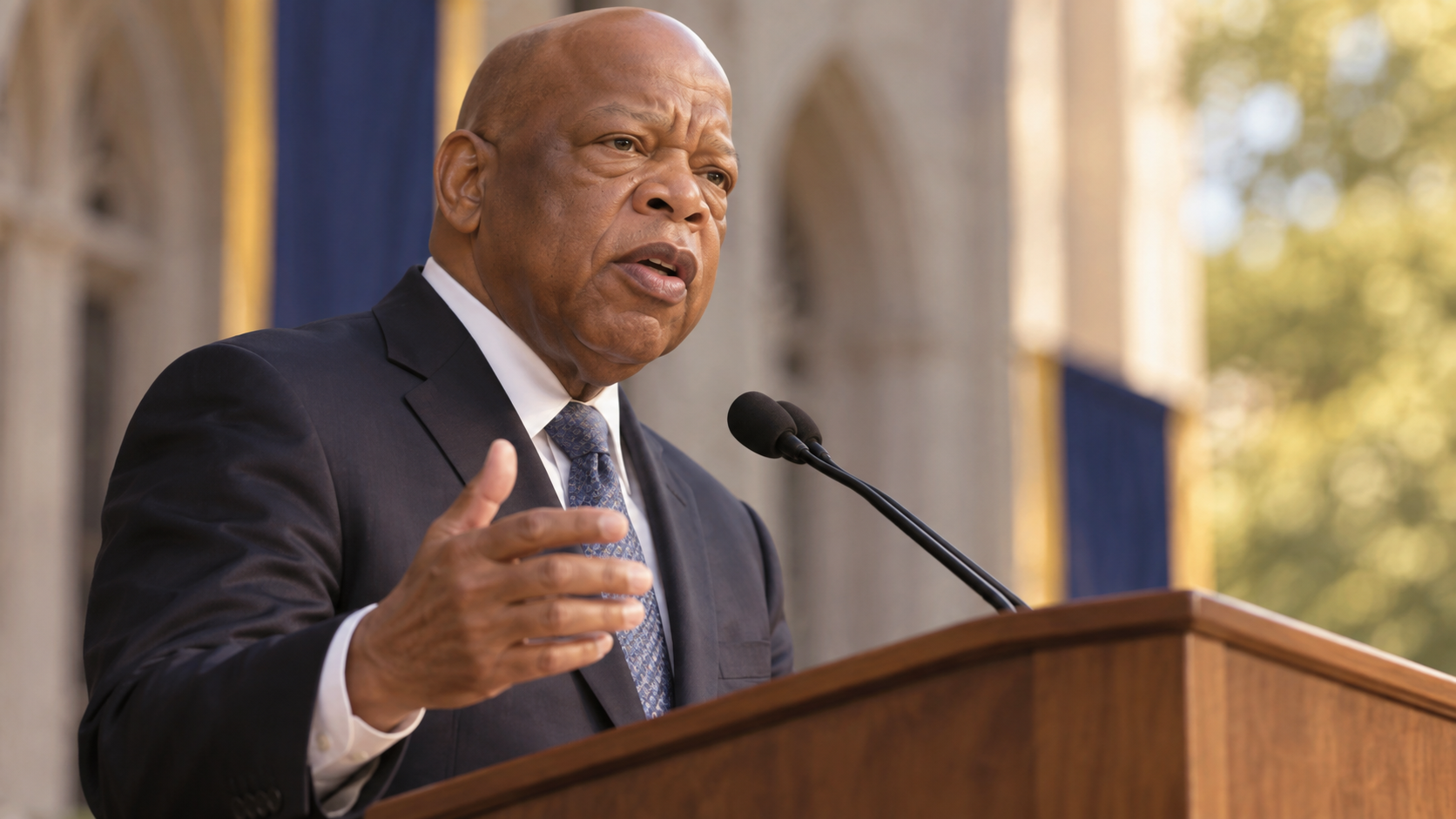
“You must find a way to get in the way, you must find a way to get into trouble. Good trouble, necessary trouble.”
John Lewis gave this charge during the 2014 commencement address at Emory University School of Law. By then he had spent decades connecting the nonviolent direct action of the civil-rights movement with legislative work in Congress. The phrase “good trouble” was not a celebration of disruption for its own sake. Lewis used it to describe principled action that interrupts injustice when ordinary channels preserve the status quo. His authority came partly from experience: as a young activist he joined sit-ins, Freedom Rides, voter-registration campaigns, and the Selma march where state troopers attacked demonstrators on Bloody Sunday. The words carried the weight of practiced sacrifice rather than abstract provocation.
For journalism, the phrase is a prompt to examine both the grievance and the method of protest. Coverage often focuses on inconvenience, confrontation, arrests, or property damage because those elements produce immediate images. That frame can obscure the policy being challenged, the steps organizers took before demonstrating, and the response of officials with greater power. Strong reporting reconstructs the timeline, identifies the demands, verifies claims from organizers and authorities, and distinguishes planned nonviolent action from conduct by unrelated individuals. It also asks whose definition of order governs the story and whether enforcement is consistent across groups.
Calling something good trouble does not automatically make it wise, lawful, or effective. Civil disobedience involves ethical choices, strategic risks, and consequences for people who may not have chosen to participate. Reporters should not romanticize arrest, minimize harm, or assume that a movement speaks with one voice. They should examine funding, leadership, internal disagreements, measurable goals, and the effect on vulnerable communities. Lewis’s own tradition emphasized nonviolent discipline and a moral appeal to a wider public; stripping away that discipline can turn his phrase into a generic endorsement of any disruptive tactic.
The quotation remains relevant when protest is organized through social platforms, recorded by participants, and interpreted in real time by competing information networks. Video can document abuse, but an isolated clip can also hide what happened before or after it. Newsrooms need verified chronology, multiple vantage points, clear labeling of uncertainty, and follow-up after crowds disperse. Did officials meet the stated demand? Were charges sustained? Did a policy change, or did attention simply move on? Lewis’s challenge is ultimately about civic responsibility. Journalism serves that responsibility when it explains why people chose to get in the way and tests whether the trouble produced accountability rather than merely spectacle.
Lewis delivered the line at Emory University School of Law's 2014 commencement. It summarized a lifetime of disciplined nonviolent action and public service, and it referred to resistance against injustice rather than disruption as entertainment.
Good trouble must still be evaluated by its purpose, methods, consequences, and accountability. The phrase does not exempt movements from evidence or scrutiny, and it should not erase people harmed or burdened by a tactic.
Digital organizing and ubiquitous cameras have changed how protest reaches the public. The quote remains useful when coverage moves beyond dramatic scenes to verified timelines, demands, state response, and durable outcomes.
Explore more "Quotes of The Day"
Discover more notable quotes from influential voices across politics, science, business, technology, sports, and culture. Each quote offers insight into how ideas, beliefs, and decisions shape the world around us.