

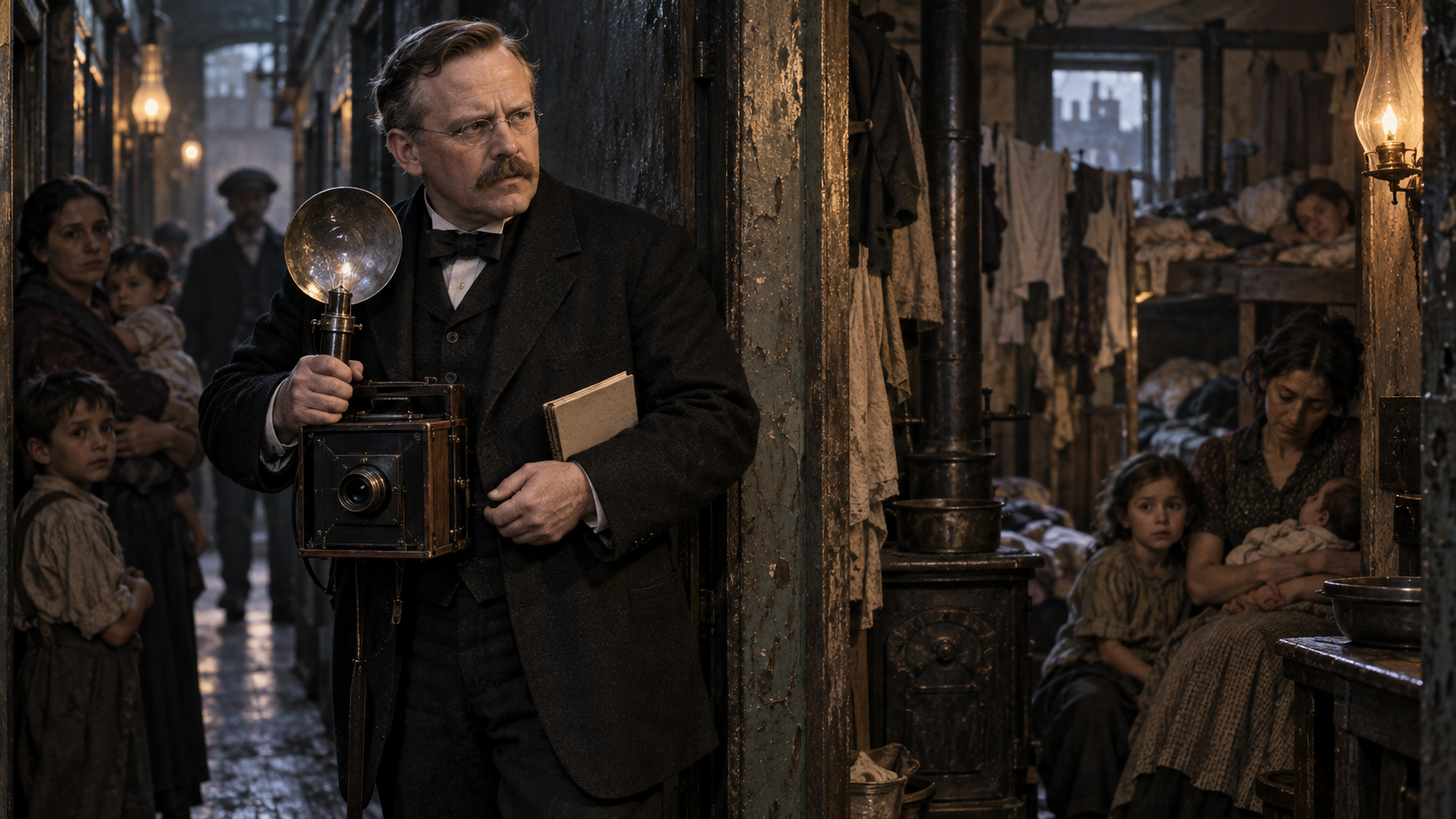
“How shall the love of God be understood by those who have been nurtured in sight only of the greed of man?”
Jacob Riis posed this question in How the Other Half Lives, his 1890 investigation of New York tenements. Drawing on years as a police reporter and on early flash photography, he took middle-class readers into crowded rooms, lodging houses, alleys, and sweatshops rarely represented in mainstream public life. The sentence connected material conditions with moral imagination: people formed by neglect and exploitation could not be judged as though society had offered them the same safety and opportunity as everyone else. Riis wanted exposure to produce reform, but his work also reflected paternalistic assumptions common to his era.
The journalistic lesson is to make hidden conditions visible and trace them to decisions. Reporting on poverty should examine rent, wages, sanitation, building codes, transportation, health, schooling, and enforcement instead of presenting hardship as personal failure. Images can supply evidence that official descriptions omit, especially when paired with records and testimony. Yet a photograph is never the whole story. Strong coverage identifies who controls the setting, explains what happened before and after the frame, and lets residents describe their own priorities rather than appearing only as examples in someone else’s argument.
Riis’s legacy requires ethical scrutiny. Some of his captions and characterizations generalized about immigrant groups, and the power imbalance between photographer and subject was substantial. Modern journalists should obtain meaningful consent when circumstances allow, protect children and people at risk, avoid degrading imagery, and consider whether publication creates danger without adding public knowledge. Dignity is not achieved by hiding suffering, but neither is it served by turning private pain into spectacle. Editors should ask what an image proves, whose perspective it privileges, and whether a less intrusive approach could document the same failure.
The quote remains relevant to homelessness, housing shortages, migrant labor, environmental exposure, and neighborhoods overlooked by shrinking local newsrooms. Data can show scale, while sustained presence reveals how policy operates day to day. The best reporting combines both. It follows budgets and landlords, maps inspections and evictions, listens before a crisis, and returns after public attention fades. It also shares findings in accessible formats and tells residents what records or images will be published. That reciprocity cannot erase unequal power, but it can reduce surprise and improve accuracy. Riis demonstrated that seeing can disturb complacency. The fuller contemporary standard is to report with people, not merely about them—documenting structural greed while preserving the agency, complexity, and ordinary life of those who bear its costs.
Riis included the question in How the Other Half Lives in 1890. His reporting and photography exposed tenement conditions that prosperous New Yorkers could otherwise ignore.
His work also contained stereotypes and severe power imbalances. Modern visual reporting needs consent, context, harm reduction, and a clear public-interest reason for showing private suffering.
Housing and poverty coverage is strongest when images, resident testimony, public records, and policy follow-up work together. Visibility should lead to accountability, not spectacle.
Explore more "Quotes of The Day"
Discover more notable quotes from influential voices across politics, science, business, technology, sports, and culture. Each quote offers insight into how ideas, beliefs, and decisions shape the world around us.