

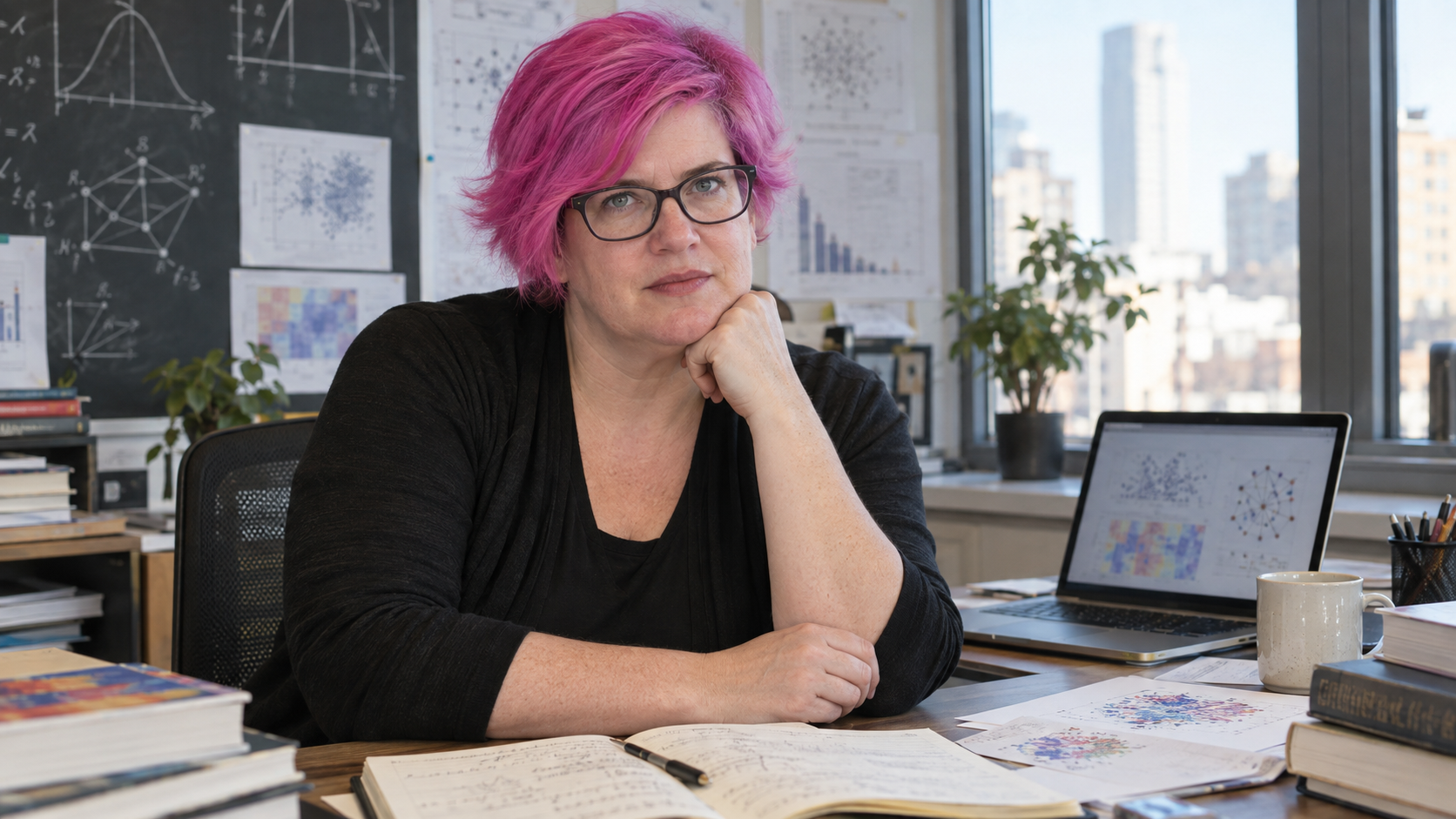
“Models are opinions embedded in mathematics.”
Cathy O’Neil wrote this sentence in Weapons of Math Destruction, her 2016 account of large-scale models that can deepen inequality while appearing objective. A model simplifies reality by deciding which outcomes matter, which data count, and which patterns stand in for facts that are difficult to measure. Those choices reflect goals and judgments, even when the final score looks impersonal. For journalism, the line is a practical warning: an algorithmic result is not self-authenticating evidence. Reporters must investigate the people, incentives, assumptions, and institutions behind the number before describing it as a neutral verdict.
A rigorous algorithm story begins with the decision the system makes and the people who bear its consequences. Journalists should ask what the model predicts, how success is defined, where training data came from, which variables serve as proxies, and whether affected people can challenge an error. They should seek documentation, independent technical review, and concrete cases rather than repeating a vendor’s accuracy claim. When possible, reporters can test outputs across comparable examples and examine false positives and false negatives separately. Clear graphics should reveal uncertainty and tradeoffs instead of decorating a single performance figure.
O’Neil’s sentence can also be flattened into the claim that mathematics is merely subjective. That would miss its force. Statistical methods can expose patterns that intuition overlooks, and transparent models can improve decisions. The problem is unaccountable power, especially when a system operates at scale, hides its logic, and creates feedback loops that reinforce earlier judgments. Journalists should distinguish a model’s technical validity from the fairness or legitimacy of the policy it implements. A well-calibrated prediction can still be used for an unjust purpose, while a socially valuable goal can be undermined by weak data.
The quote is increasingly relevant as automated systems rank news, screen applicants, estimate risk, allocate benefits, and generate summaries. Newsrooms need enough technical literacy to interrogate code without surrendering the story to specialists. They should report error rates in ordinary language, disclose when their own investigations use automated tools, and follow subjects after an algorithmic decision. Public records requests, audits, whistleblower accounts, and community testimony can reveal the lived effects that benchmark tables omit. O’Neil’s enduring point is that models deserve the same scrutiny as any powerful institution: who designed them, whose values they encode, who profits, who can appeal, and what evidence would justify changing them. A useful accountability story also identifies what would count as improvement: public documentation, independent validation, limits on reuse, regular bias testing, and a remedy for people harmed by an incorrect result. Without those benchmarks, criticism can describe a problem without showing readers how power might be constrained.
The line appears in Weapons of Math Destruction (2016), where O'Neil describes high-impact models marked by opacity, scale, and the capacity to cause harm or reinforce inequality.
Calling models opinions does not make mathematics meaningless. It means choices about targets, data, proxies, thresholds, and acceptable errors must be visible and open to challenge.
Automated scoring and generative systems now shape public life and news distribution. Audits, technical review, affected-community reporting, and meaningful appeal processes are central accountability tools.
Explore more "Quotes of The Day"
Discover more notable quotes from influential voices across politics, science, business, technology, sports, and culture. Each quote offers insight into how ideas, beliefs, and decisions shape the world around us.