

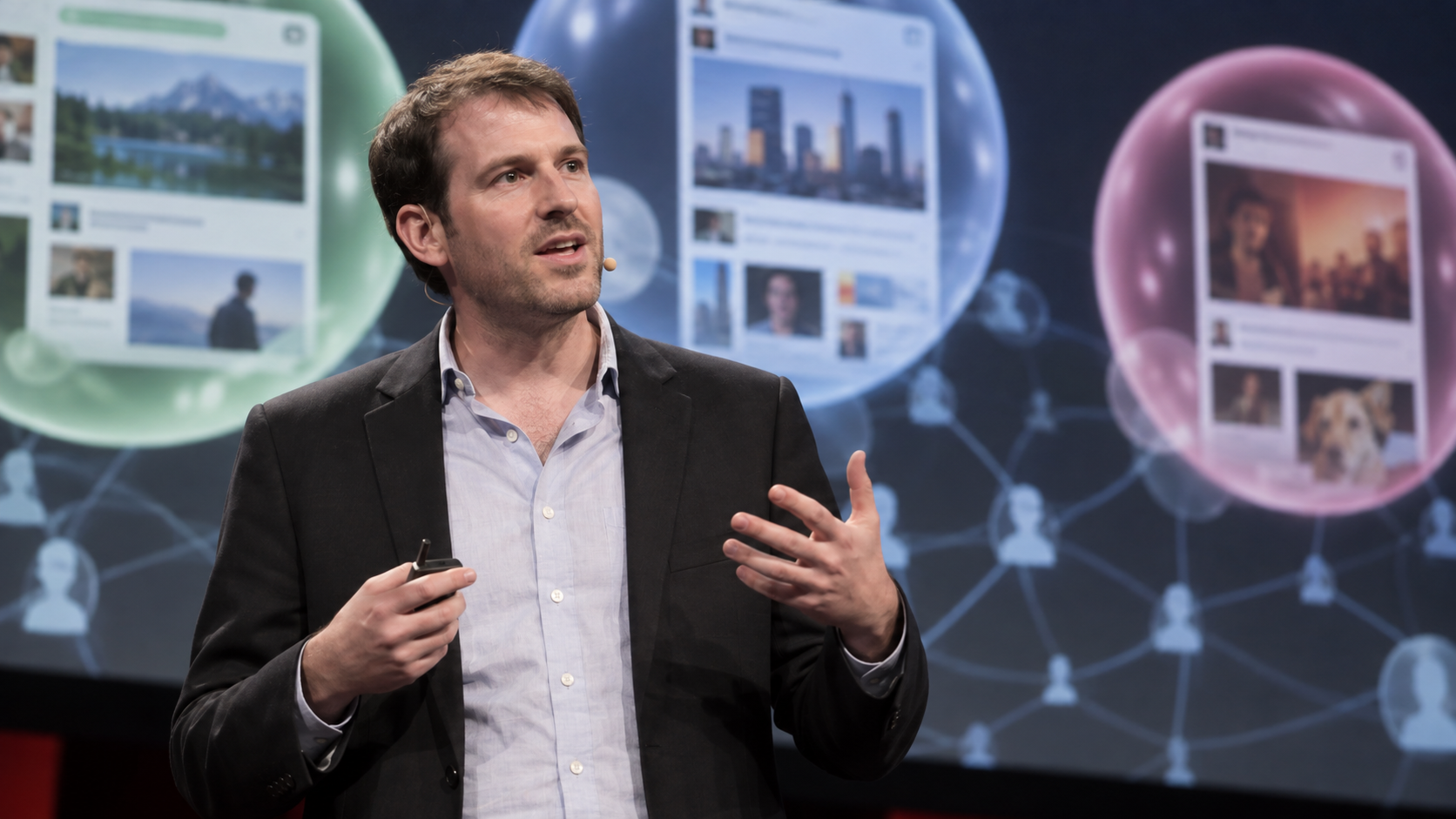
“The Internet is showing us what it thinks we want to see, but not necessarily what we need to see.”
Eli Pariser delivered this warning in his 2011 TED talk on online filter bubbles. He described a shift from a shared web toward personalized information environments shaped by predictions about each user’s behavior. The system may remove material silently, leaving people unable to see what has been excluded or why. For journalism, the line identifies a distribution problem as important as reporting itself. A carefully verified story has limited civic value if recommendation systems deliver it only to people already expected to agree or if consequential information loses to content optimized for immediate engagement.
News organizations can respond by making personalization visible and giving audiences meaningful control. A homepage, app, or newsletter should explain when recommendations are tailored and offer chronological, local, topic-based, and editor-curated alternatives. Editors can measure whether public-service reporting reaches affected communities rather than relying only on clicks. Headlines and thumbnails should represent the evidence instead of gaming curiosity. When stories are distributed through outside platforms, newsrooms should study referral patterns, document sudden reach changes, and avoid letting one company’s opaque ranking rules determine the entire editorial agenda.
The filter-bubble idea also deserves careful qualification. People encounter disagreement through families, workplaces, broadcast media, and social networks; personalization does not create total isolation. Research has found different effects across platforms and groups. Journalists should avoid using the phrase as an all-purpose explanation for polarization. The more precise questions are which content was selected, which was omitted, what objective the system optimized, and what behavior followed. Evidence about exposure, attention, and belief should not be collapsed into a single claim merely because an algorithm was involved.
Pariser’s insight now extends to short-video feeds, push alerts, AI assistants, and generated news summaries. These systems can create an apparently complete account without revealing the alternatives considered. Responsible design should provide source links, adjustable preferences, signals of uncertainty, and deliberate exposure to relevant material outside predicted taste. Newsrooms should protect editorial judgment from metrics that reward only retention and reaction. The enduring lesson is not that audiences must receive identical information. It is that invisible personalization should not decide what citizens are allowed to notice. Democratic information systems need transparency, agency, and space for facts that are important precisely because no profile predicted a desire to see them. Editors can test these principles through periodic distribution audits: compare what different audience segments receive, measure whether corrections travel, and check whether locally essential reporting remains visible without sensational packaging. Such audits turn an abstract concern about bubbles into observable editorial evidence.
Pariser used this line in his 2011 TED talk “Beware Online Filter Bubbles,” warning that invisible personalization can remove information without users knowing what was excluded.
Filter bubbles are not total isolation, and effects vary. Reporting should identify the specific selection rule, omitted material, optimization goal, audience exposure, and measurable consequence.
AI assistants and recommendation feeds make source links, adjustable controls, uncertainty signals, and non-personalized civic-information pathways increasingly important.
Explore more "Quotes of The Day"
Discover more notable quotes from influential voices across politics, science, business, technology, sports, and culture. Each quote offers insight into how ideas, beliefs, and decisions shape the world around us.