

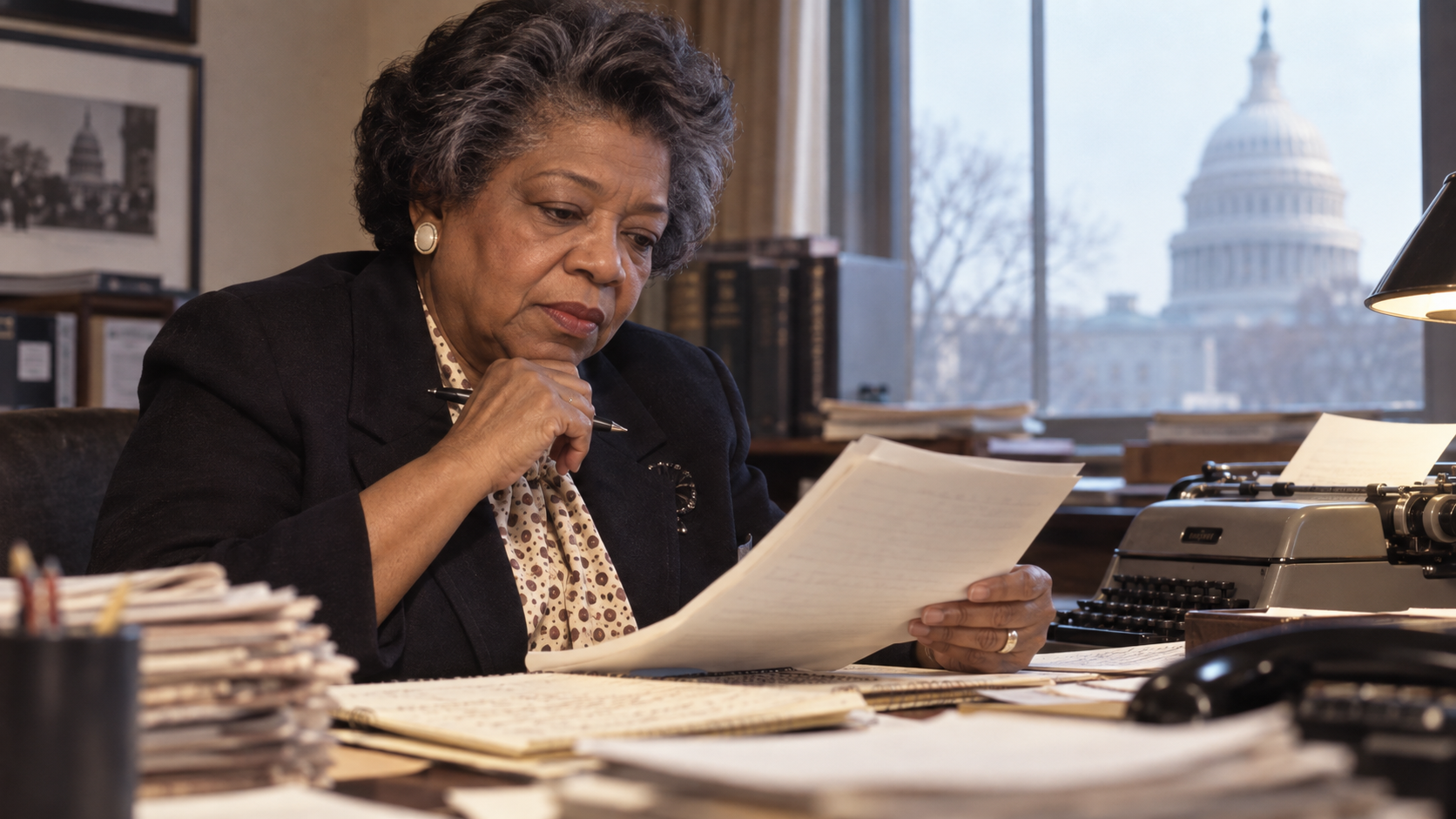
“I was not there for decoration.”
Ethel Payne used this blunt sentence while explaining how she approached the rooms of power that often treated her presence as exceptional. In an oral-history interview recorded late in her career, the pioneering Chicago Defender correspondent said she was there to obtain information, distribute it, and ask probing questions. The line distilled decades of work in which Payne covered the White House, the civil-rights movement, international affairs, and Black communities frequently neglected by larger news organizations. It was not a claim to personal importance. It was a declaration that a press credential carries a public responsibility, especially when officials would prefer ceremony, deference, or silence.
Payne’s record gives the sentence practical weight. At presidential news conferences in the 1950s, she pressed Dwight Eisenhower about segregation and federal policy. Her questions generated headlines partly because a Black woman was challenging assumptions embedded in both government and the press corps. Yet the substance mattered more than the novelty. She asked about decisions affecting travel, voting, employment, and civil rights because her readers needed answers. Her method shows why access journalism can fail when merely being invited becomes the goal. Entry into a powerful institution is useful only if a reporter uses it to seek verifiable information that the public could not otherwise obtain.
The statement should not be read as permission for careless confrontation. A probing question must still rest on preparation, accurate premises, and a clear understanding of the official’s authority. Payne’s work joined advocacy for overlooked citizens with the discipline of reporting: listening, documenting, traveling, and returning with information. That combination complicates the false choice between detachment and commitment. A journalist can recognize injustice, ask questions shaped by that recognition, and still verify the answer rigorously. The ethical test is not whether the reporter lacks values; it is whether evidence, context, and fair description govern what reaches the audience.
The line remains relevant in newsrooms where representation can be celebrated symbolically without changing coverage or decision-making. Hiring a wider range of reporters matters, but their presence becomes consequential when they can influence assignments, question framing, source selection, and editorial priorities. Payne’s example also challenges journalists to measure access by results: What did the audience learn? Which assumption was tested? Whose experience entered the record? A seat in the room is not the final achievement. It is the starting point for reporting that treats the public, rather than the institution granting access, as the journalist’s primary constituency.
Payne made the statement in a late-career oral-history interview while describing her purpose as a reporter: to obtain information, distribute it, and ask probing questions rather than serve as a symbolic presence.
Her words reject tokenism, not professional discipline. Persistent questioning is strongest when it is grounded in preparation, accurate facts, and a clear public-interest purpose.
The quote remains a useful test for newsroom inclusion. Representation has meaning when journalists can shape coverage, challenge official narratives, and bring overlooked public concerns into the record.
Explore more "Quotes of The Day"
Discover more notable quotes from influential voices across politics, science, business, technology, sports, and culture. Each quote offers insight into how ideas, beliefs, and decisions shape the world around us.