

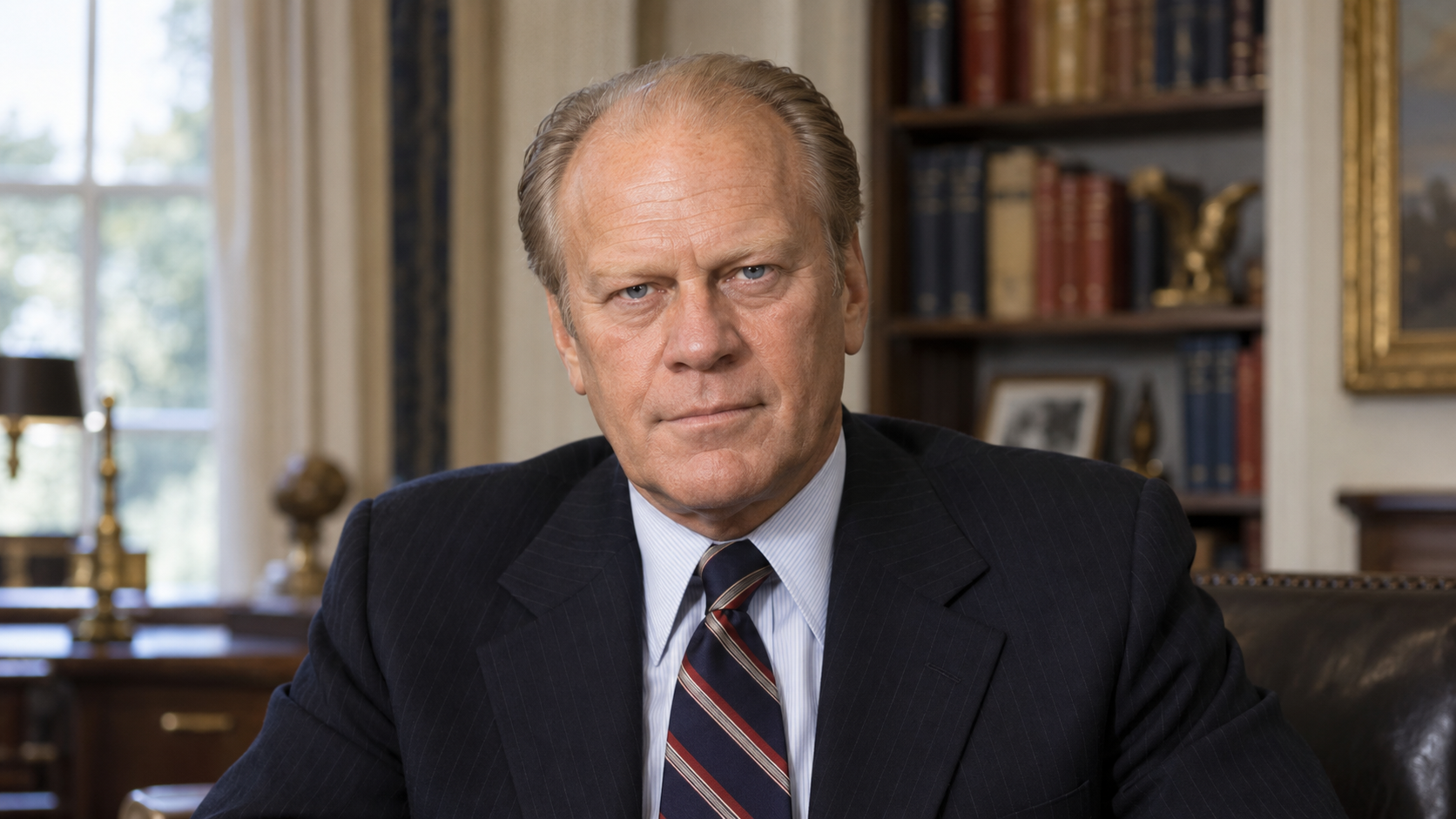
Our Constitution works; our great Republic is a government of laws and not of men.
Gerald R. Ford spoke these words in the East Room of the White House on August 9, 1974, immediately after taking the presidential oath. Richard Nixon had resigned, and Ford faced the unusual task of assuming an office for which the public had not elected him directly. His remarks acknowledge that difficulty rather than concealing it. He asks Americans for support and promises to serve the entire country. The quoted sentence locates the authority for this transfer in the Constitution. It presents lawful succession as evidence that the republic can continue even when confidence in its highest office has been severely damaged.
The contrast between laws and men concerns the basis of government authority, not the absence of human judgment. Officials still interpret rules, make choices, and bear responsibility for their conduct. Ford’s claim is that those individuals hold offices within an established order; the order is not their personal possession. The presidency can pass to a successor without ending the government or changing its constitutional identity. In the next sentence, he says that the people rule. Together, these statements connect institutional continuity with public legitimacy. They ask citizens to distinguish allegiance to the constitutional system from loyalty to the particular person who occupies an office.
Watergate gives the assurance both its force and its limits. A system can survive a crisis while leaving serious disagreements about accountability unresolved. Ford also promises openness and candor, describing truth as essential to government. Those commitments supply standards against which his own decisions can be assessed. His September 8 pardon of Nixon soon made the relationship between reconciliation and justice a renewed subject of dispute. The pardon did not occur on the day of the quotation, and the remarks should not be read as an explanation of that later choice. The speech records a moment of succession and a claim about the institutions supporting it.
Modern readers can approach the sentence as an invitation to examine whether public authority remains attached to rules that constrain its holders. A familiar ceremony or reassuring statement cannot by itself establish that constraint. The more useful evidence includes lawful succession, independent oversight, transparent decisions, and the ability to challenge an official’s actions without challenging the existence of the state. Constitutional confidence also requires room for disagreement: criticism of an administration can express loyalty to the system’s requirements. Ford’s formulation remains compelling because it identifies a form of political durability greater than any individual career. Its promise has to be demonstrated through conduct whenever personal power and public obligation pull in different directions.
Ford delivered the remarks on August 9, 1974, immediately after taking the oath following Nixon's resignation.
He acknowledged that Americans had not elected him directly to the presidency and appealed for support while promising service to all citizens.
The sentence distinguishes authority attached to a constitutional office from power treated as an individual's possession.
Ford's subsequent Nixon pardon belongs to September 8. It renewed debate about reconciliation and accountability; it was not part of the succession ceremony.
Lawful succession and enforceable restraints give constitutional continuity practical meaning when trust in a leader fails.
Citizens can criticize an officeholder while upholding the institutional rules that authorize and limit that office.
Explore more "Quotes of The Day"
Discover more notable quotes from influential voices across politics, science, business, technology, sports, and culture. Each quote offers insight into how ideas, beliefs, and decisions shape the world around us.