

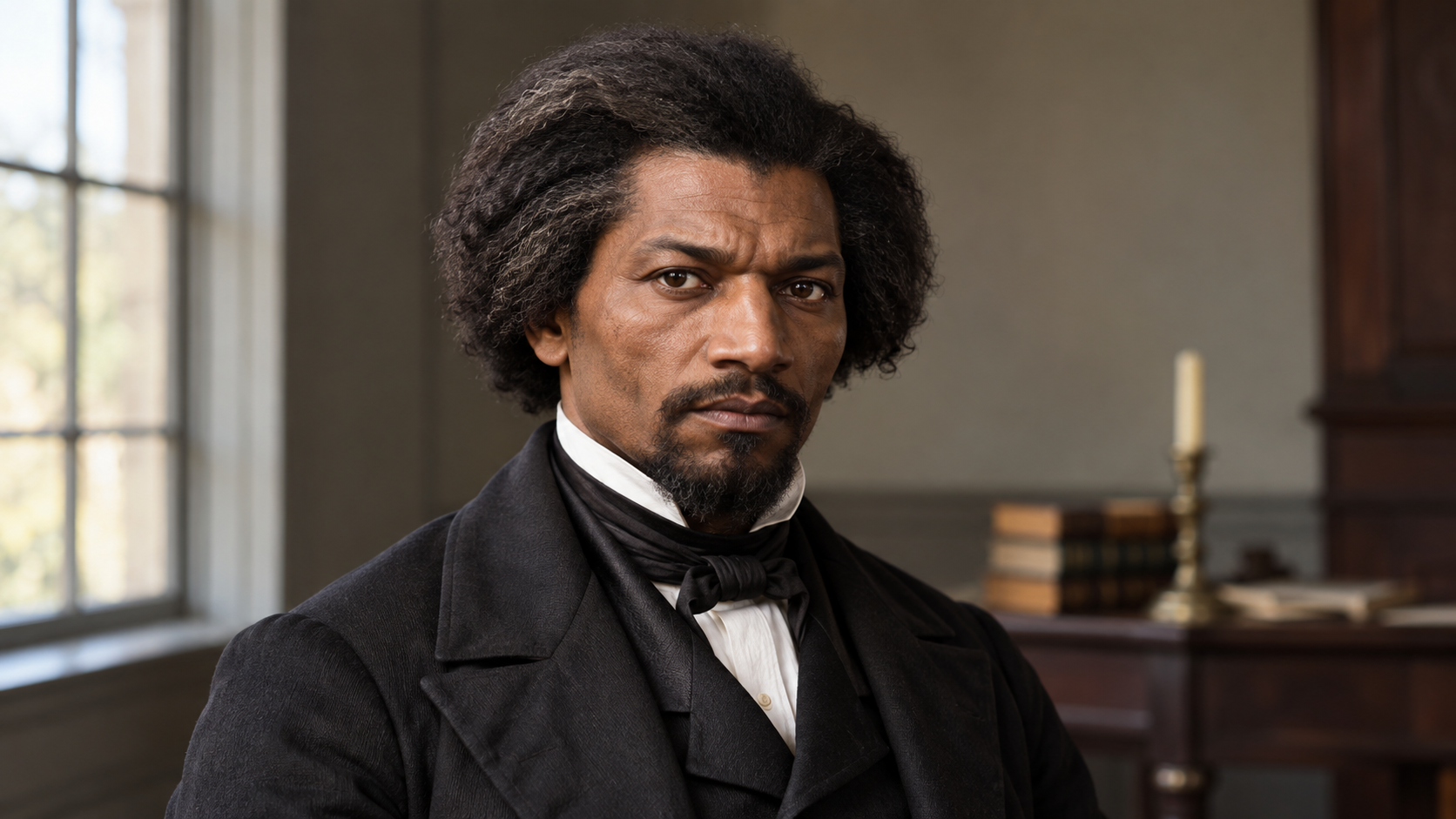
“What, to the American slave, is your 4th of July?”
Frederick Douglass asked this question in Rochester, New York, on July 5, 1852. His audience had gathered at Corinthian Hall for an address organized by the Rochester Ladies’ Anti-Slavery Sewing Society. The speech confronted the distance between America’s celebration of independence and the reality of slavery. Its date matters: Douglass spoke on the day after the Fourth, and the selected sentence should not be mistaken for a statement delivered on July 4 itself. He spoke as an abolitionist who had escaped enslavement, directing listeners to consider how a national ceremony appeared to people denied the freedom it honored.
The pronoun your gives the question its force. Douglass separates the audience’s possession of the holiday from the condition of the enslaved people whose perspective he brings into the room. He does not ask whether independence has historical value. Earlier in the address, he acknowledges the courage of the revolutionary generation. Instead, he asks who can claim the benefits of that achievement. A community may describe freedom as its defining inheritance while arranging its institutions so that millions remain outside that inheritance. The question makes the exclusion visible without allowing the audience to hide behind the dignity of the occasion or the admirable language of the founding.
The address’s answer is a severe indictment of national hypocrisy. Douglass connects the celebrations of liberty with the violence of slavery and the institutions that support it. He challenges political and religious authorities that can denounce tyranny abroad while tolerating domination at home. Yet the speech is more than a rejection of the country’s stated principles. Its criticism draws strength from the gap between those principles and their application. That distinction explains why the address can both honor the struggle against British rule and condemn the ongoing denial of freedom. The promise becomes evidence against the practice. A declaration of universal rights increases, rather than excuses, the responsibility to confront the people excluded from them.
The quotation supplies a demanding method for evaluating public celebrations. Instead of judging a national story only by the ideals it announces, readers can ask how that story is experienced by those subject to its laws and institutions. A ceremony may express sincere gratitude while still concealing unresolved injuries. Douglass requires the perspective of the excluded to become part of the public account. This approach does not mean every historical wrong is identical to slavery or that the sentence can resolve every later dispute. Its lasting force comes from the specific injustice he named and the disciplined comparison he made. Political freedom must be assessed through actual conditions, not simply through the confidence with which a nation celebrates its possession.
Douglass delivered the oration at Corinthian Hall in Rochester on July 5, 1852, at an event organized by an antislavery society.
The familiar modern title derives from the speech's central question. The wording here follows the 1852 form using 4th of July.
The word your exposes the difference between celebrating independence and sharing in its benefits.
Douglass praises the revolutionary struggle before turning its ideals against the nation's continuing support for slavery.
The speech asks public memory to include the people whom a national celebration leaves outside its promises.
Its method compares professed principles with lived conditions. The historical specificity of slavery gives that comparison its original moral force.
Explore more "Quotes of The Day"
Discover more notable quotes from influential voices across politics, science, business, technology, sports, and culture. Each quote offers insight into how ideas, beliefs, and decisions shape the world around us.