

“I write this message from behind the high, cold walls of a prison.”
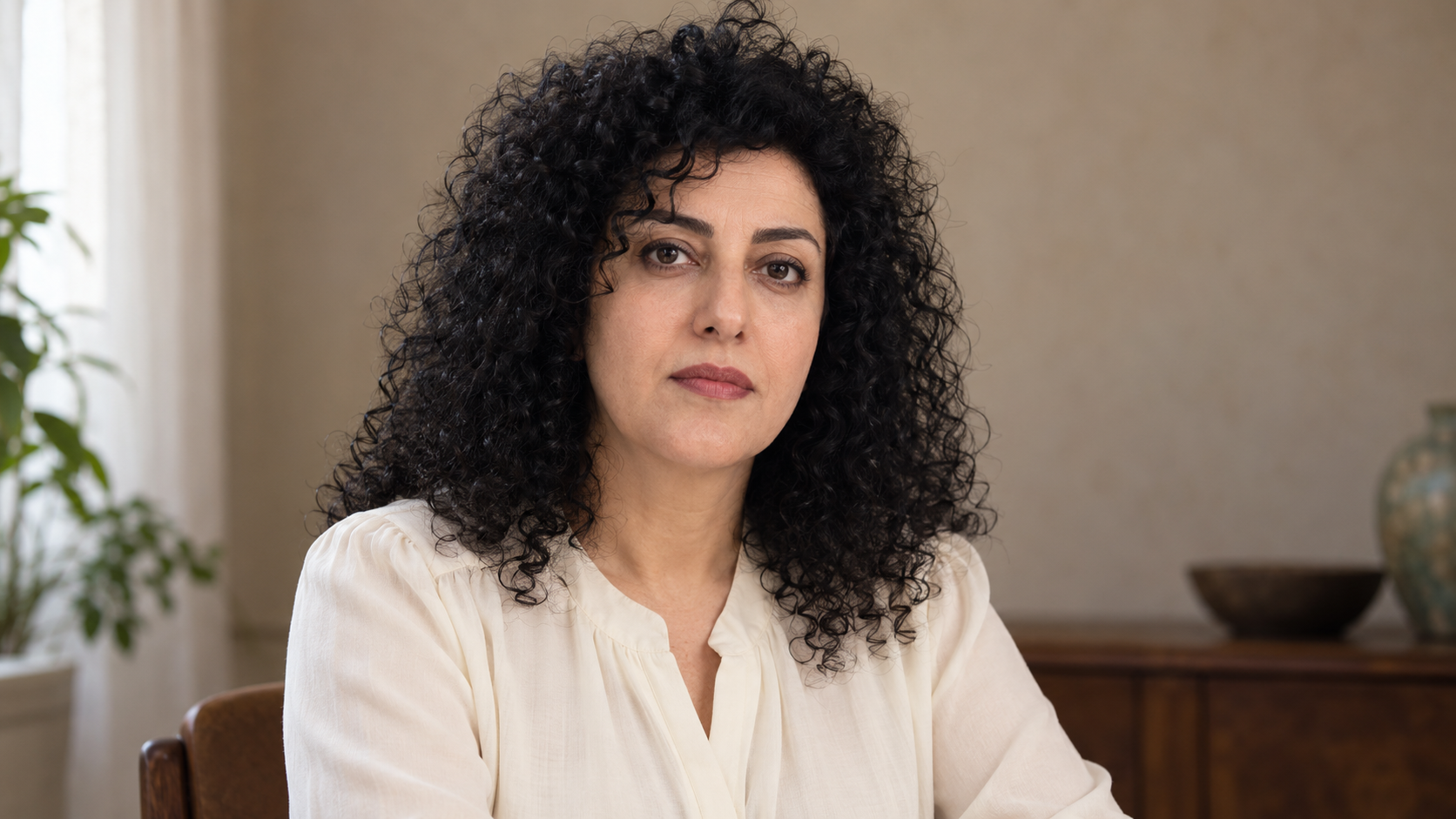
A speech can reach an international audience even when its author cannot leave a prison. Narges Mohammadi made that distance explicit in her Nobel lecture of December 10, 2023. Her children, Ali and Kiana Rahmani, delivered the lecture in Oslo on her behalf. The featured sentence follows the published English translation and identifies the circumstances in which she wrote. It changes the meaning of the occasion: the person receiving recognition was absent because her freedom was restricted. The audience was hearing a message conveyed across that restriction, rather than a laureate describing imprisonment only as a chapter of the past.
Mohammadi’s lecture linked her own experience to Iranian women’s resistance and to the movement known as Woman, Life, Freedom. She argued for democracy, equality, and human dignity while describing the political and social barriers she opposed. The personal opening did not remain a private account; it introduced a wider claim about people’s ability to determine their future. Her Nobel recognition concerned the fight against the oppression of women and the promotion of freedom and human rights. The quotation and surrounding discussion belong to 2023. They should not be read as a fresh report of her location or legal circumstances in any later year.
The sentence invites attention to how voices travel when ordinary channels are closed. A message may require relatives, translators, advocates, or a public institution willing to give it space. Each link carries responsibility for representing the author accurately. The existence of that chain also reveals something about political participation: a person can possess an argument, a public audience, and a recognized contribution while being denied the ordinary means of presenting them. Visibility is valuable, but it is not the same as freedom. An audience should avoid treating the emotional force of a remote message as a substitute for considering the rights at stake.
There is a further distinction between listening to an individual and making that individual stand for everyone. Mohammadi described herself as part of a broader struggle, and a careful reading should preserve the many people involved. Public attention can help make their concerns harder to ignore without pretending that all experiences are identical. The useful question is what follows from hearing the message: clearer understanding, sustained scrutiny, or practical support for people’s ability to participate. The walls in the sentence mark a limit imposed on one voice. The lecture asks the audience to recognize a political demand extending beyond those walls and beyond one award.
The lecture was delivered on December 10, 2023 by Mohammadi’s children, Ali and Kiana Rahmani. She did not attend the Oslo ceremony.
The featured sentence follows the English translation published by the Nobel institutions. Its prison reference describes the circumstances of that 2023 message.
The opening connects personal restriction with a larger argument about participation, women’s rights, and democracy.
International visibility and personal freedom are different conditions. Recognition does not itself remove the restrictions a speaker describes.
When a message reaches you through others, preserve its attribution, date, and translation context. Those details help prevent a moving account from becoming misleading.
Look for the wider community represented in the speech while retaining differences among its members. Listening should lead to informed, sustained attention.
Explore more "Quotes of The Day"
Discover more notable quotes from influential voices across politics, science, business, technology, sports, and culture. Each quote offers insight into how ideas, beliefs, and decisions shape the world around us.