

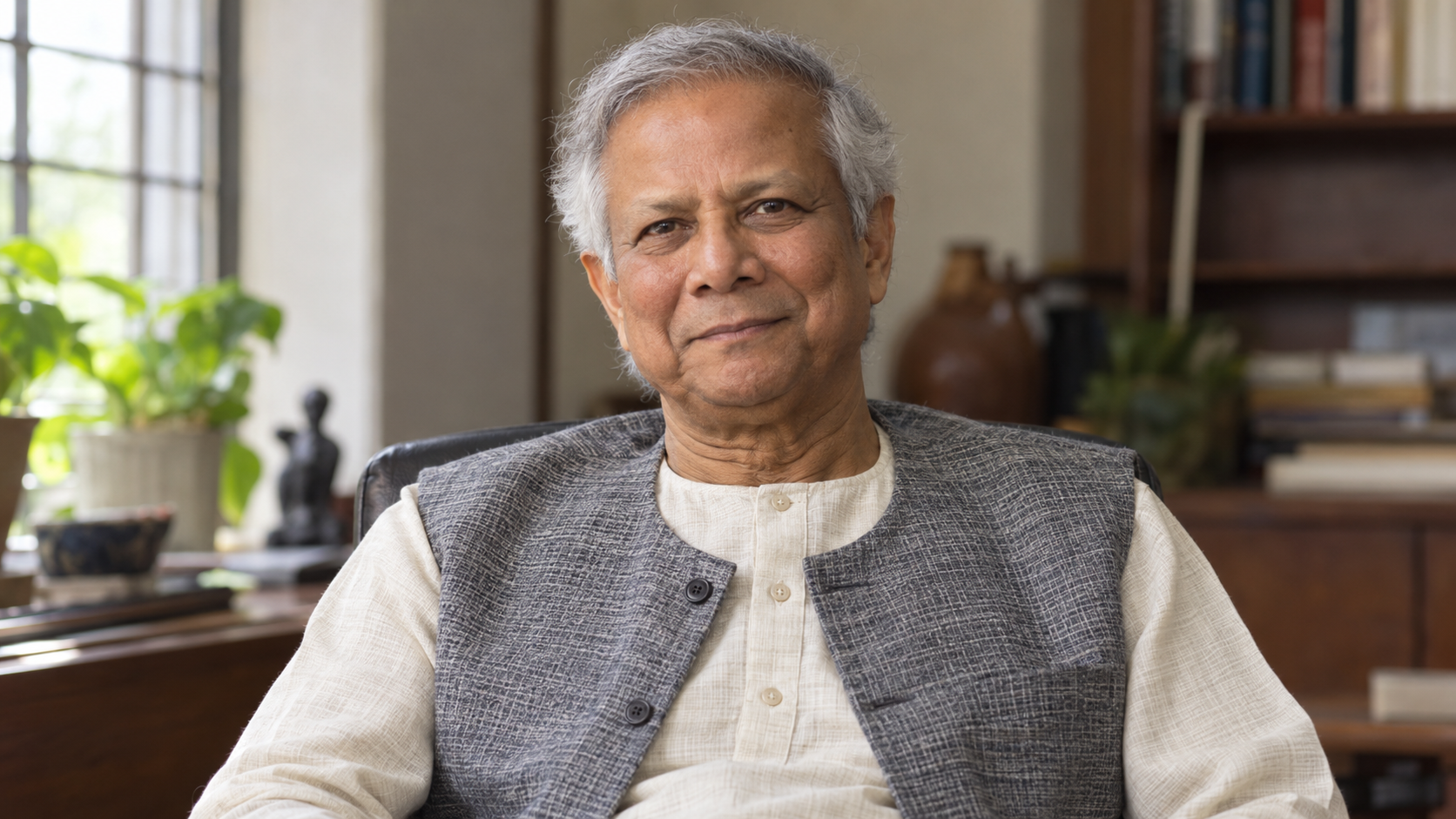
“Poverty is a threat to peace.”
Peace is affected by the opportunities people have to build a life. Muhammad Yunus made that connection directly in his Nobel lecture in Oslo on December 10, 2006. The economist and founder of Grameen Bank argued that poverty belongs within the discussion of security and human dignity. The featured sentence appears as a complete statement in the lecture, not merely as a heading. Its wording identifies a threat rather than claiming that every person experiencing poverty will become violent. That difference is essential. The argument concerns the conditions a society creates and the possibilities those conditions leave open for its people.
Yunus and Grameen Bank shared the 2006 Nobel Peace Prize for work advancing social and economic development from below. His lecture described the beginnings of his lending work in Bangladesh and connected economic access with people’s capacity to act. He also discussed democracy, environmental degradation, human rights, and unjust social or political arrangements as part of the wider setting of peace. Poverty was therefore one factor in a broader account, not the sole explanation of conflict. The speech’s examples and figures describe the institution as he presented it in 2006; they should not be confused with current financial data or an assessment of later government service.
An economic barrier can become a public problem when it makes the future seem permanently closed. Work, learning, mobility, and participation are harder to sustain if every immediate need consumes the resources required to pursue them. A society that measures stability only through the absence of disorder may overlook that erosion of possibility. Bringing opportunity into the discussion changes the questions institutions must answer. Who can use a service? Who is excluded by its requirements? What risk does a household carry when it tries to improve its circumstances? Those questions lead toward the lived conditions behind a broad promise of development.
The quotation does not establish that any particular loan program is sufficient, safe, or appropriate for every borrower. Programs still need scrutiny of their costs, terms, outcomes, and treatment of the people they serve. The value of the sentence is the larger connection it asks readers to make: peace should be considered alongside people’s ability to secure basic needs and participate in their society. Evaluating that connection calls for evidence rather than a charitable assumption about good intentions. A policy contributes to a durable future when it expands real options, respects dignity, and can show how the people affected are better able to shape their lives.
Yunus delivered the Nobel lecture on December 10, 2006. The sentence also appears in the lecture’s published text as a complete statement.
A National Press Club transcript from November 2006 records him discussing the same link between poverty and peace before the Oslo ceremony.
The quotation brings economic exclusion into the discussion of peace. It concerns social conditions, not a claim that poor people are inherently violent.
The lecture also recognizes political, environmental, and human rights factors. Poverty is part of the argument rather than its only cause.
Examine whether a development program expands people’s options in practice. Good intentions need evidence about access, costs, and outcomes.
The quotation is a historical political argument, not financial advice. Particular programs and products must be assessed on their own terms.
Explore more "Quotes of The Day"
Discover more notable quotes from influential voices across politics, science, business, technology, sports, and culture. Each quote offers insight into how ideas, beliefs, and decisions shape the world around us.