

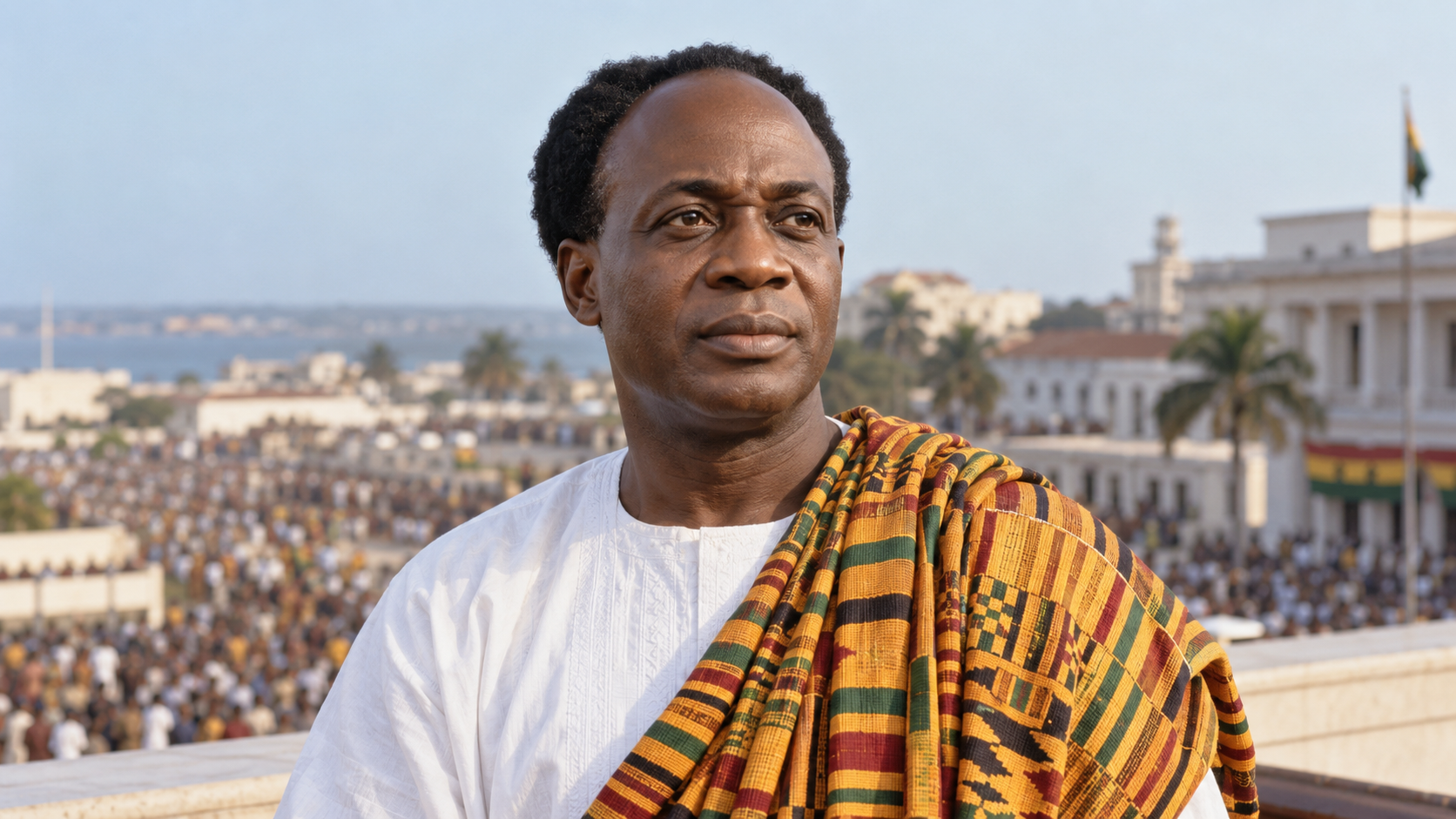
“Our independence is meaningless unless it is linked up with the total liberation of Africa.”
Kwame Nkrumah connected Ghana’s independence with the liberation of Africa in the speech marking independence in March 1957. The text reproduced by Metro TV includes the sentence quoted here, and Ghana’s Parliament has repeated it when discussing the country’s international outlook. Nkrumah was placing a national achievement within a continental struggle against colonial rule. His statement did not diminish the significance of Ghana’s freedom. It enlarged the responsibility he attached to it. A newly independent country, in this account, had reason to consider what its achievement meant for people whose own political freedom was still being denied elsewhere.
The word meaningless makes the claim deliberately demanding. Independence could provide a new flag and government, yet Nkrumah wanted it to carry a purpose beyond that national boundary. The speech celebrated the people who had contributed to the struggle and looked ahead to the work of building the country. Its continental ambition should be read alongside that practical task. Solidarity was not offered as a substitute for governing Ghana. It was part of the direction in which national independence should be used. The quotation captures an aspiration of the independence moment, rather than evidence that all the policies of Nkrumah’s later government fulfilled it.
The political question it raises concerns the relationship between one community’s freedom and another’s. A country can make progress while remaining connected to structures that restrict its neighbours or limit their choices. Cooperation may then strengthen what has been achieved at home, as well as support people elsewhere. This interpretation helps explain why national and international commitments can belong in the same discussion. It also leaves room for scrutiny. A leader who speaks for a broad liberation project still owes explanations to the people affected by specific decisions. An expansive ideal does not remove the need for consent, public debate, or accountability within national institutions.
For a modern reader, the quote offers a way to examine the reach of political solidarity without assuming that every common cause has an easy solution. The questions are concrete: what support is proposed, whose priorities shape it, and whether those receiving assistance retain the ability to decide for themselves. Independence is weakened when cooperation becomes another form of control. Nkrumah’s sentence draws attention to the unfinished circumstances surrounding a moment of victory. Its continuing value lies in that challenge to look beyond celebration, recognise connections between peoples, and ask how an achievement can widen the room for others to determine their own future.
Nkrumah used the sentence in the speech marking Ghana’s independence in March 1957. Metro TV reproduces the text.
Ghana’s Parliament has also cited the wording in discussing the country’s international outlook and continental solidarity.
The quote links a national achievement with the wider struggle against colonial rule. It expresses an ambition of the independence moment.
That ambition does not certify every later policy. A liberation project still needs consent, debate, and accountable institutions.
Solidarity can be assessed through its practical terms: whose priorities guide it and whether those receiving support retain a meaningful choice.
The sentence asks a victorious community to consider unfinished struggles around it and the responsibilities created by its new freedom.
Explore more "Quotes of The Day"
Discover more notable quotes from influential voices across politics, science, business, technology, sports, and culture. Each quote offers insight into how ideas, beliefs, and decisions shape the world around us.