

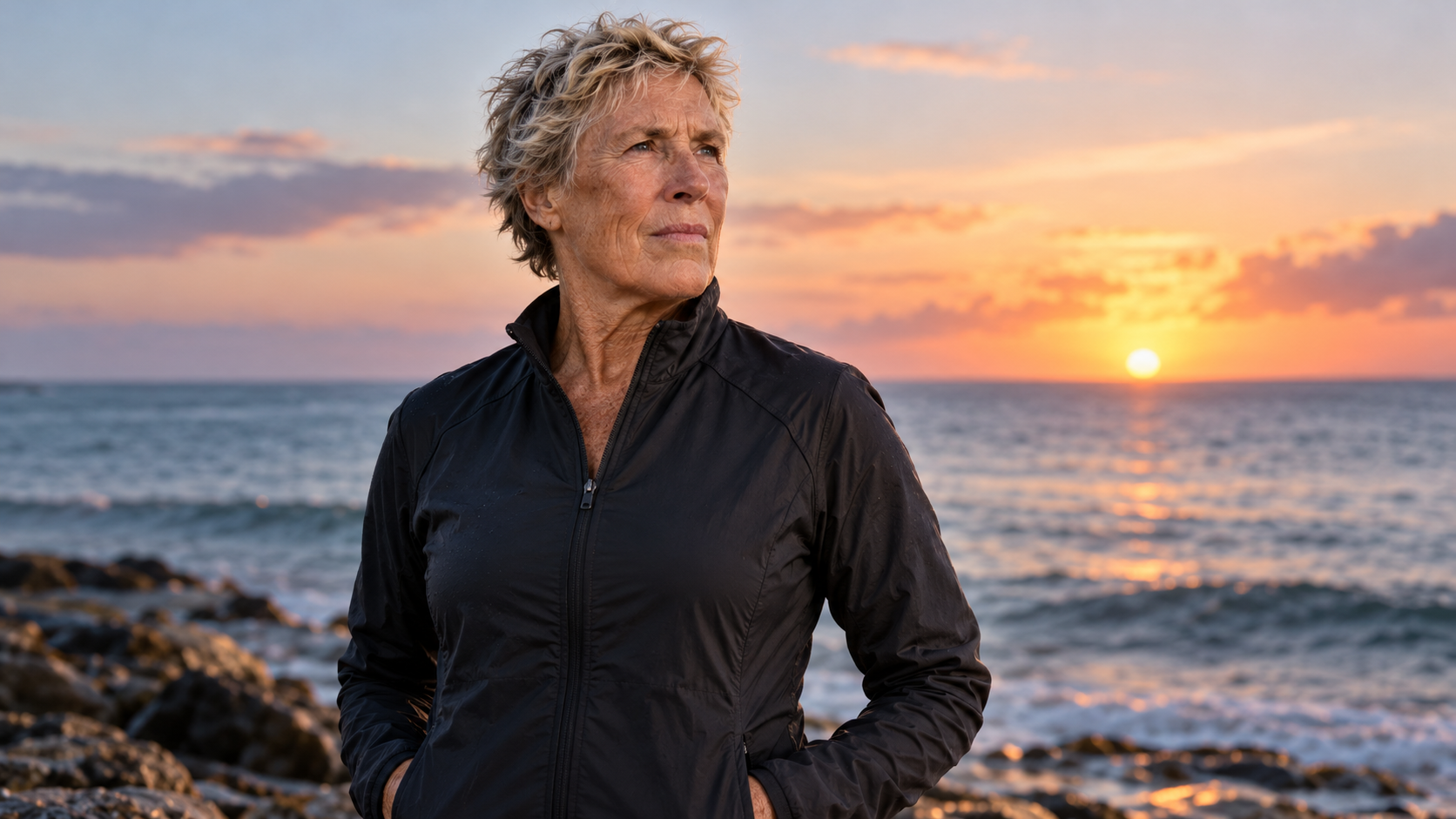
“You can chase your dreams at any age; you’re never too old.”
Diana Nyad said, “You can chase your dreams at any age; you’re never too old.” Nyad said this after completing the open-water swim from Cuba to Florida at age sixty-four. Speaking at TEDWomen, she described arriving in Key West after roughly fifty-three hours in the water and repeated three messages she wanted the achievement to carry. The age line stood beside a refusal to give up and an insistence that a seemingly solitary feat still required a team. The words are compact, but their meaning depends on the occasion in which they were spoken.
Nyad had first attempted the Cuba-to-Florida crossing in 1978, then returned to the project decades later. Multiple efforts were stopped by storms, jellyfish, currents, and health risks before the 2013 completion. The long interval matters because it turns the quotation away from fantasy: the swim involved renewed training, navigation, safety planning, technical experiments, and a crew capable of protecting a vulnerable athlete. That history keeps the quotation connected to practice rather than allowing it to drift into a generic slogan. It also explains why the line belongs in a sports series: competition made the principle visible, while the speaker’s wider life showed where the principle could help and where it could be misunderstood.
The sentence challenges cultural timetables, but it is not a promise that age has no physical consequences. Bodies change, recovery changes, and risk must be evaluated honestly. Nyad’s point is that chronology alone should not close inquiry. A dream may need a different pace, method, support structure, or definition. Pursuit can be meaningful even when the final outcome remains uncertain. A careful reading preserves both its motivational value and the limits that real people and real competitions impose. Motivation becomes more credible when it respects context instead of treating every obstacle as identical or every result as a moral judgment.
Sport often celebrates early peaks and treats later participation as decline. Masters athletes, returning parents, and adults learning a new game complicate that story. Nyad’s quote gives them permission to begin while also emphasizing preparation and teamwork. The mature question is not simply “Am I too old?” but “What would a responsible attempt require now?” That reframing converts longing into an evidence-based plan. Used this way, the quotation supports better decisions as well as stronger effort. For readers, the practical question is not how to imitate a famous career. It is how to translate the underlying idea into one honest, proportionate action in the situation directly ahead.
Nyad said this after completing the open-water swim from Cuba to Florida at age sixty-four. Speaking at TEDWomen, she described arriving in Key West after roughly fifty-three hours in the water and repeated three messages she wanted the achievement to carry. The age line stood beside a refusal to give up and an insistence that a seemingly solitary feat still required a team.
The wording and surrounding record are documented in the primary source and supported by this additional source.
The sentence challenges cultural timetables, but it is not a promise that age has no physical consequences. Bodies change, recovery changes, and risk must be evaluated honestly. Nyad’s point is that chronology alone should not close inquiry. A dream may need a different pace, method, support structure, or definition. Pursuit can be meaningful even when the final outcome remains uncertain.
The line is most responsible when it encourages deliberate action without pretending that effort controls every condition, injury, institution, or outcome.
Sport often celebrates early peaks and treats later participation as decline. Masters athletes, returning parents, and adults learning a new game complicate that story. Nyad’s quote gives them permission to begin while also emphasizing preparation and teamwork. The mature question is not simply “Am I too old?” but “What would a responsible attempt require now?” That reframing converts longing into an evidence-based plan.
Its continuing value lies in turning admiration into a practical question about preparation, support, judgment, and the next decision.
Explore more "Quotes of The Day"
Discover more notable quotes from influential voices across politics, science, business, technology, sports, and culture. Each quote offers insight into how ideas, beliefs, and decisions shape the world around us.