

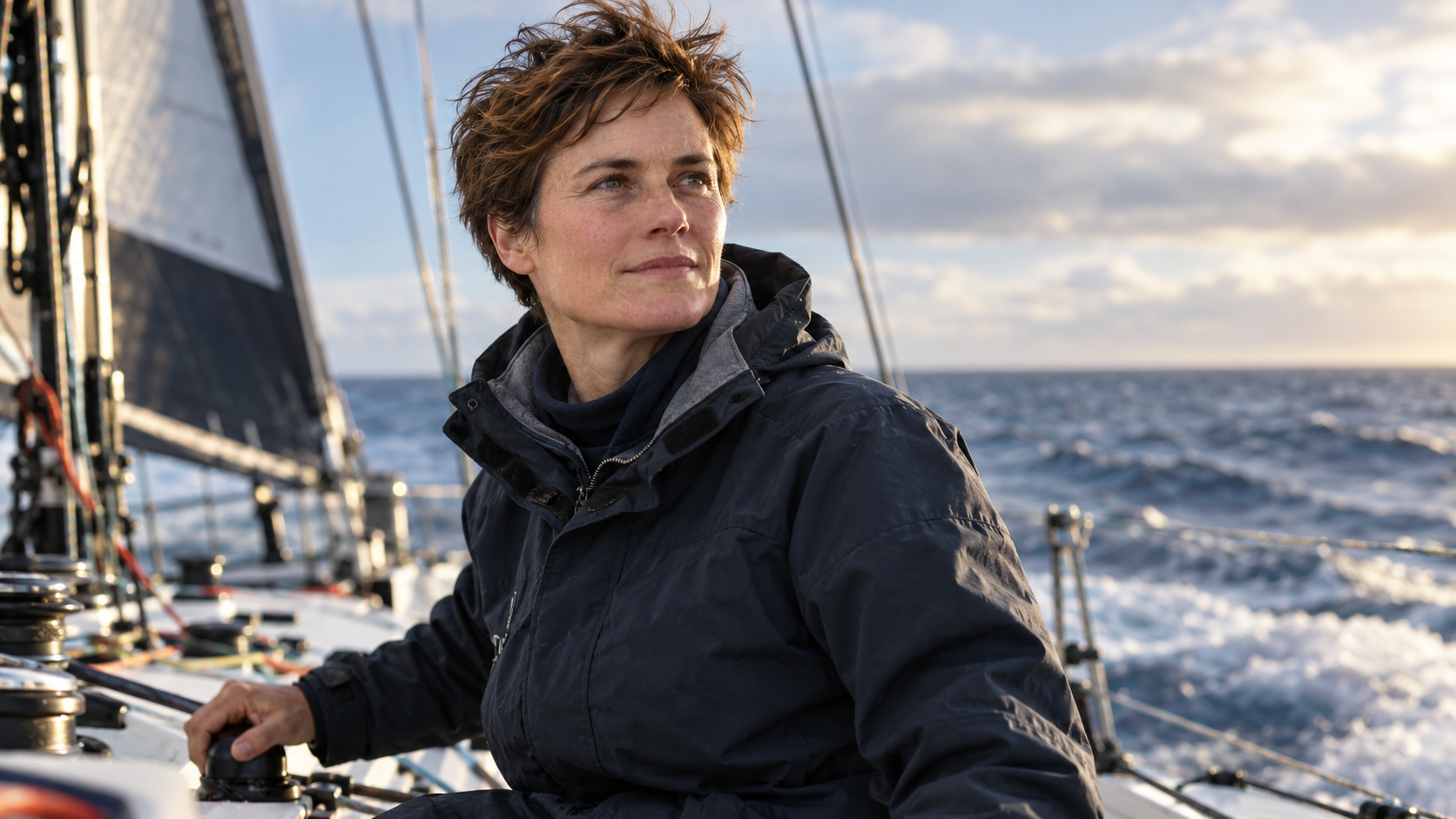
“I made my mind up there and then that one day, somehow, I was going to sail around the world.”
Dame Ellen MacArthur said, “I made my mind up there and then that one day, somehow, I was going to sail around the world.” MacArthur recalled making this decision as a child in her TED talk. The dream eventually led to a solo circumnavigation record, but the talk used sailing to explain a wider realization about finite resources. On a boat, everything needed for survival is carried aboard and every repair draws from a limited inventory. The childhood ambition therefore became both an athletic story and an environmental lens. Read alone, the sentence sounds universal; read in context, it becomes more precise and more useful.
In 2005, MacArthur completed a solo nonstop circumnavigation in just over seventy-one days, then the fastest time on record. Alone at sea, she managed navigation, weather, sleep, repairs, and physical strain while remaining connected to a shore team. The achievement grew from years of smaller boats, sponsorship work, technical learning, and races that converted a distant dream into specific capabilities. The record matters because it shows how the idea was tested through preparation, change, and public pressure. It also explains why the line belongs in a sports series: competition made the principle visible, while the speaker’s wider life showed where the principle could help and where it could be misunderstood.
The quote celebrates decision, but “somehow” should not erase planning. A strong commitment can organize years of choices without guaranteeing a particular route or timetable. MacArthur’s story shows a productive sequence: declare a direction, learn what it demands, start at an appropriate scale, and keep adapting. The dream had emotional power because it generated disciplined attention rather than entitlement to an outcome. That distinction is important whenever inspirational language is used around injury, inequality, or uncertain outcomes. Motivation becomes more credible when it respects context instead of treating every obstacle as identical or every result as a moral judgment.
Athletes often need a horizon large enough to sustain unglamorous work. At the same time, sport’s use of travel, equipment, and facilities creates resource questions that MacArthur later made central to her work on a circular economy. The sentence therefore carries two lessons: ambition can focus a life, and every pursuit operates within systems that are not limitless. Responsible dreams account for both performance and the world that makes it possible. The result is a lesson that can guide preparation without flattening the complexity of a human life. For readers, the practical question is not how to imitate a famous career. It is how to translate the underlying idea into one honest, proportionate action in the situation directly ahead.
MacArthur recalled making this decision as a child in her TED talk. The dream eventually led to a solo circumnavigation record, but the talk used sailing to explain a wider realization about finite resources. On a boat, everything needed for survival is carried aboard and every repair draws from a limited inventory. The childhood ambition therefore became both an athletic story and an environmental lens.
The wording and surrounding record are documented in the primary source and supported by this additional source.
The quote celebrates decision, but “somehow” should not erase planning. A strong commitment can organize years of choices without guaranteeing a particular route or timetable. MacArthur’s story shows a productive sequence: declare a direction, learn what it demands, start at an appropriate scale, and keep adapting. The dream had emotional power because it generated disciplined attention rather than entitlement to an outcome.
The line is most responsible when it encourages deliberate action without pretending that effort controls every condition, injury, institution, or outcome.
Athletes often need a horizon large enough to sustain unglamorous work. At the same time, sport’s use of travel, equipment, and facilities creates resource questions that MacArthur later made central to her work on a circular economy. The sentence therefore carries two lessons: ambition can focus a life, and every pursuit operates within systems that are not limitless. Responsible dreams account for both performance and the world that makes it possible.
Its continuing value lies in turning admiration into a practical question about preparation, support, judgment, and the next decision.
Explore more "Quotes of The Day"
Discover more notable quotes from influential voices across politics, science, business, technology, sports, and culture. Each quote offers insight into how ideas, beliefs, and decisions shape the world around us.