

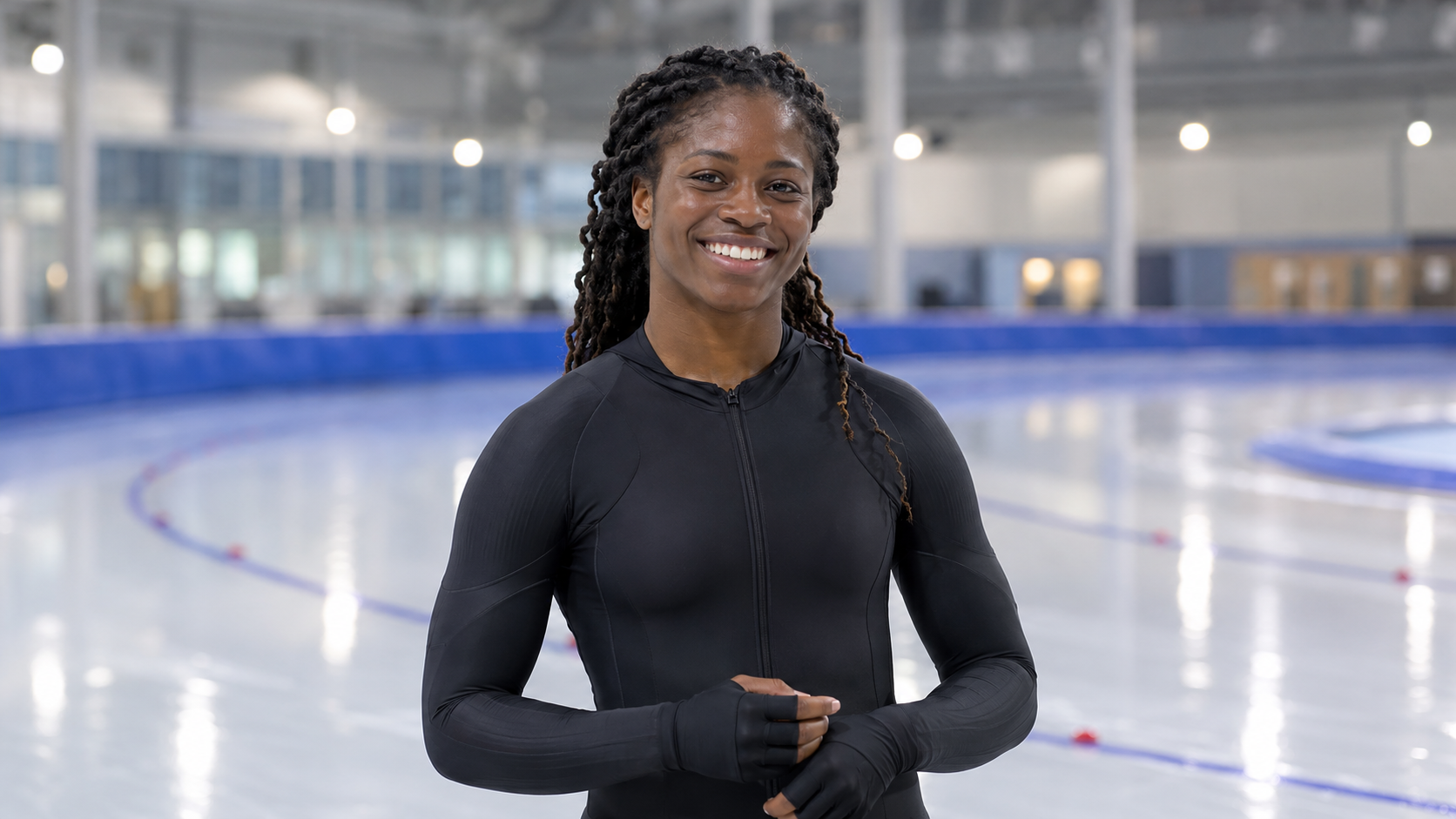
“I just want to go out there and do even better.”
Erin Jackson said, “I just want to go out there and do even better.” in an interview about transferring her inline-skating skill to long-track speed skating. Jackson applied an engineering background and elite inline experience to a newer discipline, learning unfamiliar edges and race demands quickly. Her statement joined satisfaction with a specific appetite for further improvement. Its brevity works only because the surrounding performance, risk, and public expectation supply the rest of the argument.
Elite sport often compresses years of preparation into a score, time, or final possession. This account restores the longer process behind that narrow result and shows why one instant can carry several meanings at once. In this case, the quotation belongs to speed skating, but the record around it also shows how sporting achievement is shaped by relationships, institutions, and the meaning an athlete gives to experience. A source-first reading checks three connected layers: the exact wording, the occasion described as an interview about transferring her inline-skating skill to long-track speed skating, and the later significance attached to the remark. Keeping those layers together helps protect Erin Jackson from a cleaner or larger interpretation than the documented moment can support.
Doing better should not mean that every previous result was inadequate. Improvement can coexist with appreciation, and its measures should include technique, health, and understanding as well as placement. The point is not that confidence overrides evidence or that persistence always receives a reward. Good judgment still includes safety, support, changing conditions, and the courage to revise a plan when the original one no longer fits. This is the difference between honoring a speaker’s insight and turning a vivid sentence into advice it was never designed to carry.
The quote reflects a learning orientation that helped Jackson convert expertise across sports without assuming the transition would be automatic. The quote lasts because it offers direction rather than certainty. It asks for a clearer response to the present challenge while respecting the people, structures, and time required for meaningful change. The enduring question is not whether another person can reproduce the same career. It is whether the underlying idea can improve preparation, judgment, or care in the circumstances that actually exist now. That approach lets the quotation remain attached to Erin Jackson and speed skating while still inviting a reader to carry its most defensible lesson into a different arena. Context narrows the claim, but that precision is what makes the lesson portable.
Erin Jackson delivered these words in an interview about transferring her inline-skating skill to long-track speed skating. Jackson applied an engineering background and elite inline experience to a newer discipline, learning unfamiliar edges and race demands quickly. Her statement joined satisfaction with a specific appetite for further improvement.
Doing better should not mean that every previous result was inadequate. Improvement can coexist with appreciation, and its measures should include technique, health, and understanding as well as placement.
The quotation is most responsible when it strengthens deliberate action without pretending that effort controls every body, institution, resource, injury, or competitive result.
The quote reflects a learning orientation that helped Jackson convert expertise across sports without assuming the transition would be automatic.
Its present value lies in turning admiration into a practical question about preparation, support, judgment, and the next decision.
Explore more "Quotes of The Day"
Discover more notable quotes from influential voices across politics, science, business, technology, sports, and culture. Each quote offers insight into how ideas, beliefs, and decisions shape the world around us.