

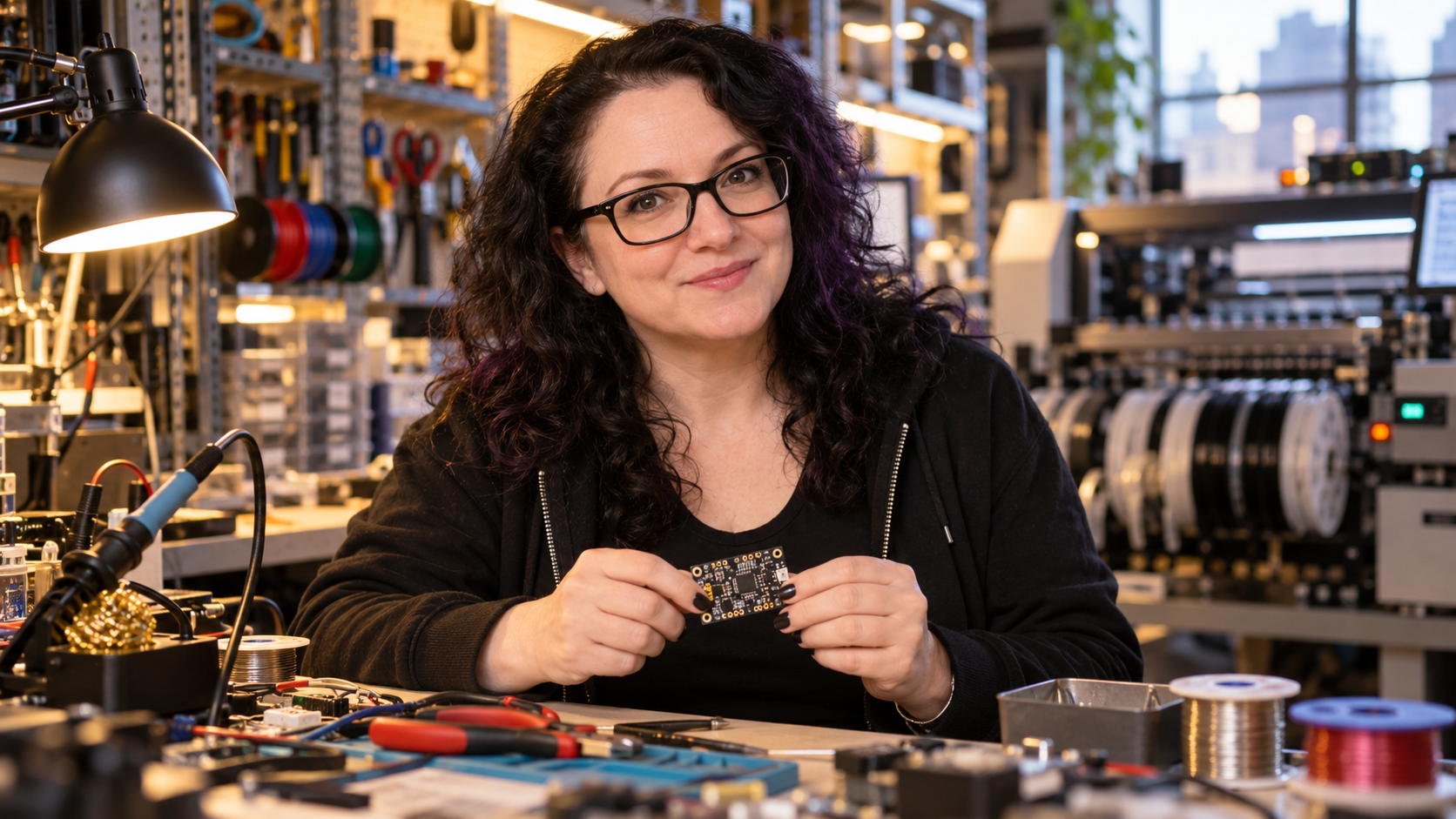
“Writing code and doing electronics, it doesn’t actually make any difference.”
Limor Fried made this observation on GitHub’s ReadME Podcast while discussing how people learn to build with technology. The founder of Adafruit has spent years creating open-source electronics, tutorials, and tools that invite beginners into engineering. Her point was not that software and hardware are literally identical. Code is expressed through instructions, while electronics involves components, signals, power, and physical constraints. From the maker’s perspective, however, both are materials used to solve a problem. A project may move back and forth between them so naturally that treating one as the “creative” part and the other as specialist machinery becomes an unnecessary barrier.
Consider a wearable light that reacts to movement. The maker chooses sensors, a microcontroller, LEDs, a battery, and connections; then writes software that interprets measurements and controls the display. A fault may come from a loose wire, an incorrect voltage, a timing error, or a mistaken assumption in the program. Solving it requires observing the whole system. The same is true of environmental monitors, musical instruments, robots, accessibility devices, and interactive art. Hardware determines what can be sensed or changed in the physical world, while software shapes the behavior. The finished object is the conversation between the two.
Fried’s teaching philosophy often begins with something a person wants to make rather than with a long sequence of prerequisites. A clear goal creates reasons to learn each concept: solder this connection because the sensor needs power; change this loop because the lights should respond faster; read this data sheet because the component behaves unexpectedly. That top-down path can make engineering more approachable for people who were never encouraged to imagine themselves as programmers or electrical engineers. It also gives experienced developers a reason to cross a disciplinary line. Curiosity becomes the entry credential, and the project supplies immediate feedback.
The quote matters even more as computing spreads into ordinary objects. Cars, medical devices, home appliances, factories, toys, and scientific instruments are combinations of code and electronics whose failures cannot be understood in isolation. Teams still need deep specialists, but they also benefit from people who can reason across the boundary and communicate how decisions interact. For learners, Fried’s phrasing removes a false choice: they do not have to declare allegiance to hardware or software before they begin. They can start with a need, assemble the tools it requires, and learn through construction. Technology becomes less a set of guarded domains and more a flexible medium for turning an idea into something that works.
Fried made the remark on GitHub’s ReadME Podcast while discussing makers, engineering education, and barriers to participation.
Her work at Adafruit combines open-source hardware, software libraries, documentation, and project-based tutorials.
Hardware and software have different constraints, but a maker often uses both as connected materials in one problem-solving process.
Beginning with a desired project gives learners a practical reason to acquire concepts that might otherwise feel abstract or inaccessible.
Connected products—from medical devices to vehicles—depend on physical components and code behaving correctly together.
Crossing the boundary helps learners enter engineering and helps teams diagnose failures that do not fit neatly within one specialty.
Explore more "Quotes of The Day"
Discover more notable quotes from influential voices across politics, science, business, technology, sports, and culture. Each quote offers insight into how ideas, beliefs, and decisions shape the world around us.