

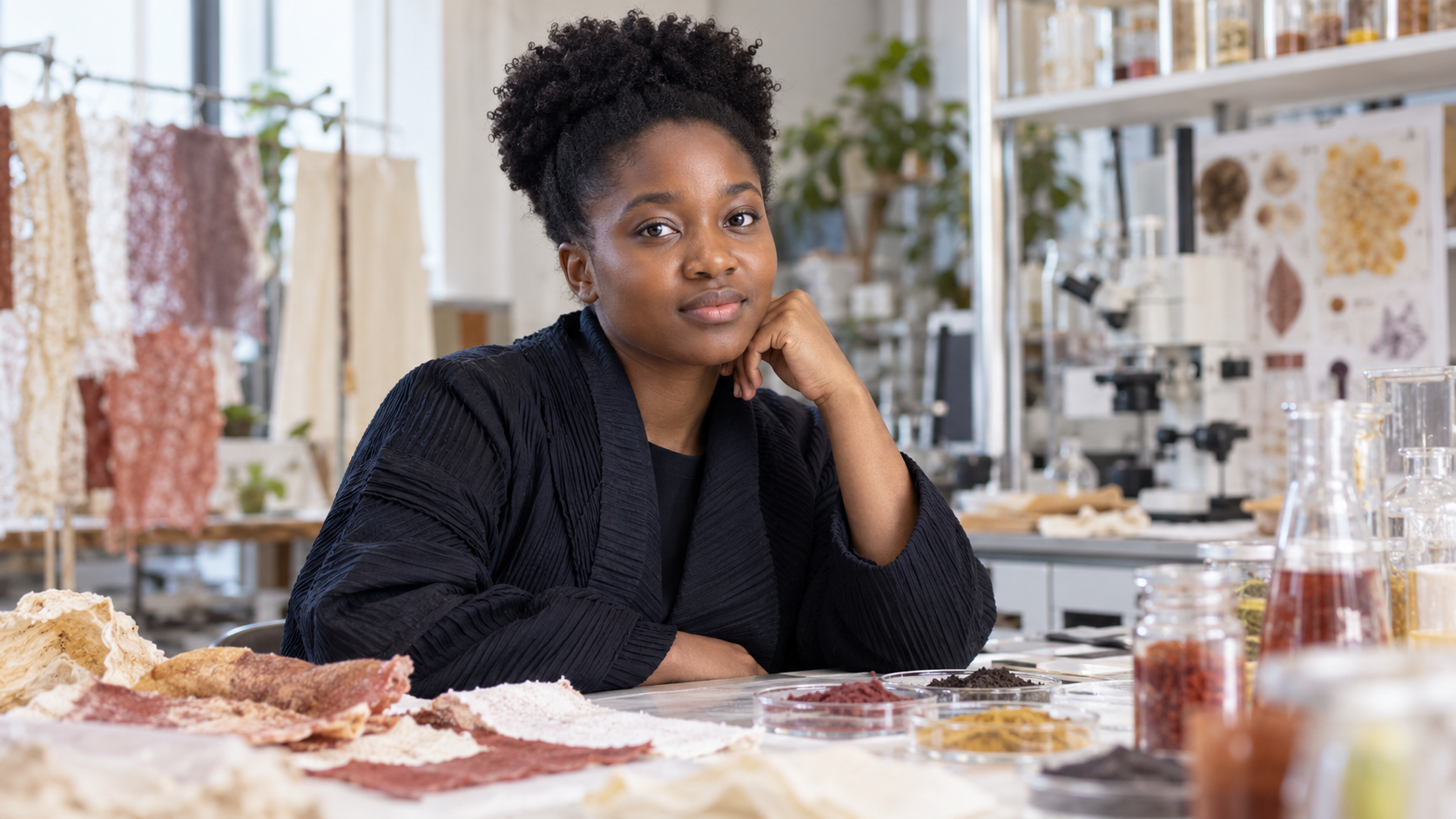
“This is the material future that we must be bold enough to shape.”
Natsai Audrey Chieza closed a 2017 TED@BCG talk with this sentence after describing experiments that used bacteria to dye textiles. Working between design and biotechnology, she showed how a pigment-producing microbe could color fabric with far less water than conventional industrial dyeing processes. The example was not offered as a finished replacement for the global textile system. It was a demonstration that living organisms can become collaborators in manufacturing, allowing designers to rethink not only a product’s appearance but the biological and industrial process by which its material qualities are created.
The word “shape” is important. Biological fabrication is sometimes described as if nature will automatically deliver a sustainable future, but living systems do not remove human choices. Researchers decide which organisms to use, how to modify or contain them, what resources the process consumes, and how it will be scaled. A laboratory result may perform differently when manufacturing volume, supply chains, worker safety, waste, and regulation enter the picture. Boldness therefore includes rigorous measurement and restraint. The relevant comparison is a complete life cycle, not an attractive sample presented without the energy and materials required to produce it.
Chieza’s work also questions the separation between technical and creative disciplines. A biologist may understand an organism’s metabolism while a designer asks how color, texture, and use can change. Manufacturing knowledge, ethics, business, and community perspectives add further requirements. This collaboration can produce possibilities that no discipline sees alone, but it also requires a shared language and clear responsibility. When a material is alive or biologically derived, decisions about ownership, release, and ecological effects cannot be left to aesthetics or efficiency alone. The future is shaped through institutions as much as through experiments.
The quote remains relevant as companies seek alternatives to resource-intensive materials and petrochemical processes. Climate claims can encourage premature celebration, while fear can close off promising research before evidence develops. Chieza’s sentence offers a more demanding stance: engage early enough to influence the direction. Ask what problem a biomaterial solves, what new risks it creates, whose knowledge guides deployment, and whether benefits survive at scale. A material future is not waiting to be discovered in a single organism. It will emerge from choices about research, standards, production, access, and disposal. Boldness means taking responsibility for those choices before they become infrastructure. Transparent lifecycle data would let customers, regulators, and researchers test whether a celebrated process actually improves on the materials it aims to replace.
Chieza delivered the line at TED@BCG after presenting work with pigment-producing bacteria used to color textiles. The research explored biological routes to material production.
Her examples connected laboratory experimentation with the environmental burden of conventional dyeing, while remaining demonstrations rather than claims of an already complete industrial replacement.
To shape a material future is to make choices about organisms, processes, scale, labor, containment, and lifecycle impacts instead of assuming biology is automatically sustainable.
Boldness includes careful evidence. A promising sample must still be evaluated for resources, safety, consistency, regulation, and end-of-life consequences across real production conditions.
Biomanufacturing is expanding as industries search for lower-impact materials. Early design and policy choices will influence which methods become affordable, trusted, and environmentally credible.
Collaboration among biology, design, manufacturing, ethics, and affected communities can steer that growth toward useful outcomes before a narrow technical pathway becomes difficult to change.
Explore more "Quotes of The Day"
Discover more notable quotes from influential voices across politics, science, business, technology, sports, and culture. Each quote offers insight into how ideas, beliefs, and decisions shape the world around us.