

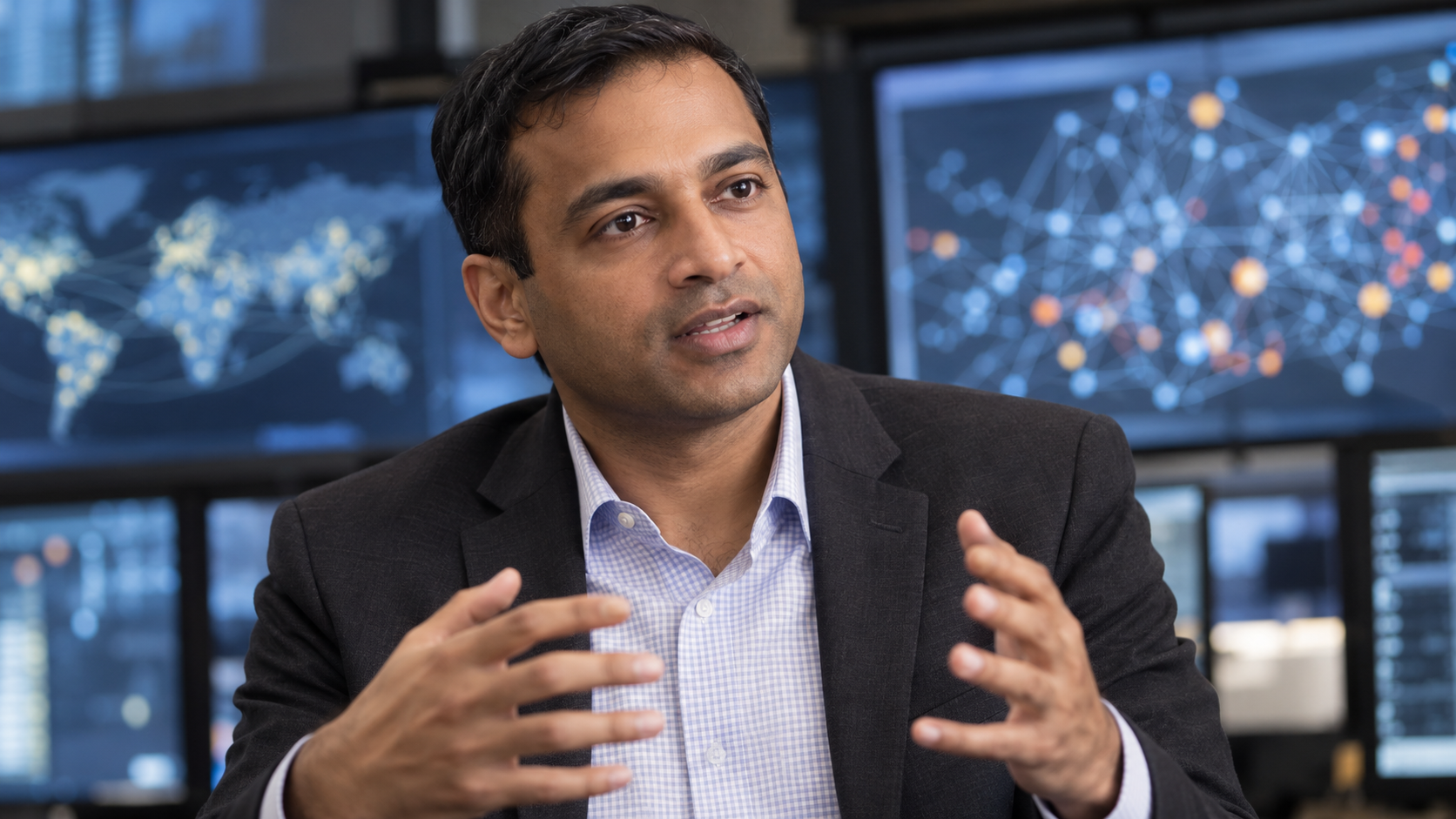
“Instead of thinking how the computer can solve the problem, design the process around what the human can do with it.”
Shyam Sankar offered this principle in a 2012 TEDGlobal talk about human-computer cooperation. He contrasted the familiar story of a computer defeating a chess champion with competitions in which teams of humans and machines outperformed either working alone. His examples ranged from scientific games to data analysis. The recurring idea was that computers excel at searching, calculating, and processing volume, while people contribute context, goals, intuition, and the ability to recognize when a framing is wrong. Good design begins with the combined process rather than assuming the machine should inherit the entire task.
The sentence does not establish a fixed division in which humans are always creative and computers are always mechanical. Capabilities change, and people can be inconsistent, biased, or overwhelmed. Nor does adding a person guarantee accountability. A reviewer who receives a score without time, authority, or useful evidence may simply approve the machine’s recommendation. Human-computer cooperation works only when the interface exposes relevant uncertainty, supports investigation, and assigns a real decision role. Otherwise “human in the loop” becomes a label for responsibility without the power needed to exercise it.
Designing the process around human capability means asking where judgment creates value and what information makes that judgment possible. A medical system might retrieve comparable cases while a clinician integrates symptoms and patient preferences. A security tool might rank unusual events while an analyst examines intent and context. A creative application might generate alternatives while a person defines purpose and selects what belongs. In each case, evaluation must cover the joint system. A highly accurate model can still produce poor outcomes if its alerts arrive too late, its explanation is unusable, or workload causes people to ignore it.
The principle is newly important as generative AI performs tasks that once looked resistant to automation. Organizations may focus on whether a model can draft, classify, or recommend, when the more useful question is how work should be reorganized. Effective collaboration may require new review stages, provenance, escalation paths, and limits on delegation. Sankar’s formulation resists both automation enthusiasm and nostalgia. It treats the human and computer as components of a designed relationship. The goal is not to preserve every existing job step or maximize machine autonomy; it is to create a process whose combined capabilities, checks, and responsibilities produce a better result than either participant could achieve alone. Measuring that result should include error recovery and workload, not only the apparent speed of the machine-assisted step.
Sankar delivered the line in a TEDGlobal talk that used chess and data-analysis examples to argue for human-computer symbiosis rather than a simple contest between people and machines.
He emphasized interfaces and workflows because cooperation depends on how machine calculation and human interpretation are connected, not merely on placing both near the same task.
The design unit is the combined process. Teams should locate where computation adds scale and where people need context, discretion, creativity, or responsibility.
A nominal human reviewer is not enough. The person must receive usable evidence, time, authority, and a clear way to challenge or override the system.
Generative AI can now produce drafts and recommendations across many fields, making workflow design more consequential than a narrow demonstration of model capability.
Provenance, escalation, review boundaries, and joint-system evaluation help turn automation into accountable augmentation instead of responsibility being lost between human and machine.
Explore more "Quotes of The Day"
Discover more notable quotes from influential voices across politics, science, business, technology, sports, and culture. Each quote offers insight into how ideas, beliefs, and decisions shape the world around us.