

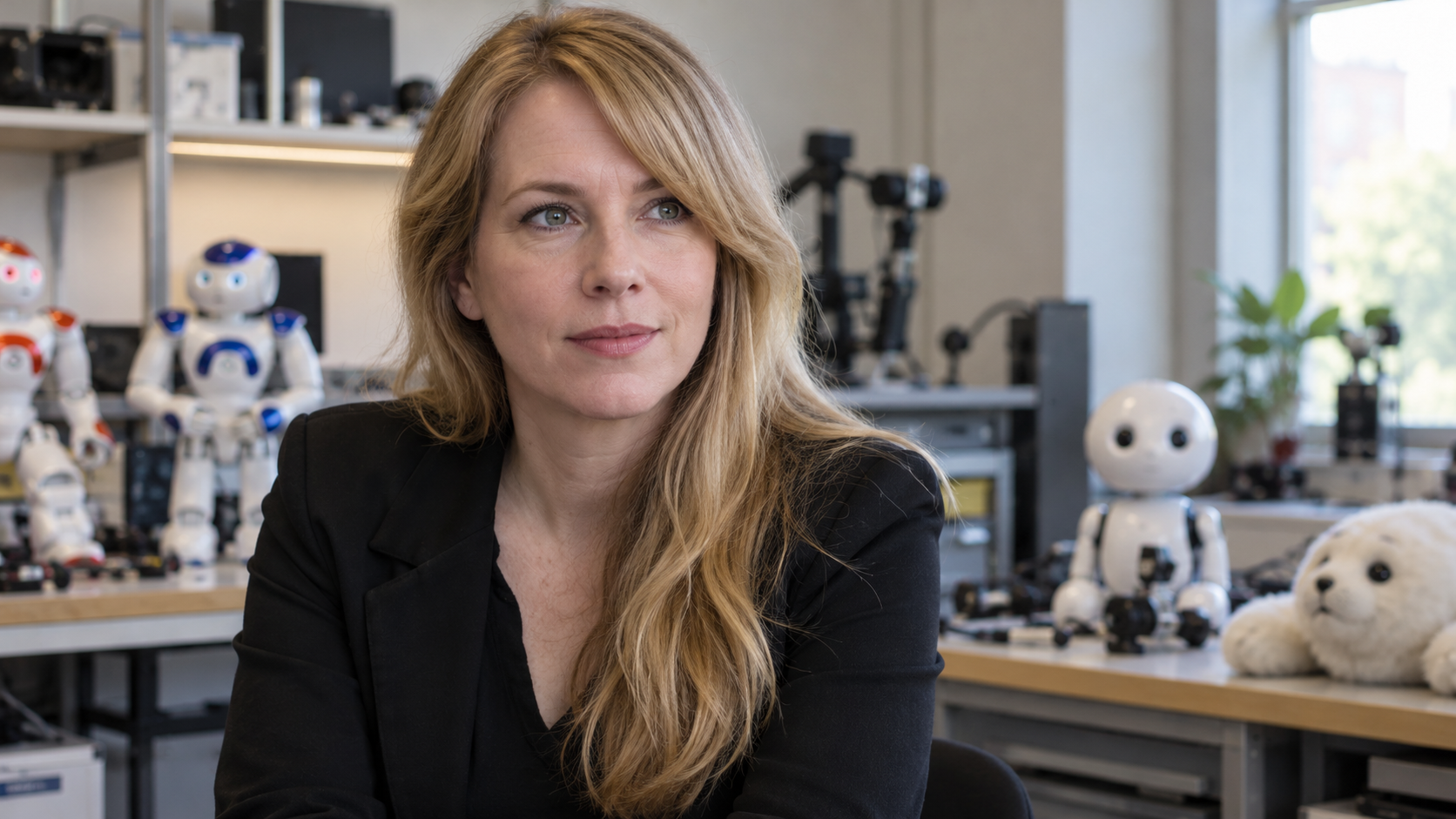
“We’re far from developing robots that feel emotions, but we already have feelings towards them.”
Kate Darling offered this line in her TED Salon talk on human emotional connections to robots. Darling used experiments with simple robotic toys to show that people hesitate to harm machines that move or respond in lifelike ways. The robots did not need inner experience for humans to project intent, vulnerability, and social meaning onto them. Its force comes from experience: the speaker was describing consequences already visible in real systems and institutions.
Human reactions become part of a technology’s real effects. Whether a machine actually feels is separate from whether its design elicits care, authority, fear, or attachment. Those responses can influence behavior and relationships. The line asks readers to look past novelty and examine what the technology enables people to do. It directs attention to the work between an appealing idea and a dependable result: defining the problem clearly, exposing assumptions, and learning from evidence instead of relying on reputation or momentum. In practice, that means asking what changed, who gained new capability, and how the result would be checked by someone who did not share the builder’s expectations.
Emotional projection should not be confused with proof of machine consciousness. Companies can exploit attachment through deceptive cues, and empathy toward a device should not displace concern for the people whose labor, data, or safety support it. That distinction is essential whenever a compact quotation travels farther than the detailed account that produced it. Strong technology reporting must preserve this nuance, because the same words can support very different choices when the original constraints disappear. A responsible reading also separates the speaker’s documented claim from broader promises that admirers may attach to it later. That protects both the historical record and the reader’s ability to disagree intelligently.
Social robots and conversational agents increasingly use voices, faces, and personalities. Darling’s distinction helps designers set honest expectations, study vulnerable users, and avoid interfaces that manipulate trust by pretending a system understands more than it does. Used this way, the quote becomes a prompt for better practice rather than a decorative line about innovation. For readers, builders, and institutions, the practical question is not whether the quotation sounds true in isolation, but whether current decisions honor the conditions and responsibilities it identifies. Teams can make that test concrete through review, accessible documentation, independent feedback, and measures that include failures as well as successes. Those habits turn a memorable insight into work that others can examine and improve.
Kate Darling offered this line in her TED Salon talk on human emotional connections to robots. Darling used experiments with simple robotic toys to show that people hesitate to harm machines that move or respond in lifelike ways. The robots did not need inner experience for humans to project intent, vulnerability, and social meaning onto them. Its force comes from experience: the speaker was describing consequences already visible in real systems and institutions.
The source record connects the wording to her TED Salon talk on human emotional connections to robots, which is the context used for this post.
Human reactions become part of a technology’s real effects. Whether a machine actually feels is separate from whether its design elicits care, authority, fear, or attachment. Those responses can influence behavior and relationships. The line asks readers to look past novelty and examine what the technology enables people to do. It directs attention to the work between an appealing idea and a dependable result: defining the problem clearly, exposing assumptions, and learning from evidence instead of relying on reputation or momentum. In practice, that means asking what changed, who gained new capability, and how the result would be checked by someone who did not share the builder’s expectations.
The interpretation focuses on a decision or design principle that readers can test against actual systems.
Emotional projection should not be confused with proof of machine consciousness. Companies can exploit attachment through deceptive cues, and empathy toward a device should not displace concern for the people whose labor, data, or safety support it. That distinction is essential whenever a compact quotation travels farther than the detailed account that produced it. Strong technology reporting must preserve this nuance, because the same words can support very different choices when the original constraints disappear. A responsible reading also separates the speaker’s documented claim from broader promises that admirers may attach to it later. That protects both the historical record and the reader’s ability to disagree intelligently.
Social robots and conversational agents increasingly use voices, faces, and personalities. Darling’s distinction helps designers set honest expectations, study vulnerable users, and avoid interfaces that manipulate trust by pretending a system understands more than it does. Used this way, the quote becomes a prompt for better practice rather than a decorative line about innovation. For readers, builders, and institutions, the practical question is not whether the quotation sounds true in isolation, but whether current decisions honor the conditions and responsibilities it identifies. Teams can make that test concrete through review, accessible documentation, independent feedback, and measures that include failures as well as successes. Those habits turn a memorable insight into work that others can examine and improve.
Explore more "Quotes of The Day"
Discover more notable quotes from influential voices across politics, science, business, technology, sports, and culture. Each quote offers insight into how ideas, beliefs, and decisions shape the world around us.