

“If we bake Einstein’s equations too much into our algorithms, we’ll just end up seeing what we expect to see.”
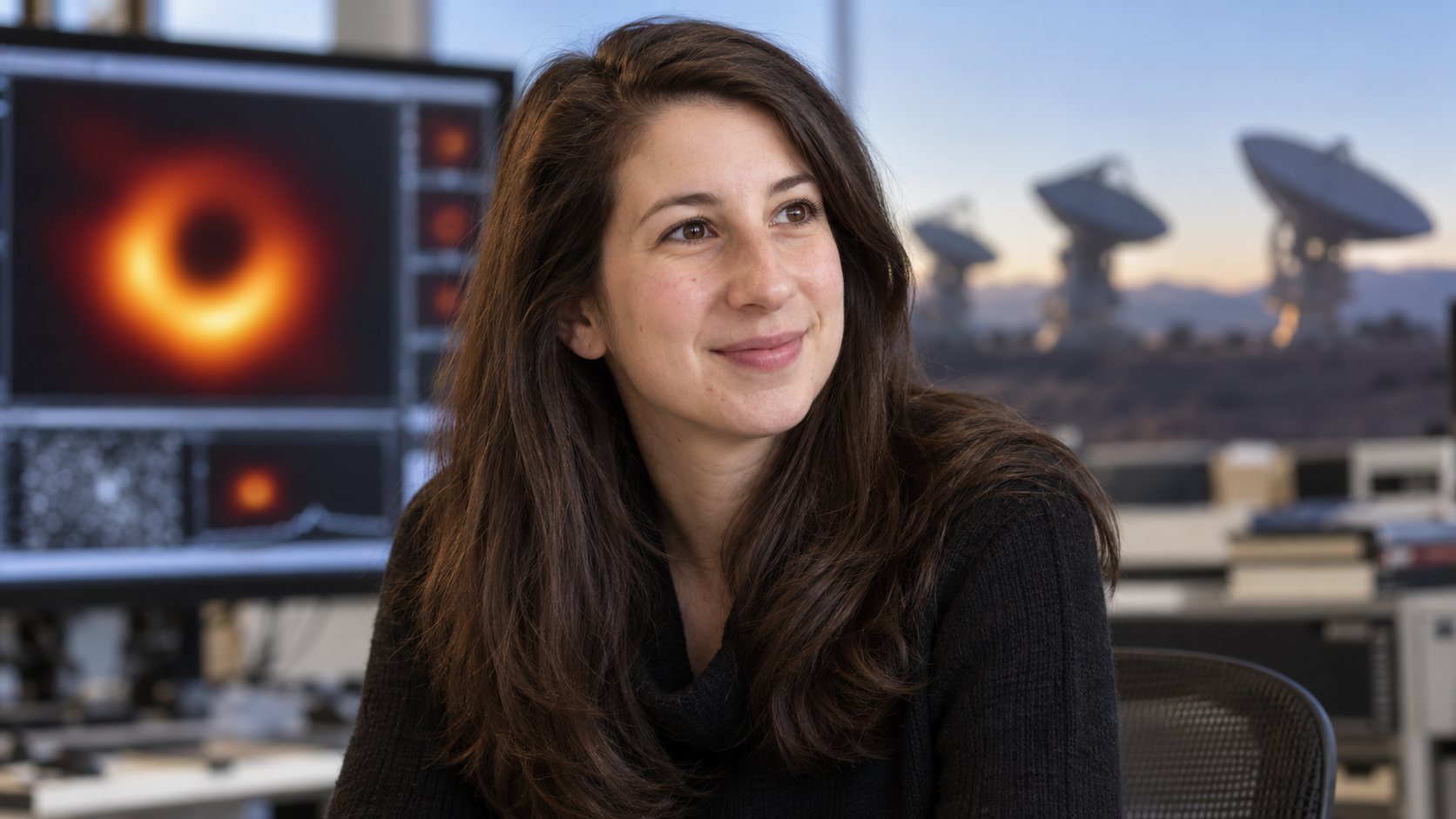
Katie Bouman offered this line in her TEDxBeaconStreet talk on imaging a black hole. Bouman explained how the Event Horizon Telescope would reconstruct an image from sparse measurements gathered across the Earth. Because infinitely many pictures could fit incomplete data, the team tested different image assumptions rather than forcing the result to resemble a familiar simulation. Read in that setting, the quotation records a practical lesson earned through a particular technical challenge.
Prior knowledge makes reconstruction possible, but a prior can also predetermine the answer. Scientific software must use assumptions strongly enough to interpret data while leaving room for a genuinely unexpected observation. The central issue is the relationship between capability, understanding, and responsibility. In practice, that means asking what changed, who gained new capability, which assumption carries the most risk, and how the result would be checked by someone who did not share the builder’s expectations. It also means comparing the claimed benefit with the maintenance, access, and recovery work required to keep it real over time. The quotation earns its place by sharpening those questions instead of closing them.
No imaging algorithm is assumption-free. Even the choice to compare multiple methods reflects a model of reliability. The safeguard is not pretending to remove judgment, but exposing it through synthetic tests, independent teams, and robustness checks. The limitation strengthens the argument because it identifies the conditions under which the idea can be applied responsibly. Strong technology reporting must preserve this boundary, because the same words can support very different choices after the original constraints disappear. Readers should be able to see both the useful principle and the evidence that would require a different judgment. A responsible reading separates the speaker’s documented claim from broader promises that admirers may attach to it later.
AI systems increasingly infer images, text, and patterns from incomplete evidence. Bouman’s warning applies wherever outputs look convincing: vary assumptions, compare pipelines, and test whether the conclusion survives attempts to make the system see something else. That is a demanding standard, but it is more durable than judging progress by speed, scale, or attention alone. Teams can make that test concrete through review, accessible documentation, independent feedback, and measures that include failures as well as successes. The same discipline should follow the system after launch, when real users reveal consequences no prototype fully predicted in advance. Those habits turn a memorable insight into work that readers, builders, and institutions can examine and improve.
Katie Bouman offered this line in her TEDxBeaconStreet talk on imaging a black hole. Bouman explained how the Event Horizon Telescope would reconstruct an image from sparse measurements gathered across the Earth. Because infinitely many pictures could fit incomplete data, the team tested different image assumptions rather than forcing the result to resemble a familiar simulation. Read in that setting, the quotation records a practical lesson earned through a particular technical challenge.
The source record connects the wording to her TEDxBeaconStreet talk on imaging a black hole, which is the context used for this post.
Prior knowledge makes reconstruction possible, but a prior can also predetermine the answer. Scientific software must use assumptions strongly enough to interpret data while leaving room for a genuinely unexpected observation. The central issue is the relationship between capability, understanding, and responsibility. In practice, that means asking what changed, who gained new capability, which assumption carries the most risk, and how the result would be checked by someone who did not share the builder’s expectations. It also means comparing the claimed benefit with the maintenance, access, and recovery work required to keep it real over time. The quotation earns its place by sharpening those questions instead of closing them.
The interpretation focuses on a decision or design principle that readers can test against actual systems.
No imaging algorithm is assumption-free. Even the choice to compare multiple methods reflects a model of reliability. The safeguard is not pretending to remove judgment, but exposing it through synthetic tests, independent teams, and robustness checks. The limitation strengthens the argument because it identifies the conditions under which the idea can be applied responsibly. Strong technology reporting must preserve this boundary, because the same words can support very different choices after the original constraints disappear. Readers should be able to see both the useful principle and the evidence that would require a different judgment. A responsible reading separates the speaker’s documented claim from broader promises that admirers may attach to it later.
AI systems increasingly infer images, text, and patterns from incomplete evidence. Bouman’s warning applies wherever outputs look convincing: vary assumptions, compare pipelines, and test whether the conclusion survives attempts to make the system see something else. That is a demanding standard, but it is more durable than judging progress by speed, scale, or attention alone. Teams can make that test concrete through review, accessible documentation, independent feedback, and measures that include failures as well as successes. The same discipline should follow the system after launch, when real users reveal consequences no prototype fully predicted in advance. Those habits turn a memorable insight into work that readers, builders, and institutions can examine and improve.
Explore more "Quotes of The Day"
Discover more notable quotes from influential voices across politics, science, business, technology, sports, and culture. Each quote offers insight into how ideas, beliefs, and decisions shape the world around us.