

On This Day in Science: January 4, 1958
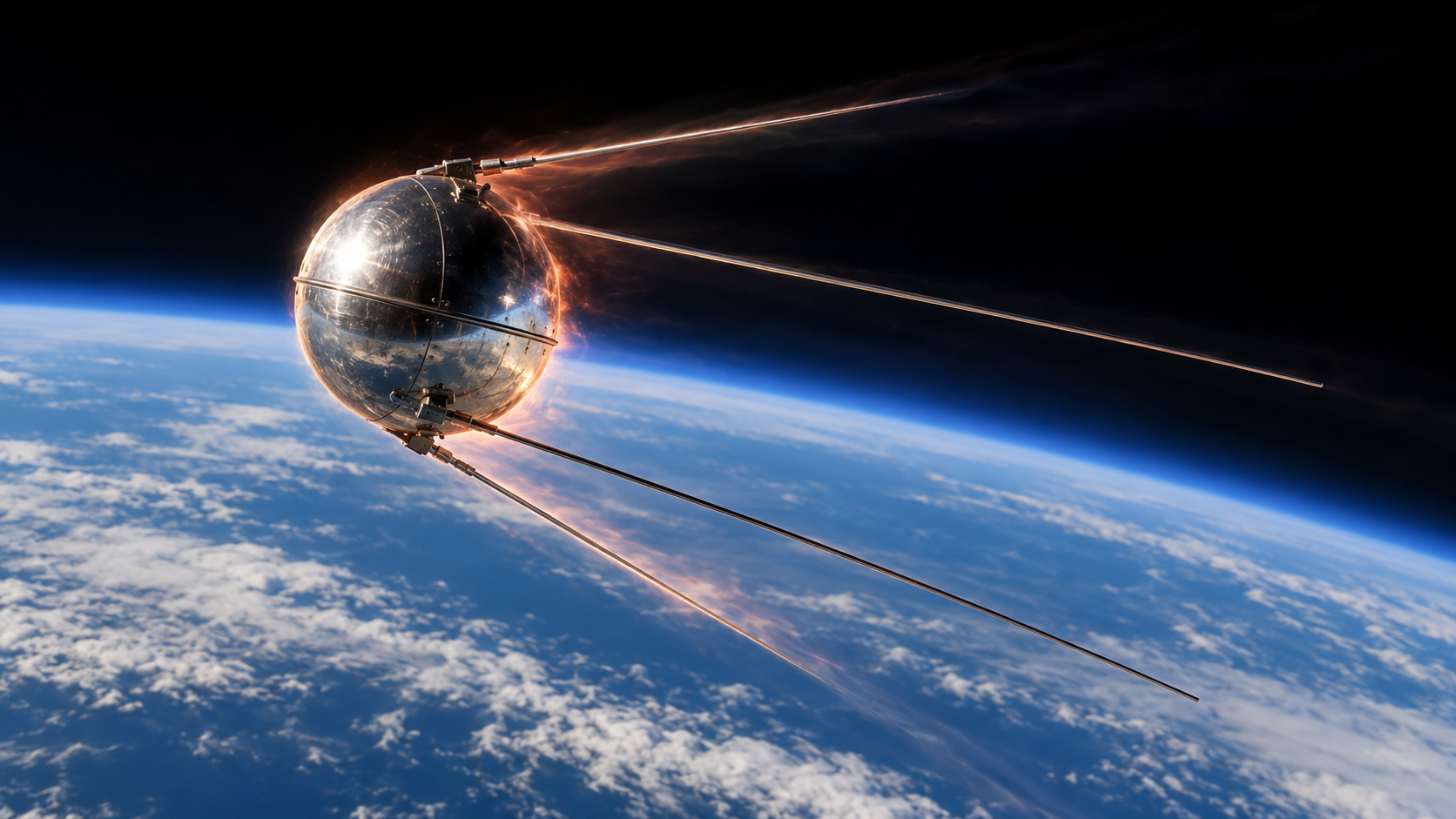
On January 4, 1958, Sputnik 1 fell from orbit and burned up in Earth’s atmosphere, ending the flight of the world’s first artificial satellite. The Soviet Union had launched the polished aluminum sphere from the site now known as Baikonur Cosmodrome on October 4, 1957. Measuring about 58 centimeters across and weighing roughly 84 kilograms, Sputnik was simple by later standards. Four long antennas extended from its pressurized body, and radio transmitters sent a repeating signal that professional and amateur observers could detect around the world. Its orbit carried it around Earth in a little more than an hour and a half, proving that an engineered object could remain in sustained free fall around the planet.
The transmitters stopped after their batteries ran down on October 26, but the silent satellite kept circling for more than two additional months. Each pass through the thin upper atmosphere created a small amount of drag. That resistance gradually lowered Sputnik’s orbit until reentry became unavoidable. The satellite was not designed to survive the heating and mechanical stress of its descent, and no recoverable fragment was expected to reach the ground. Its January 4 disappearance was therefore not a malfunction or a separate experiment; it was the natural conclusion of a low-orbit mission with no propulsion system for maintaining altitude.
Although Sputnik carried no conventional scientific instrument package, its flight supported important observations. Tracking the satellite and its spent rocket stage helped researchers study the density of the upper atmosphere, while changes in the radio signal offered information about propagation through the ionosphere. The achievement also exposed limitations. The beacons operated for only about three weeks, the satellite could not maneuver, and the bright object many people saw was often the much larger rocket stage rather than Sputnik itself. Still, the mission established the basic techniques of launch, orbital tracking, radio reception, and lifetime prediction that later satellite science would refine.
Sputnik’s political effect outlasted its physical presence. Its launch shocked the United States, intensified the Cold War competition in science and engineering, and encouraged new spending on research, education, and missile and space technology. Congressional hearings and government planning contributed to the creation of NASA in 1958, while the Soviet program moved quickly to more ambitious spacecraft. By the time Sputnik 1 reentered on January 4, the central fact it demonstrated could not be reversed: Earth had acquired an artificial satellite, and orbit had become a practical place for scientific instruments, communications systems, weather observation, and exploration.
Sputnik 1 was a polished pressurized sphere with four whip antennas and radio transmitters, intentionally simpler than the larger scientific satellite first planned.
Its compact design allowed the Soviet team to launch quickly while still proving that an object and its signals could be tracked in orbit.
Even high above the surface, traces of atmosphere slowed the satellite on every orbit and gradually reduced its altitude.
With no propulsion to raise its path, reentry after three months was expected; the craft was not built to survive or be recovered.
Sputnik accelerated satellite development and transformed public expectations about science, education, national security, and exploration.
Its brief flight helped make orbital tracking and upper-atmosphere research foundations of the space programs that followed.
Explore more of "On This Day ..."
Discover more events from the same date across news, politics, technology, sports, and other fields. Each link highlights significant moments that shaped history on different fronts.