

On This Day in Science: January 3, 2004
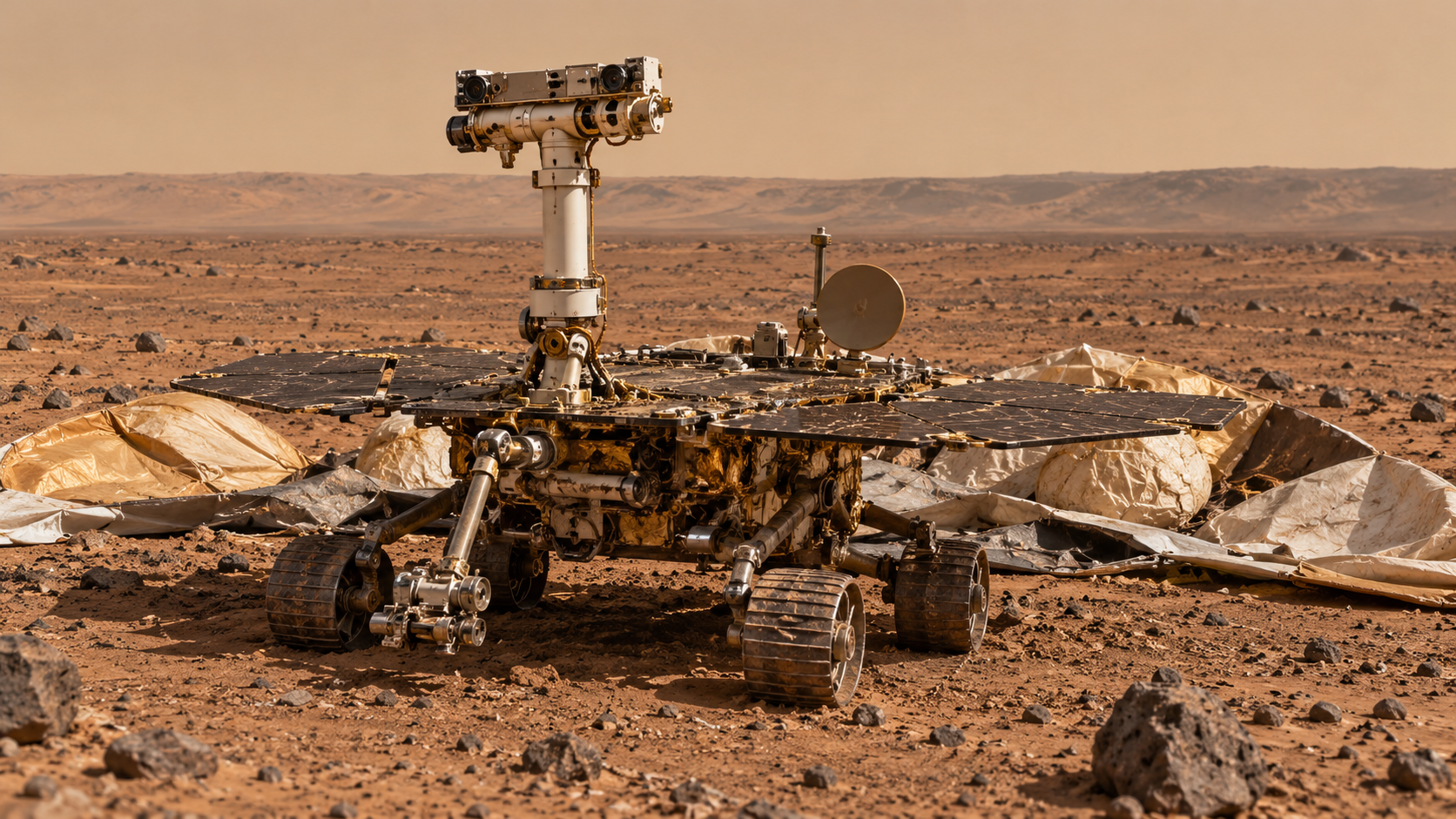
On January 3, 2004, at 8:35 p.m. Pacific time, NASA’s Spirit rover reached the surface of Mars inside Gusev Crater. The landing ended a seven-month journey that began at Cape Canaveral and placed a mobile robotic geologist on a plain scientists suspected might preserve evidence of an ancient lake. Spirit approached inside a protective aeroshell, deployed a parachute in the thin Martian atmosphere, dropped its heat shield, and descended on a tether. Retrorockets slowed the final approach before inflated airbags cushioned the lander. The package struck the ground at about 14 meters per second, bounced 28 times, and rolled to a stop several hundred meters from its first impact point.
The rover came to rest about 13 kilometers from its planned target, safely within Gusev Crater. After the airbags deflated, the petal-shaped lander opened and exposed Spirit’s solar panels. The spacecraft began sending engineering data and images through NASA orbiters, and the landing site was named Columbia Memorial Station in honor of the seven astronauts lost aboard space shuttle Columbia in 2003. Spirit was designed as a field geologist: panoramic cameras surveyed the terrain, spectrometers identified minerals, a microscopic imager examined textures, and a rock abrasion tool brushed or ground away weathered surfaces so instruments on the robotic arm could study fresher material beneath.
The initial mission was planned for only 90 Martian days. Gusev’s floor did not immediately reveal the lake sediments researchers had hoped to find; many nearby rocks were volcanic and showed limited alteration by water. Spirit’s mobility changed the scientific picture. After driving to the Columbia Hills, the rover encountered minerals and rock textures that recorded a more complicated wet history, including goethite, sulfate salts, carbonate-rich material, and nearly pure silica exposed when a damaged wheel dragged through the soil. Those discoveries pointed to environments influenced by water, including possible hot springs or steam vents, without proving that life had existed there.
Spirit ultimately operated for more than six years and traveled 7.73 kilometers, far exceeding its design life. It survived dust, steep slopes, computer faults, and a failed wheel before becoming embedded in soft soil in 2009. NASA last heard from it in March 2010 and ended recovery efforts in 2011. The rover’s January 3 landing opened a sustained era of mobile Martian geology. Spirit showed that a machine could navigate another planet, select targets, and build a regional history from many small observations, while its long life gave engineers experience that shaped later rovers including Curiosity and Perseverance.
Mars' thin atmosphere required a sequence of aeroshell protection, parachute braking, retrorockets, and airbags; no single system could slow the lander safely on its own.
Spirit bounced repeatedly before stopping, then relied on unfolding petals to right the lander and expose the rover and its solar arrays.
Cameras and spectrometers let Spirit work like a field geologist, linking broad landscapes to the mineral and chemical properties of individual rocks and soils.
Gusev's crater floor first appeared mostly volcanic, so the rover had to travel to the Columbia Hills before finding stronger evidence of past water.
Spirit's six-year operating life multiplied the number of landscapes and seasonal conditions the mission could examine far beyond its original plan.
Its discoveries and engineering lessons helped establish mobile surface exploration as a central method for investigating Mars' environmental history.
Explore more of "On This Day ..."
Discover more events from the same date across news, politics, technology, sports, and other fields. Each link highlights significant moments that shaped history on different fronts.