

On This Day in Science: January 8, 1973
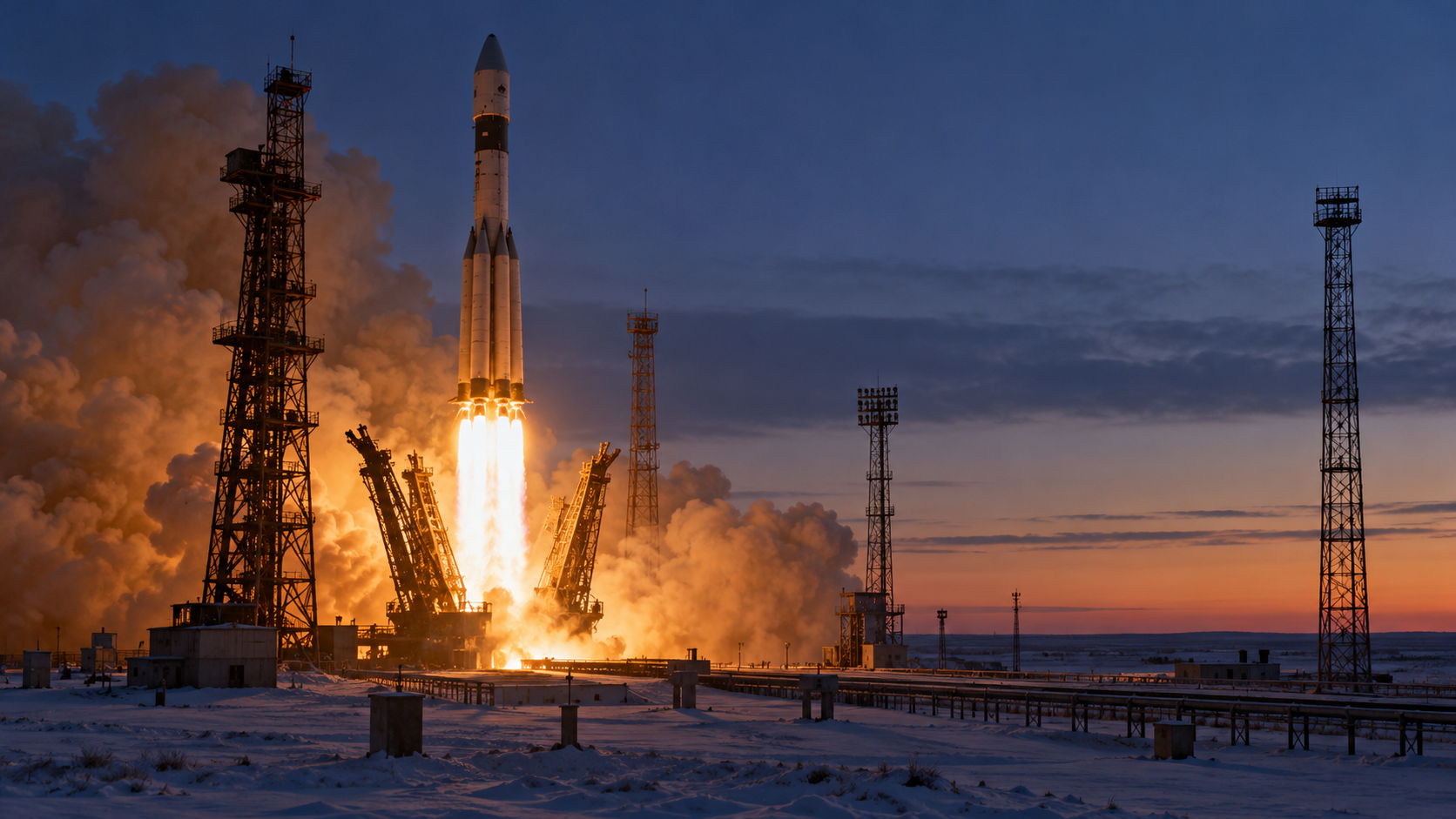
On January 8, 1973, the Soviet Union launched Luna 21 from the Baikonur Cosmodrome with the eight-wheeled Lunokhod 2 rover folded inside its landing stage. The Proton-K rocket sent the nearly six-ton spacecraft toward the Moon at 06:55 UTC. The mission followed Lunokhod 1, which had demonstrated that operators on Earth could drive a robotic laboratory across the lunar surface. Luna 21 aimed to extend that achievement with improved television cameras, scientific instruments, and a route through the geologically varied region around Le Monnier crater on the eastern edge of Mare Serenitatis.
After a midcourse correction, Luna 21 entered lunar orbit on January 12 and landed on January 15. Ramps unfolded from the lander, and Lunokhod 2 rolled onto the surface the next day. A five-person driving team on Earth relied on television images that arrived after the delay imposed by the Earth-Moon distance. The rover stopped for imaging and measurements, then waited through frigid lunar nights with a radioisotope heater protecting its systems. Its instruments included an x-ray spectrometer, magnetometer, radiation detector, soil-mechanics tools, and a French-built laser retroreflector.
Lunokhod 2 traveled about 39 kilometers during roughly four months of operation, a remarkable distance for its era. It examined soil properties, magnetic conditions, solar x-rays, and the local landscape while transmitting tens of thousands of television images and panoramic views. The drive was not effortless. Operators had to judge slopes and obstacles from narrow views, and dust gradually affected the vehicle. In May the rover entered a crater, apparently brushed its open lid against the wall, and carried abrasive lunar soil onto equipment and radiators. Rising temperatures eventually ended communications.
The January 8 launch helped establish mobile robotic fieldwork as a durable method of planetary exploration. Lunokhod 2 showed that a rover could combine movement with repeated measurements, using terrain decisions made by a remote team rather than following a fixed lander program. Its laser reflector remains scientifically useful for ranging experiments, and later missions refined the same basic partnership among cameras, onboard hardware, and human planning. Although the Soviet lunar program ended soon afterward, Luna 21 and its rover left a practical blueprint for the machines that now cross the Moon and Mars. Its traverse also demonstrated the scientific advantage of linking distant sites, allowing researchers to compare terrain instead of treating one landing spot as representative of an entire world. Modern orbital images have since helped place that ground route into a wider geological context.
Luna 21 carried Lunokhod 2 to lunar orbit and then made a soft landing before deploying ramps for the rover.
The lander and rover formed a single system for delivery, communications, power management, and science operations.
Controllers steered from television images, pausing often because each command and response crossed the Earth-Moon distance.
The rover survived lunar nights with a heater and resumed travel when sunlight again powered its solar array.
Lunokhod 2 covered about 39 kilometers and returned extensive imagery and measurements of soil, radiation, magnetism, and terrain.
Its success helped prove that mobile laboratories could examine many sites instead of being limited to one landing point.
Explore more of "On This Day ..."
Discover more events from the same date across news, politics, technology, sports, and other fields. Each link highlights significant moments that shaped history on different fronts.