

On This Day in Science: February 3, 1966
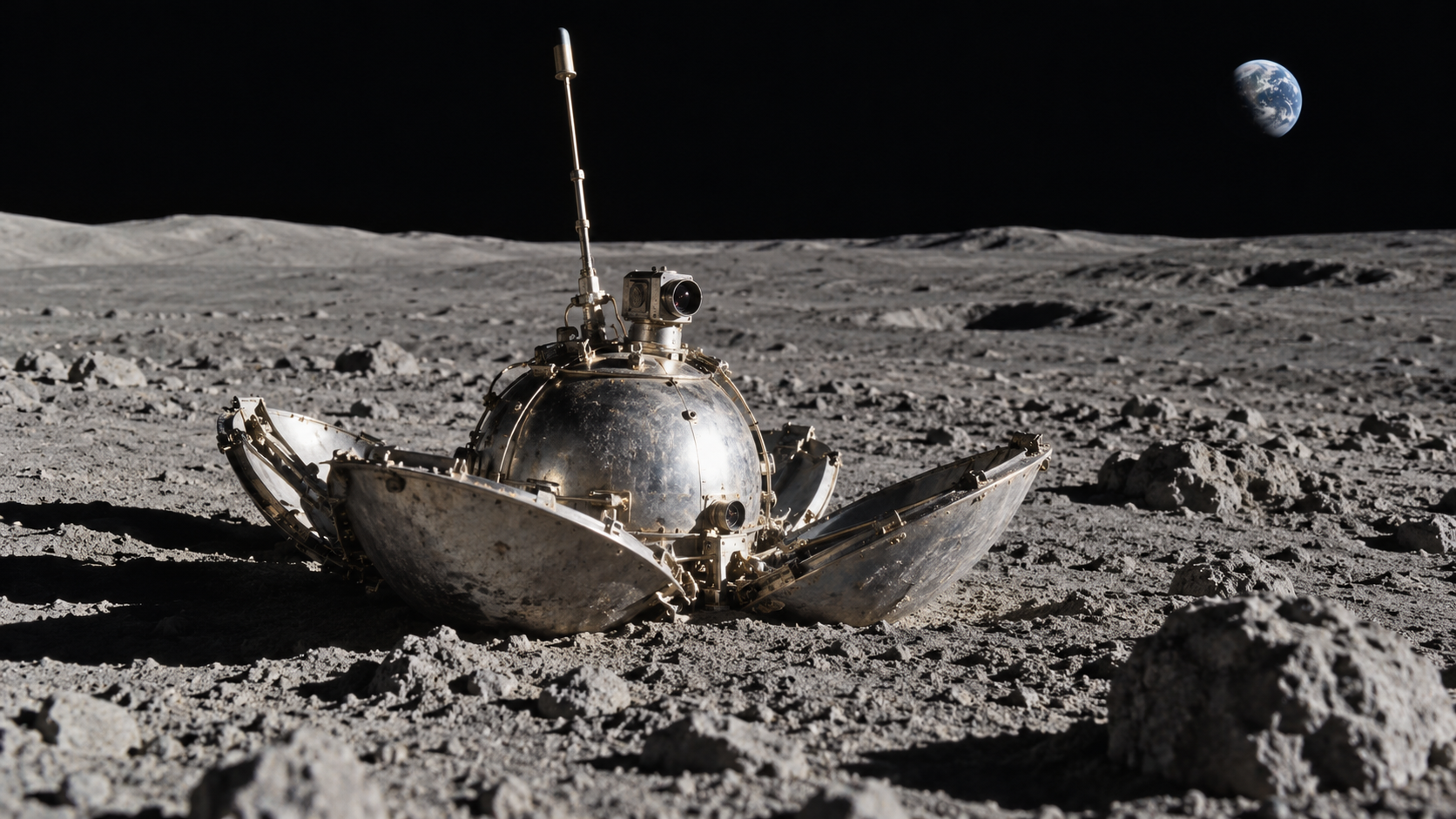
On February 3, 1966, the Soviet spacecraft Luna 9 became the first human-made vehicle to make a survivable soft landing on another world. After a flight of roughly three and a half days, its landing capsule descended into Oceanus Procellarum, the Ocean of Storms. A retrorocket slowed the approach, and an airbag-protected capsule separated just above the surface. It bounced, rolled, opened four petal-like panels, and began transmitting. Earlier lunar probes had flown past, orbited, or struck the Moon; Luna 9 was the first to arrive gently enough to operate from the ground.
The achievement settled a practical question that had shadowed lunar planning. Some researchers had worried that the Moon might be covered by a deep layer of loose dust capable of swallowing a lander. Luna 9 remained stable. Its panoramic television system scanned the surrounding terrain, revealing nearby rocks, shallow depressions, and a firm surface. The images were assembled line by line from radio signals received on Earth. Although the little station operated for only several days, it returned multiple panoramas and environmental measurements that proved a spacecraft could stand and work on the lunar surface.
Luna 9 was the successful result of repeated attempts. The Soviet program had lost several predecessor vehicles to launch failures, upper-stage problems, and missed trajectories. Engineers refined guidance, communications, braking, and the rugged landing package through that difficult sequence. The final craft was compact: a descent stage handled the braking maneuver while the roughly spherical automatic lunar station carried its cameras and radio equipment. Its deployment system used the petals as both protective covers and stabilizing legs, a solution well suited to an unknown landscape.
The landing came during an intense competition in lunar exploration, four months before the American Surveyor 1 achieved its own soft landing. Together, these robotic missions supplied the surface knowledge needed for later human expeditions. Luna 9’s importance reaches beyond the space race. It demonstrated a complete chain that every planetary lander must still master: navigate across interplanetary distance, shed enormous speed, survive contact, establish a stable platform, and send interpretable data home. The first pictures taken from the Moon’s surface turned a distant disk into a place where an instrument could arrive, look around, and report. The anniversary also highlights the difference between a first result and a finished understanding. A successful observation can settle one question while opening several harder ones, and even a failed objective can return measurements that reshape later designs. Preserved data, specimens, photographs, and hardware allow new generations to revisit the work with better tools. Science advances through that continuity, where a specific date marks progress without pretending that inquiry stopped there.
Luna 9 touched down in Oceanus Procellarum and became the first spacecraft to operate after landing on another celestial body.
An airbag system cushioned the capsule before four petals opened to stabilize the station.
A rotating television camera scanned the horizon and transmitted panoramic views line by line.
The images showed that the lunar surface was firm enough to support a lander rather than a bottomless dust layer.
Success followed a long series of Soviet attempts that tested launch vehicles, guidance, braking, and communications.
Luna 9 helped establish the engineering pattern later used by robotic explorers across the solar system.
Explore more of "On This Day ..."
Discover more events from the same date across news, politics, technology, sports, and other fields. Each link highlights significant moments that shaped history on different fronts.