

On This Day in Science: January 25, 1983
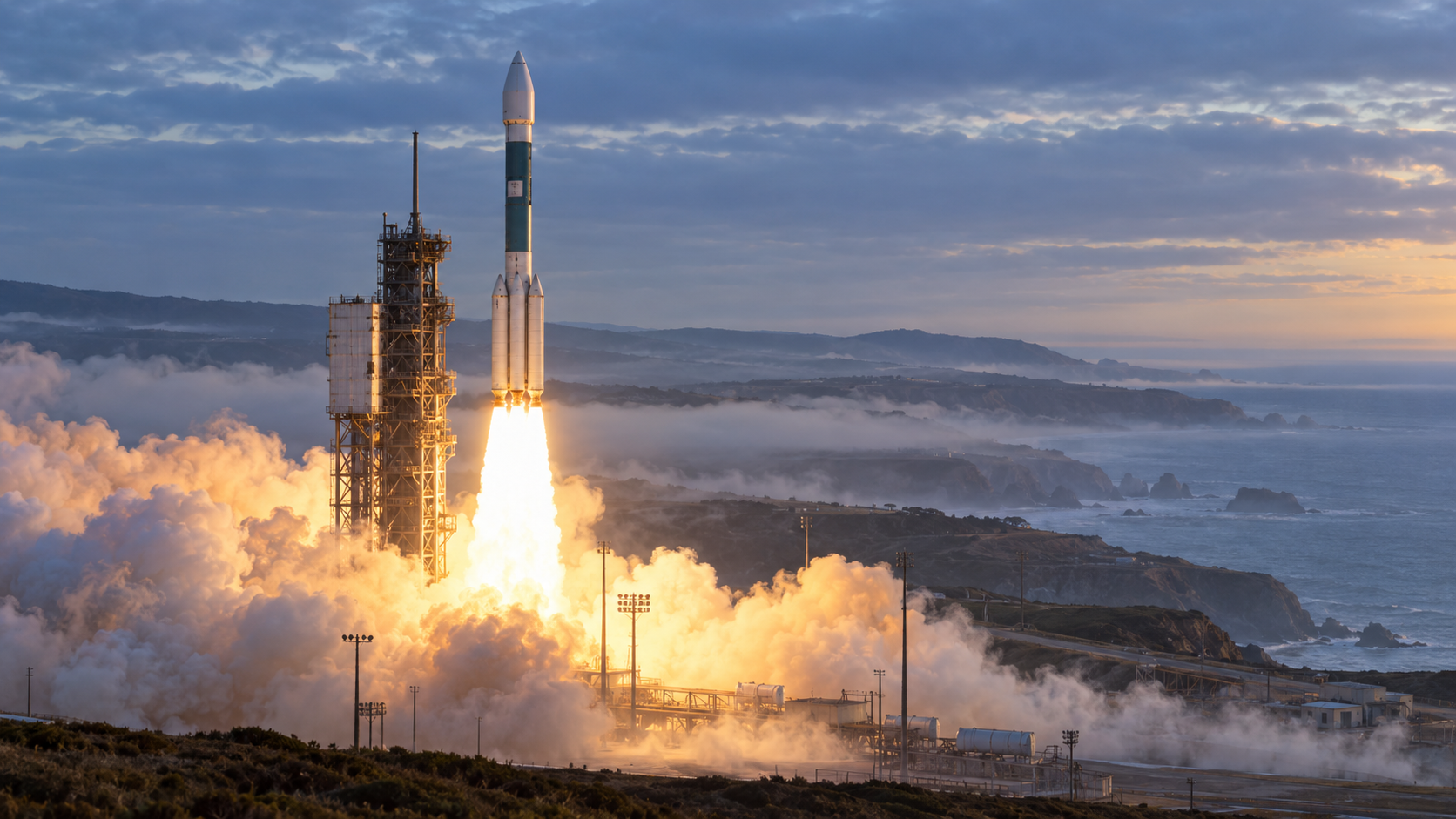
On January 25, 1983, the Infrared Astronomical Satellite, or IRAS, launched from Vandenberg Air Force Base to conduct the first survey of nearly the entire sky in infrared light from space. The mission was a partnership among the United States, the Netherlands, and the United Kingdom. Earth’s atmosphere absorbs many infrared wavelengths and its own heat overwhelms faint cosmic signals, so an orbital telescope offered a much clearer view. IRAS also cooled its detectors and telescope with superfluid helium to about 2.5 degrees above absolute zero, making the observatory colder than the objects it measured.
IRAS circled Earth in a near-polar orbit while scanning strips of sky in four broad infrared bands. Repeated coverage allowed the team to reject moving objects and noise, confirm sources, and assemble an atlas. The mission was limited by its supply of liquid helium: when the coolant ran out in November, useful observations ended after about ten months. That short lifetime was enough to catalog roughly 350,000 infrared sources and map about 96 percent of the sky. Its success came from systematic coverage rather than prolonged attention to a small group of targets.
The survey revealed dusty galaxies, star-forming regions hidden inside dark clouds, debris disks around nearby stars such as Vega and Fomalhaut, and six comets. Infrared light traces relatively cool objects and can pass through dust that blocks visible light, so IRAS exposed structures that optical surveys missed. The excess emission around Vega supplied early evidence that other stars possess planet-forming or collision-produced disks. The catalog also gave astronomers a target list for later observatories, multiplying the scientific return long after the satellite stopped operating.
IRAS established the value of a cold space telescope and a public all-sky archive. Later missions including the Infrared Space Observatory, Spitzer, Herschel, WISE, and the James Webb Space Telescope used more sensitive instruments and finer resolution, but they inherited both targets and engineering lessons from IRAS. Its January 25 launch opened a sky that had been present all along yet largely hidden by Earth’s atmosphere and interstellar dust. In less than a year, the observatory changed the census of the universe and demonstrated how a comprehensive survey can generate questions for decades of focused research. Cross-checking modern observations against the 1983 atlas can also reveal objects whose brightness or surroundings have changed over time. The original catalog therefore functions as both a map and a dated measurement of the infrared universe.
Warm instruments emit infrared radiation, so superfluid helium cooled IRAS enough to detect faint cosmic heat.
Operating above the atmosphere also removed much of the absorption and glow that limit ground-based infrared work.
IRAS scanned repeated strips from a polar orbit and covered about 96 percent of the sky before its coolant was exhausted.
The resulting catalog contained roughly 350,000 sources, far more than astronomers could study individually during the mission.
Infrared wavelengths revealed star-forming clouds, dusty galaxies, comets, and disks around nearby stars.
The public survey became a roadmap for later observatories with sharper vision and longer wavelength coverage.
Explore more of "On This Day ..."
Discover more events from the same date across news, politics, technology, sports, and other fields. Each link highlights significant moments that shaped history on different fronts.