

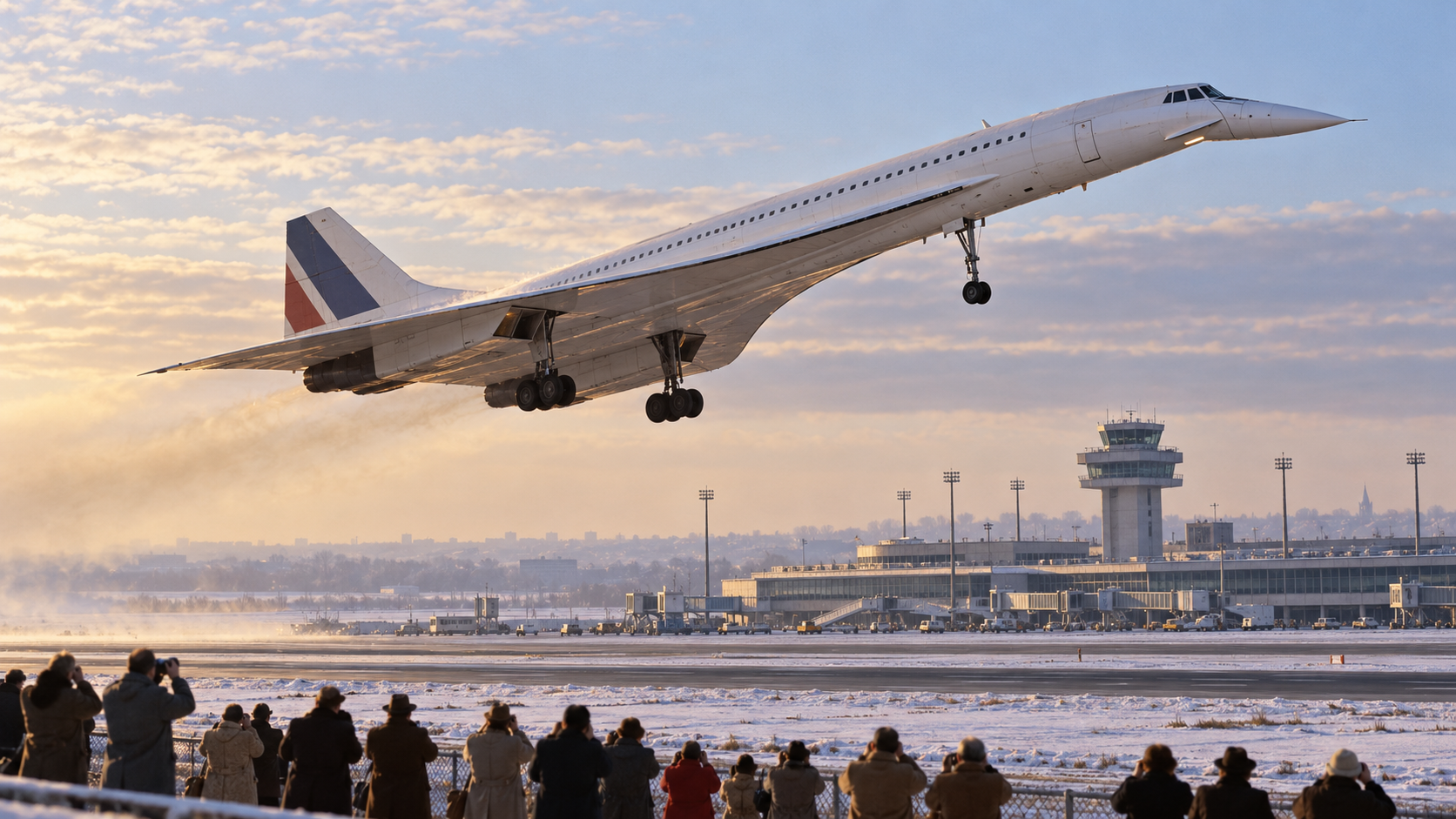
On This Day in Science: January 21, 1976
On January 21, 1976, Concorde began scheduled passenger service in coordinated flights by British Airways and Air France. British Airways flight BA300 departed London Heathrow for Bahrain, while an Air France Concorde left Paris for Rio de Janeiro via Dakar. The services opened a new era in which paying passengers could cruise at about Mach 2, twice the speed of sound, at altitudes near 60,000 feet. The journeys followed years of Anglo-French development, prototype flights, certification work, and route proving for an aircraft that demanded solutions unlike those of conventional airliners.
Concorde’s long, narrow fuselage and slender delta wing were shaped for efficient supersonic travel. Four Olympus 593 turbojet engines used afterburning for takeoff and acceleration, while movable intake ramps slowed supersonic air before it entered the engines. The famous drooping nose gave pilots a view of the runway during takeoff and landing, then raised to streamline the aircraft in cruise. Heat from air friction lengthened the fuselage by several inches, so materials, paint, fuel distribution, and cabin systems all had to accommodate repeated thermal expansion.
Speed produced tradeoffs. Concorde carried only about one hundred passengers, consumed large amounts of fuel, generated a sonic boom, and required high fares. Noise concerns restricted overland supersonic flight and delayed access to important U.S. routes. The Soviet Tu-144 had flown earlier and briefly carried passengers, but Concorde became the only long-running supersonic passenger service. It eventually concentrated on transatlantic routes, where it could cross between Europe and New York in under four hours. Technically impressive performance did not make the design economical for mass transportation.
Air France and British Airways retired Concorde in 2003 after twenty-seven years of service, influenced by operating costs, fleet age, demand, and the aftermath of the 2000 Air France crash. The January 21 inauguration remains a rare moment when commercial transportation took a dramatic step faster and later stepped back. Current supersonic research focuses on quieter sonic booms, efficiency, emissions, and materials rather than simply repeating Concorde. Its legacy is therefore both inspiration and engineering evidence: exceptional speed can be achieved, but a transport system succeeds only when performance, safety, economics, and environmental effects work together. The aircraft’s preserved examples now allow engineers and the public to examine that compromise in physical form. They also show how passenger experience, airport access, and maintenance belong inside any definition of technological success. Those lessons remain relevant as companies again pursue civilian supersonic flight.
British Airways flew from London to Bahrain while Air France opened service from Paris to Dakar and Rio.
The paired departures reflected the equal British-French partnership that designed and built the aircraft.
Delta wings, variable engine intakes, afterburning turbojets, and a drooping nose solved different phases of supersonic flight.
Thermal expansion affected the entire airframe, requiring systems and materials designed for repeated heating and cooling.
Concorde cut transatlantic time dramatically but carried few passengers, burned substantial fuel, and could not fly supersonically over most land.
Its career shows that a technological achievement can remain commercially narrow when economics and environmental limits dominate.
Explore more of "On This Day ..."
Discover more events from the same date across news, politics, technology, sports, and other fields. Each link highlights significant moments that shaped history on different fronts.