

On This Day in Science: January 29, 1989
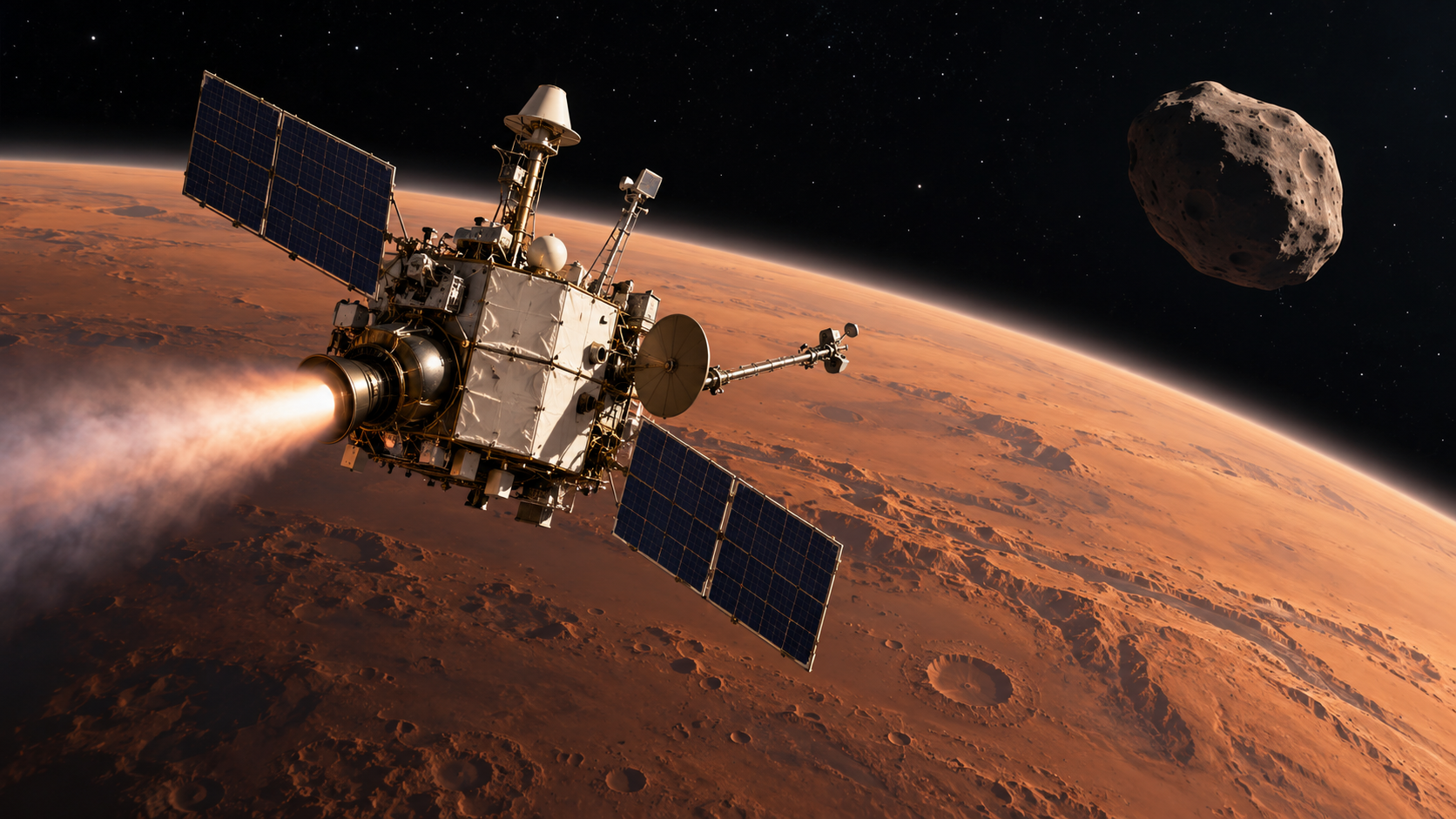
On January 29, 1989, the Soviet spacecraft Phobos 2 fired its engine and entered orbit around Mars. Launched the previous July, it was the second of two ambitious probes designed to study Mars and make close observations of the planet’s larger moon, Phobos. The first spacecraft, Phobos 1, had been lost en route after an incorrect ground command disabled attitude control. Phobos 2 survived its cruise despite transmitter problems and arrived with an international instrument package contributed by organizations across Europe and the Soviet Union.
Initial orbit insertion placed the spacecraft in a highly elliptical path, followed by corrections that gradually aligned it for encounters with Phobos. Instruments examined the Martian atmosphere, plasma environment, magnetic conditions, surface temperatures, and mineral signatures. Cameras returned thirty-seven detailed images of Phobos and mapped much of the small moon. The plan was unusually complex: the orbiter would approach within tens of meters, release a stationary lander, and deploy a small hopping vehicle capable of moving across the low-gravity surface.
Phobos 2 never completed that final phase. On March 27, during preparations for close operations, communication ended. A weak carrier signal suggested the spacecraft had lost orientation, and later analysis pointed toward failures in its onboard computer system. Without stable pointing, solar arrays could not maintain power and antennas could not face Earth. The loss came shortly before lander deployment, leaving the most dramatic objectives unrealized. Even so, the images and remote measurements added important information about Phobos and Mars after a long gap in successful Soviet Mars exploration.
The mission illustrates why partial success matters in planetary science. Orbit insertion, international instruments, Mars observations, and close imaging all worked; autonomous proximity operations and landing did not. Later missions used improved navigation and computing to examine Phobos from Mars orbit, while sample-return proposals continue to target the moon as a record of material moving through the Martian system. The January 29 arrival should neither be called a complete triumph nor dismissed as a failure. Phobos 2 expanded knowledge and exposed the engineering difficulty of operating beside a tiny, irregular moon where weak gravity makes every maneuver delicate. Its surviving data also preserve a snapshot of Mars before later orbiters began continuous, high-resolution monitoring. Revisiting those measurements can connect separate generations of missions into a longer record. That continuity matters because atmospheric and surface conditions change across Martian seasons and years. Partial records can still answer future questions.
Phobos 2 carried instruments from numerous countries to study Mars, its space environment, and its inner moon.
The collaboration broadened the science even though the spacecraft and launch system were Soviet.
The spacecraft adjusted its Mars orbit for increasingly close passes and planned to deploy both a lander and a hopping robot.
Operating near a small irregular moon demanded precise navigation because its gravity was far too weak for conventional orbiting.
Thirty-seven detailed images mapped much of Phobos, while other instruments returned data on Mars and its environment.
Losing the spacecraft before deployment left the mission incomplete but did not erase the observations already delivered.
Explore more of "On This Day ..."
Discover more events from the same date across news, politics, technology, sports, and other fields. Each link highlights significant moments that shaped history on different fronts.