

On This Day in Science: February 19, 1986
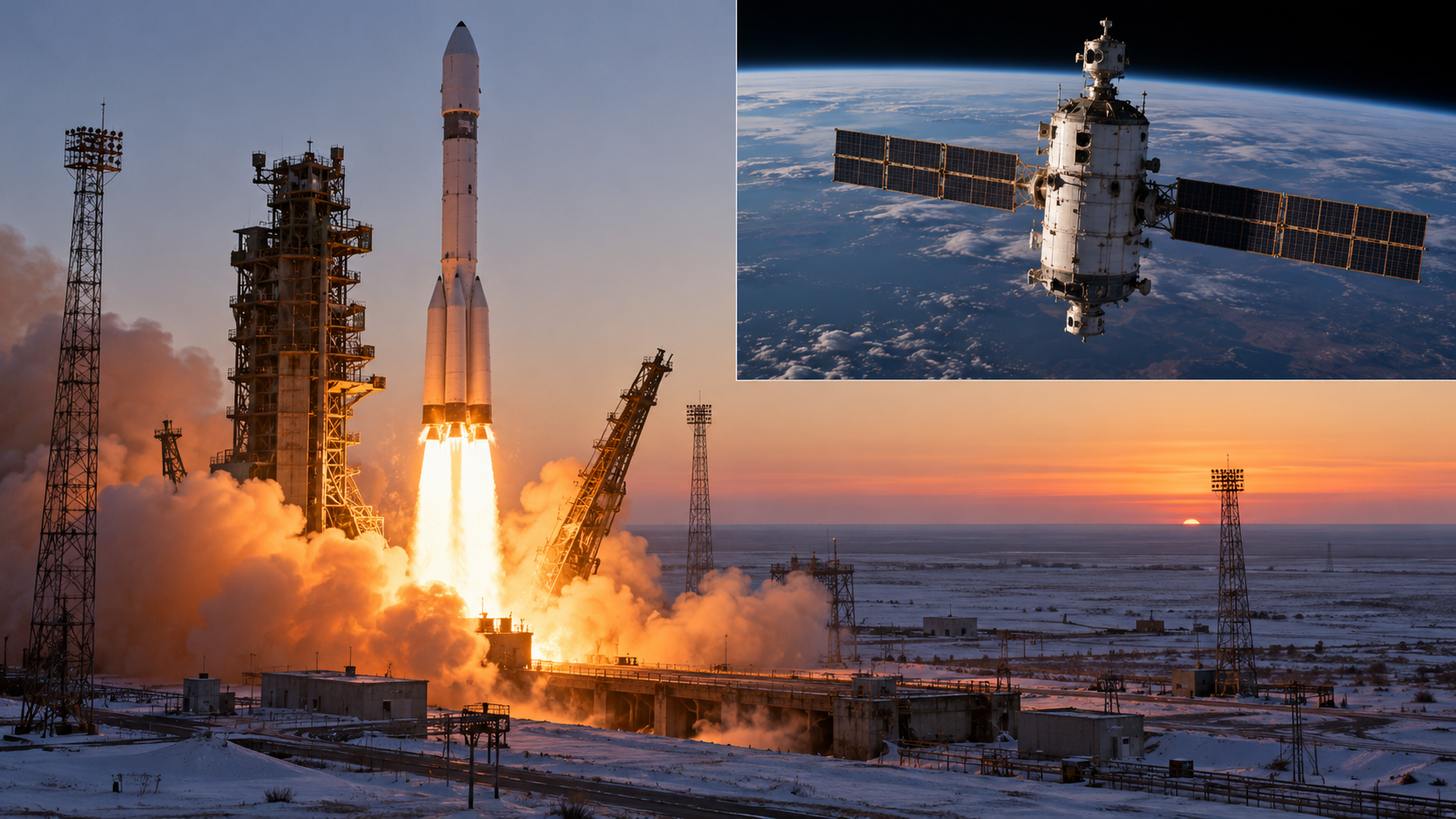
On February 19, 1986, a Proton rocket lifted the core module of Mir into orbit from the Baikonur Cosmodrome. The cylindrical spacecraft contained crew quarters, control systems, propulsion, communications, and docking ports that would support a station assembled over time. Its name meant both peace and world in Russian. Unlike earlier stations launched largely as complete units, Mir was designed as a modular complex. Additional laboratories and utility modules could arrive later, expanding capability while the original core continued to provide the station’s essential services.
The first crew reached Mir in March 1986 after briefly visiting the older Salyut 7 station, demonstrating an orbital transfer between inhabited complexes. Over the following decade, modules including Kvant, Kvant 2, Kristall, Spektr, and Priroda turned the core into a many-armed research outpost. Cosmonauts studied human physiology, astronomy, materials, Earth observation, and long-duration operations. Docked Soyuz crew vehicles and Progress cargo craft supplied transport, fuel, food, water, and equipment, making Mir dependent on a regular logistics chain.
Life aboard the station mixed scientific productivity with maintenance. Long missions revealed how bodies adapt to microgravity and how isolation, workload, and confined spaces affect crews. Mir also experienced equipment failures, leaks, computer problems, a serious fire, and a 1997 collision with a Progress vehicle. Crews and controllers learned to isolate modules, repair aging systems, and keep a complex spacecraft operating far beyond its original planned lifetime. Those experiences provided evidence about resilience as well as the costs of extending hardware in orbit.
After the Soviet Union dissolved, Mir became a platform for international partnership. American astronauts spent long stays aboard during the Shuttle-Mir program, while space shuttles docked with the station in preparation for the International Space Station. Mir was deliberately deorbited over the South Pacific in 2001 after fifteen years of operation. The core module’s launch marked the start of that continuous experiment in assembly, habitation, and cooperation. Its greatest contribution was not any single result but the accumulated knowledge of how people, machines, and institutions can sustain a laboratory that never returns to the ground for routine servicing. The anniversary also highlights the difference between a first result and a finished understanding. A successful observation can settle one question while opening several harder ones, and even a failed objective can return measurements that reshape later designs. Preserved data, specimens, photographs, and hardware allow new generations to revisit the work with better tools. Science advances through that continuity, where a specific date marks progress without pretending that inquiry stopped there.
Mir's core module carried living space, navigation, propulsion, communications, and multiple docking ports.
Later modules added specialized laboratories and equipment around that original hub.
Crews conducted long-duration research while maintaining systems that aged in the demanding orbital environment.
Fires, leaks, computer failures, and a collision forced astronauts and controllers to practice real-time recovery.
Mir hosted visitors from many countries and became central to the Shuttle-Mir cooperation program.
Its operational lessons influenced assembly and long-duration work aboard the International Space Station.
Explore more of "On This Day ..."
Discover more events from the same date across news, politics, technology, sports, and other fields. Each link highlights significant moments that shaped history on different fronts.