

On This Day in Science: February 21, 1947
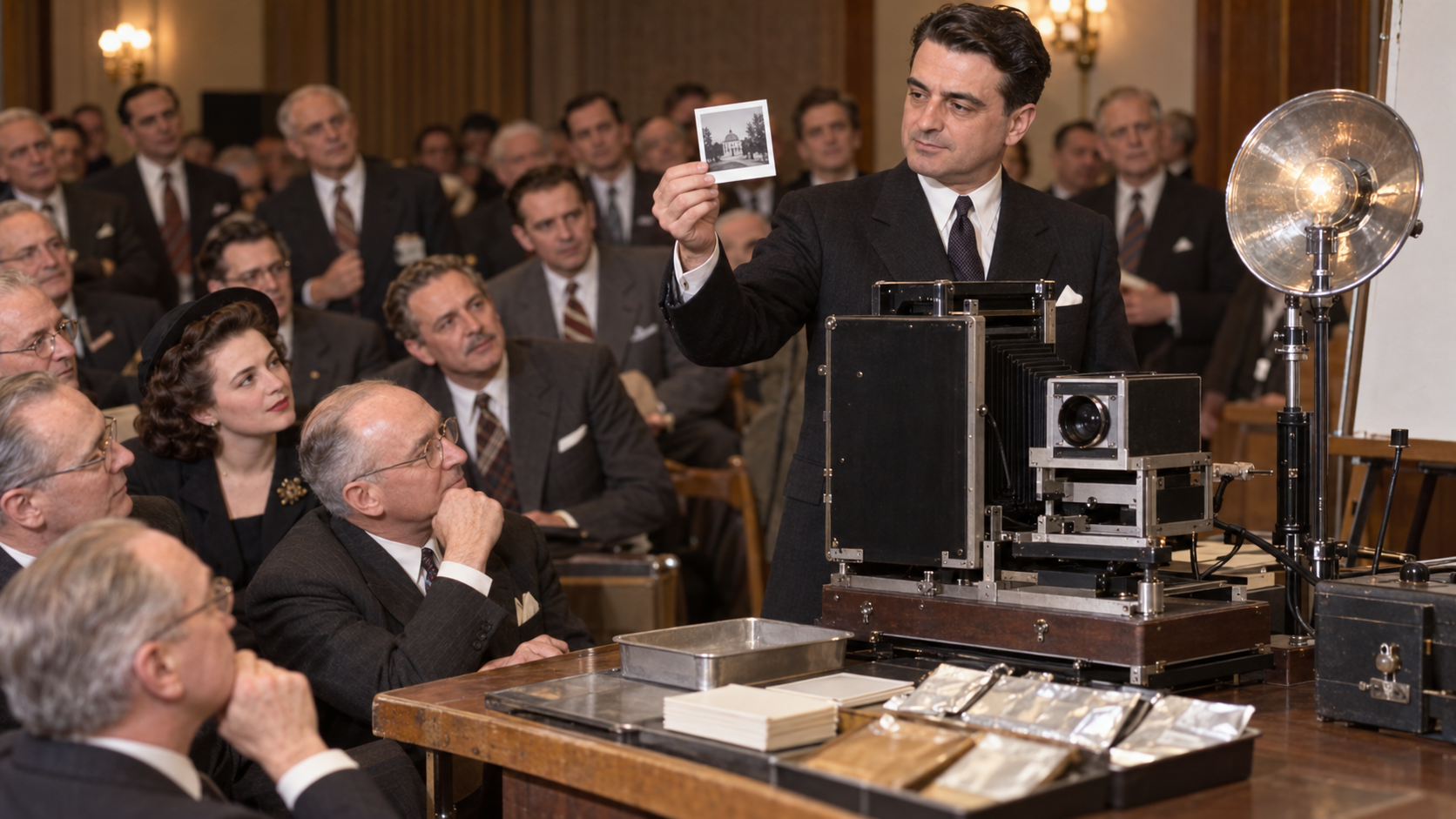
On February 21, 1947, Edwin H. Land demonstrated a new one-step photographic process at a meeting of the Optical Society of America in New York. Land exposed a photograph and produced a finished positive print in about a minute, without sending film to a darkroom. The demonstration grew from a question his young daughter had asked several years earlier: why could she not see a picture immediately after it was taken? Land, already known for developing polarizing materials, turned that simple impatience into a problem spanning optics, chemistry, film manufacture, and camera design.
Conventional photography separated exposure from development. A negative had to be processed in darkness, then used to make a positive print through additional chemical steps. Land’s system packaged negative material, positive receiving paper, and chemical reagent so that rollers inside the camera could spread the developer evenly after exposure. The image-forming chemicals moved through the sandwiched layers while the user waited. Peeling the materials apart revealed the print. Achieving reliable results required controlling reaction time, temperature, coating thickness, pressure, and the movement of silver compounds.
The first commercial Polaroid Land Camera, the Model 95, reached a Boston department store in 1948 and sold out quickly. Early prints were sepia-toned, with black-and-white and color processes improving over time. Instant photography became useful in households, medicine, science, identification, industry, and art because the result could be evaluated while the subject and camera were still present. A photographer could correct lighting, composition, or focus immediately, changing the rhythm of picture-making long before electronic screens offered the same feedback.
Land’s February demonstration was not simply a faster camera. It reorganized a laboratory process into a self-contained material system ordinary users could operate. Later instant films became increasingly sophisticated, culminating in integral packs that developed in the open without a peel-apart step. Digital imaging eventually displaced much of the market, but the desire Land addressed did not disappear; it became a defining expectation of modern cameras and phones. Instant photography showed how an invention can succeed by compressing distance between action and knowledge, allowing the photographer to see, learn, and try again while the moment is still near. For science history, the episode is also a case study in how evidence moves from an observation or engineered test into a durable body of knowledge. Instruments supplied measurements, specialists debated interpretation, and later work refined what the first result could mean. Archives preserve the early record while new methods let researchers ask different questions of it. That continuing revision is not a weakness in the original achievement; it is the process through which a dated milestone remains scientifically useful.
Land's public demonstration combined camera, film, and chemistry to deliver a positive print without a darkroom.
The process placed the developing reagent between negative and receiving layers as the print passed through rollers.
Uniform coatings, precise pressure, timing, and temperature were all necessary for a dependable image.
The invention turned several laboratory operations into a sequence performed by the user after one exposure.
Commercial instant cameras let photographers evaluate results while the subject and lighting were still available.
That immediate feedback anticipated a central convenience later associated with digital photography.
Explore more of "On This Day ..."
Discover more events from the same date across news, politics, technology, sports, and other fields. Each link highlights significant moments that shaped history on different fronts.