

How Quantum Tunneling Crosses Energy Barriers Explainer
In classical mechanics, a ball without enough energy to climb a hill will roll back. At quantum scales, an electron, proton, or other particle is described by a wavefunction that gives probabilities for possible measurement outcomes. When the wavefunction encounters an energy barrier, it does not necessarily stop abruptly at the boundary. Part of its amplitude extends into the barrier.
Inside a barrier higher than the particle’s energy, the wavefunction usually decays exponentially rather than propagating like an ordinary traveling wave. If the barrier is thin enough, some amplitude remains at the far side. A measurement can then find the particle beyond the barrier. The particle did not borrow energy or follow a hidden classical path over the top; the outcome follows from quantum evolution.
Tunneling probability falls rapidly as a barrier becomes wider or higher and as the particle’s mass increases. That is why tunneling is conspicuous for electrons and other light particles across nanometer-scale barriers but negligible for everyday objects. The process still conserves energy: the particle measured after tunneling has energy consistent with the state before the barrier, unless it exchanged energy with its environment.
Alpha decay is a natural example. An alpha particle is bound inside a nucleus by nuclear forces but has a small probability of tunneling through the surrounding barrier. The enormous number of nuclei in a sample turns that tiny probability into a measurable decay rate. Nuclear fusion in stars also depends on tunneling, which allows positively charged nuclei to approach despite electrical repulsion.
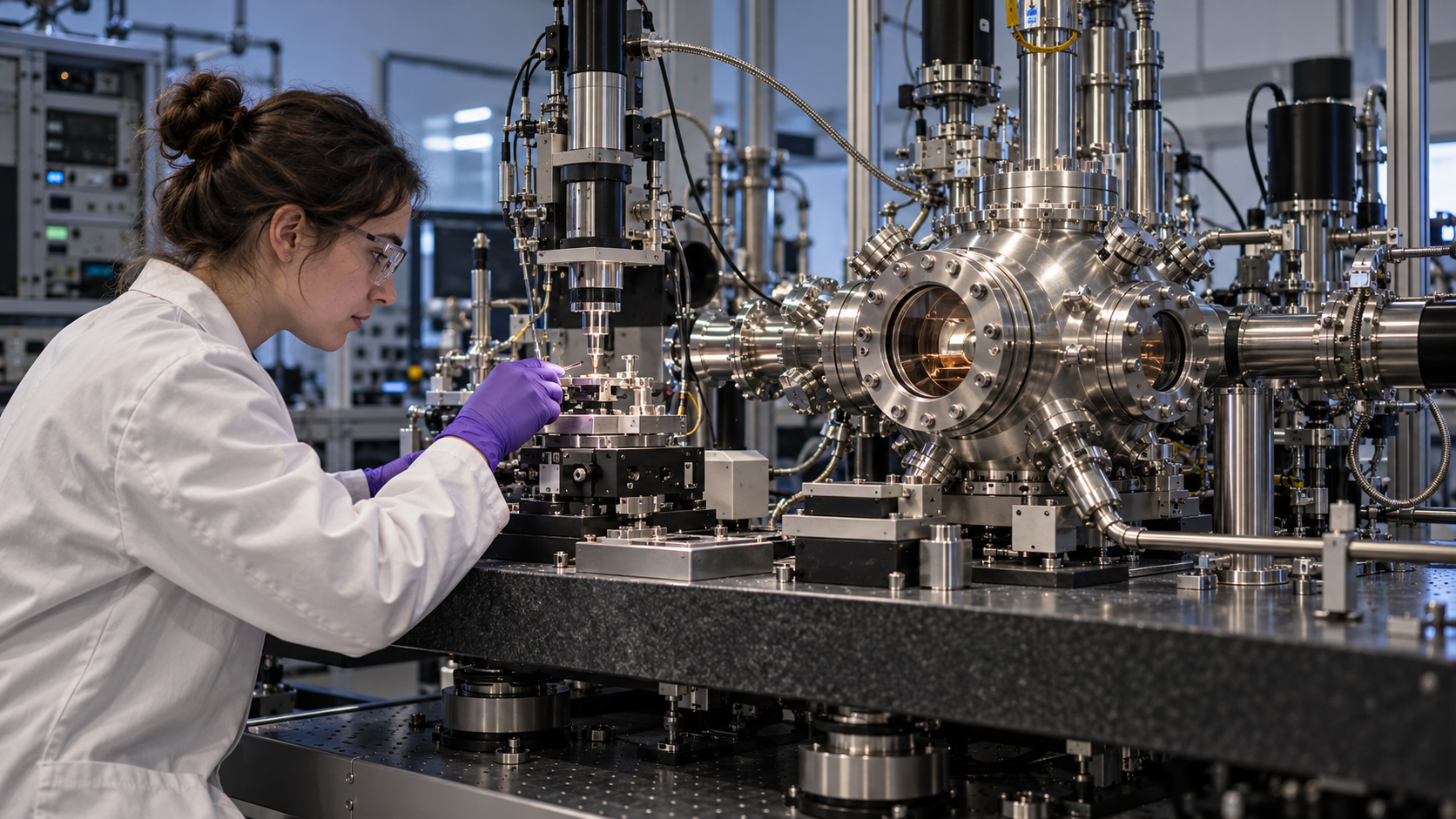
Engineers use tunneling in devices. A scanning tunneling microscope places a sharp conducting tip extremely close to a surface and measures a tunneling current that changes strongly with distance, revealing atomic-scale structure. Tunnel diodes and flash memory rely on controlled barriers, while unwanted tunneling can cause leakage as electronic components become extremely small.
Tunneling does not mean any wall can be crossed with a useful probability, and it does not permit faster-than-light communication. Descriptions of a particle’s exact route or time inside a barrier can become subtle because position and travel time are quantum measurement questions. The robust prediction is statistical: repeated preparations yield a specific transmission probability that experiments verify.
A quantum wavefunction extends into a classically forbidden barrier. If amplitude remains beyond it, a measurement can find the particle on the other side.
Tunneling is not a temporary energy loan. Quantum mechanics directly permits transmission probability while total energy remains conserved.
Transmission drops exponentially with barrier width and depends strongly on barrier height and particle mass. Everyday objects therefore have effectively zero tunneling probability.
The effect is probabilistic for individual events but yields precise rates when the same quantum state is prepared many times.
Alpha decay and stellar fusion depend on tunneling. Scanning tunneling microscopes, tunnel diodes, and memory devices put it to practical use.
Tunneling does not make all barriers permeable, reveal a simple classical path, or enable messages to outrun light.
Explore more "Explainers"
Discover additional explainers across politics, science, business, technology, and other fields. Each explainer breaks down a complex idea into clear, everyday language—helping you better understand how major concepts, systems, and debates shape the world around us.