

How Bees See Ultraviolet Patterns Explainer
Human color vision usually compares signals from receptors most sensitive to red, green, and blue wavelengths. Many bees use a different three-receptor system tuned broadly to ultraviolet, blue, and green. Ultraviolet light has shorter wavelengths than visible violet and is invisible to people, but it is part of the ordinary visual world for a bee moving among flowers.
Light enters a bee’s compound eyes, which contain many small units called ommatidia. Photoreceptor cells within those units contain light-sensitive pigments. The nervous system compares their responses to distinguish colors, edges, motion, and polarized light. Bees do not simply add ultraviolet as a fourth human color; their color space is built from a different set of receptor sensitivities.
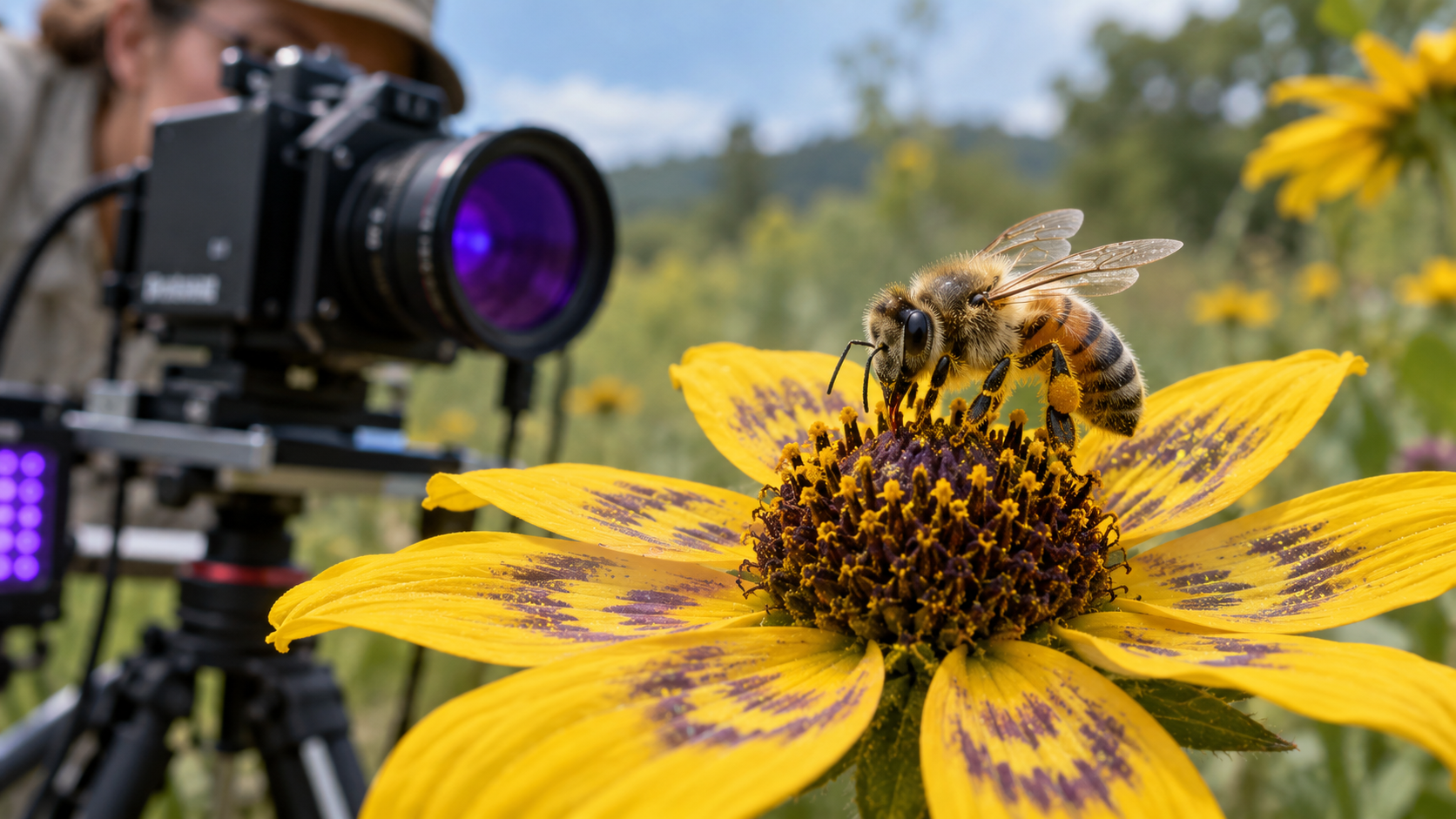
Flower petals may absorb and reflect ultraviolet unevenly. A bloom that looks uniformly yellow to a person can present a dark ultraviolet center surrounded by reflective petals to a bee. These patterns, often called nectar guides, can direct a visitor toward pollen, nectar, and the flower’s reproductive structures. Color, scent, shape, texture, and electrical cues can all work together.
Bees learn associations between visual patterns and rewards. Experiments train individuals to choose particular colors or shapes, then test how they respond when brightness or other cues change. Such work shows that color vision helps with flower constancy, navigation, landing, and recognition. Sensitivity varies across bee species, and not every flower has a dramatic ultraviolet bull’s-eye.
Sunlight is scattered and polarized in the atmosphere. Bees can detect patterns of polarized light, which may help them infer the Sun’s position when it is partly hidden. Their visual system also has high sensitivity to movement, useful during fast flight, but it does not resolve fine detail exactly as a human eye does. Vision is adapted to the animal’s tasks rather than ranked as simply better or worse.
Ultraviolet photographs made for people are false-color translations, because a screen cannot directly reproduce a sensation humans lack. Cameras also differ from bee eyes, so a UV image is not a literal record of bee experience. Still, measuring reflectance and receptor responses reveals how flowers communicate with pollinators in a channel that remains hidden to unaided human sight.
Bee eyes commonly compare ultraviolet-, blue-, and green-sensitive receptors. Human eyes use a different set, so the two species divide color space differently.
Compound eyes contain many ommatidia. Their signals support color, motion, orientation, and polarized-light detection.
Some petals have ultraviolet-reflective and ultraviolet-absorbing regions that guide bees toward nectar, pollen, and reproductive structures.
Bees learn which patterns predict rewards, and they integrate color with scent, shape, texture, and location.
Polarized skylight can help orientation. Fast motion sensitivity is strong, while fine spatial detail differs from human vision.
False-color UV photographs are useful translations, not direct pictures of a bee's subjective experience. Species and flowers also vary.
Explore more "Explainers"
Discover additional explainers across politics, science, business, technology, and other fields. Each explainer breaks down a complex idea into clear, everyday language—helping you better understand how major concepts, systems, and debates shape the world around us.