

How Lightning Forms in Thunderstorms Explainer
Lightning begins inside a vigorously growing thunderstorm where ice crystals, supercooled droplets, and soft hail called graupel collide in turbulent air. Under common storm conditions, those collisions transfer electrical charge. Updrafts tend to carry lighter, positively charged ice crystals upward while heavier graupel with negative charge concentrates lower in the cloud. The exact distribution varies, but the result is a strong electric field.
Air normally acts as an insulator. As charge separation grows, however, the electric field can become intense enough to accelerate free electrons and trigger ionization. A faint, branching channel called a leader advances through the air in steps. In cloud-to-ground lightning, a negatively charged stepped leader often descends while electric fields intensify around objects at the surface.
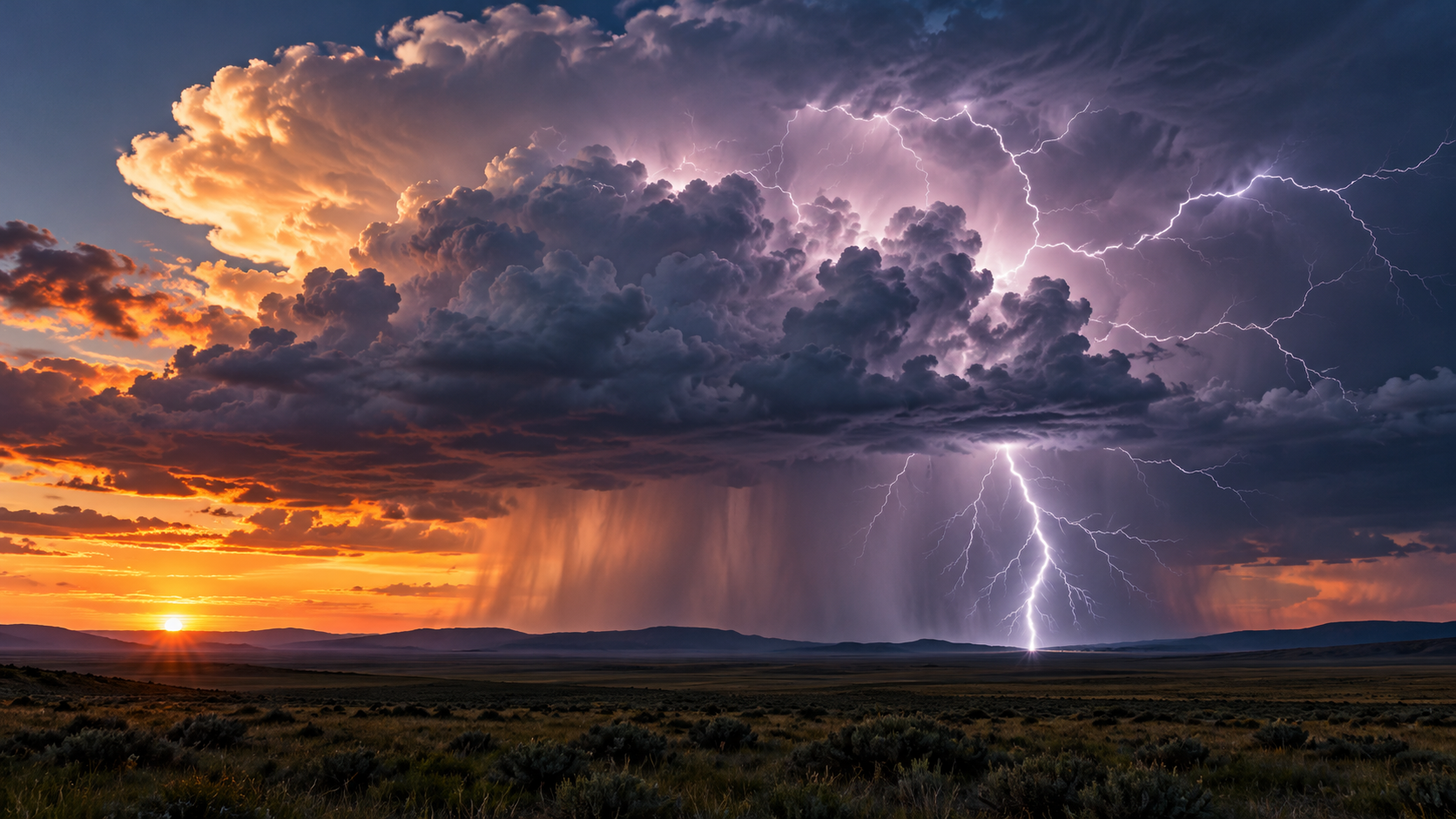
Upward streamers can rise from trees, buildings, or the ground as the leader approaches. When a streamer connects with a descending branch, a continuous conducting path forms. A powerful current called the return stroke then travels along the channel. That rapidly brightening stroke is the brilliant event people usually identify as the lightning bolt.
A single visible flash can contain several strokes. After the first current, additional charge may travel down the partly ionized channel in a faster dart leader, followed by another return stroke. The rapid sequence makes a flash flicker. Lightning also occurs within a cloud, between clouds, and from a cloud toward the surrounding air, not only between cloud and ground.
The current heats the narrow channel to temperatures far above the surrounding air. The heated air expands explosively and launches a pressure wave that becomes thunder. Light reaches an observer almost immediately, while sound travels much more slowly. The delay between flash and thunder therefore gives a rough indication of distance, not the duration of the discharge.
Forecasters can identify storms favorable for lightning, but the exact strike point and moment remain difficult to predict. Charge can travel beyond the visible rain shaft, and bolts may strike several miles from the storm core. The safest response is to move into a substantial building or hard-topped vehicle and remain sheltered until the storm has clearly passed.
Collisions among ice particles and graupel separate charge while storm updrafts sort particles by size and weight.
A strong electric field ionizes air and allows a branching leader to advance through the storm or toward the ground.
Upward streamers can connect with a leader, completing the conductive path for a bright return stroke.
One flash may contain multiple leaders and return strokes, which is why lightning often appears to flicker.
The channel heats air rapidly; explosive expansion produces the pressure wave heard as thunder.
Lightning can extend beyond heavy rain, so safe shelter is necessary even when a storm seems distant.
Explore more "Explainers"
Discover additional explainers across politics, science, business, technology, and other fields. Each explainer breaks down a complex idea into clear, everyday language—helping you better understand how major concepts, systems, and debates shape the world around us.