

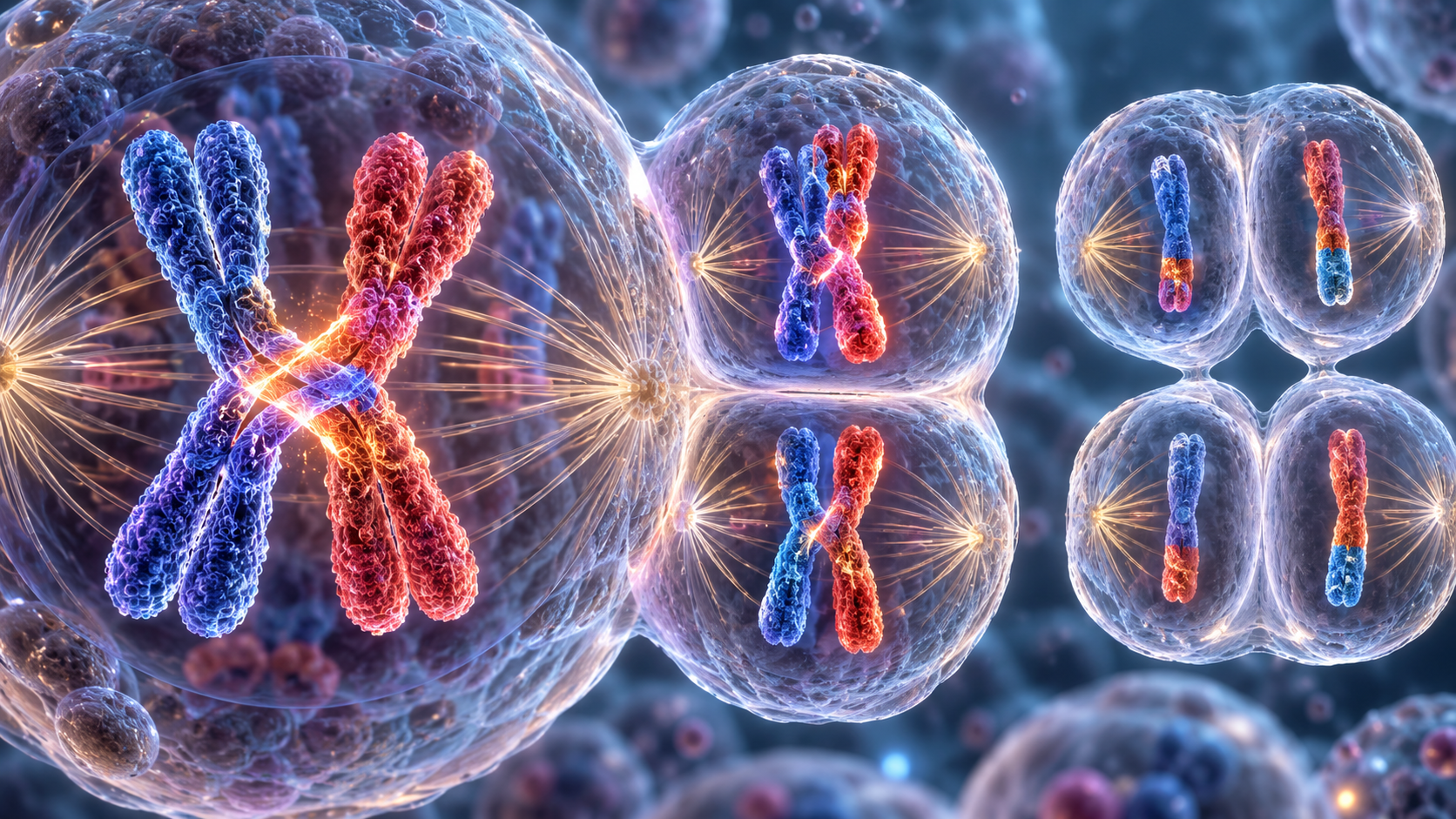
How Meiosis Creates Genetic Diversity Explainer
Meiosis is the specialized cell division that produces eggs, sperm, or equivalent reproductive cells. Before it begins, a cell copies its DNA once. It then divides twice. The first division separates homologous chromosome pairs, and the second separates sister chromatids. The resulting cells contain one set of chromosomes rather than the two sets present in most body cells.
Each homologous pair contains one chromosome inherited from each parent. Early in meiosis I, the homologs align closely in a process called synapsis. Matching DNA regions can break and reconnect between nonsister chromatids. This crossing over exchanges segments, creating recombinant chromosomes that carry a mixture of variants from the two original homologs.
The alignment of each homologous pair at the cell’s equator is largely independent of the other pairs. A maternal homolog may face one pole while a paternal homolog in another pair faces the same or opposite pole. When the pairs separate, this independent assortment creates many possible chromosome combinations even before recombination is considered.
During meiosis II, sister chromatids separate into different cells. Because crossing over can make sister chromatids no longer identical, this division distributes additional variation. In humans, the four products of male meiosis commonly mature into sperm, while female meiosis typically produces one large egg and smaller polar bodies because the cytoplasm is divided unequally.
Meiosis does not invent all genetic variation. New mutations provide novel sequence changes, and random fertilization combines one reproductive cell from each parent. Together, mutation, recombination, independent assortment, and fertilization create the diverse genotypes on which natural selection and other evolutionary processes can act.
Errors can occur if homologs or chromatids fail to separate, a problem called nondisjunction. The resulting cells may have an extra or missing chromosome. Checkpoints remove many abnormal cells, but not all. Meiosis is therefore both a precise reduction process that preserves chromosome number across generations and a powerful reshuffling process that makes siblings genetically distinct.
One DNA replication followed by two divisions reduces a diploid cell to haploid reproductive cells.
Homologous chromosomes pair in meiosis I and exchange matching segments through crossing over.
Each chromosome pair aligns independently, producing many possible maternal and paternal combinations.
Meiosis II separates chromatids, which may already differ because of recombination.
Mutation and random fertilization add variation beyond the combinations created during meiosis.
Nondisjunction can produce cells with extra or missing chromosomes when separation fails.
Explore more "Explainers"
Discover additional explainers across politics, science, business, technology, and other fields. Each explainer breaks down a complex idea into clear, everyday language—helping you better understand how major concepts, systems, and debates shape the world around us.