

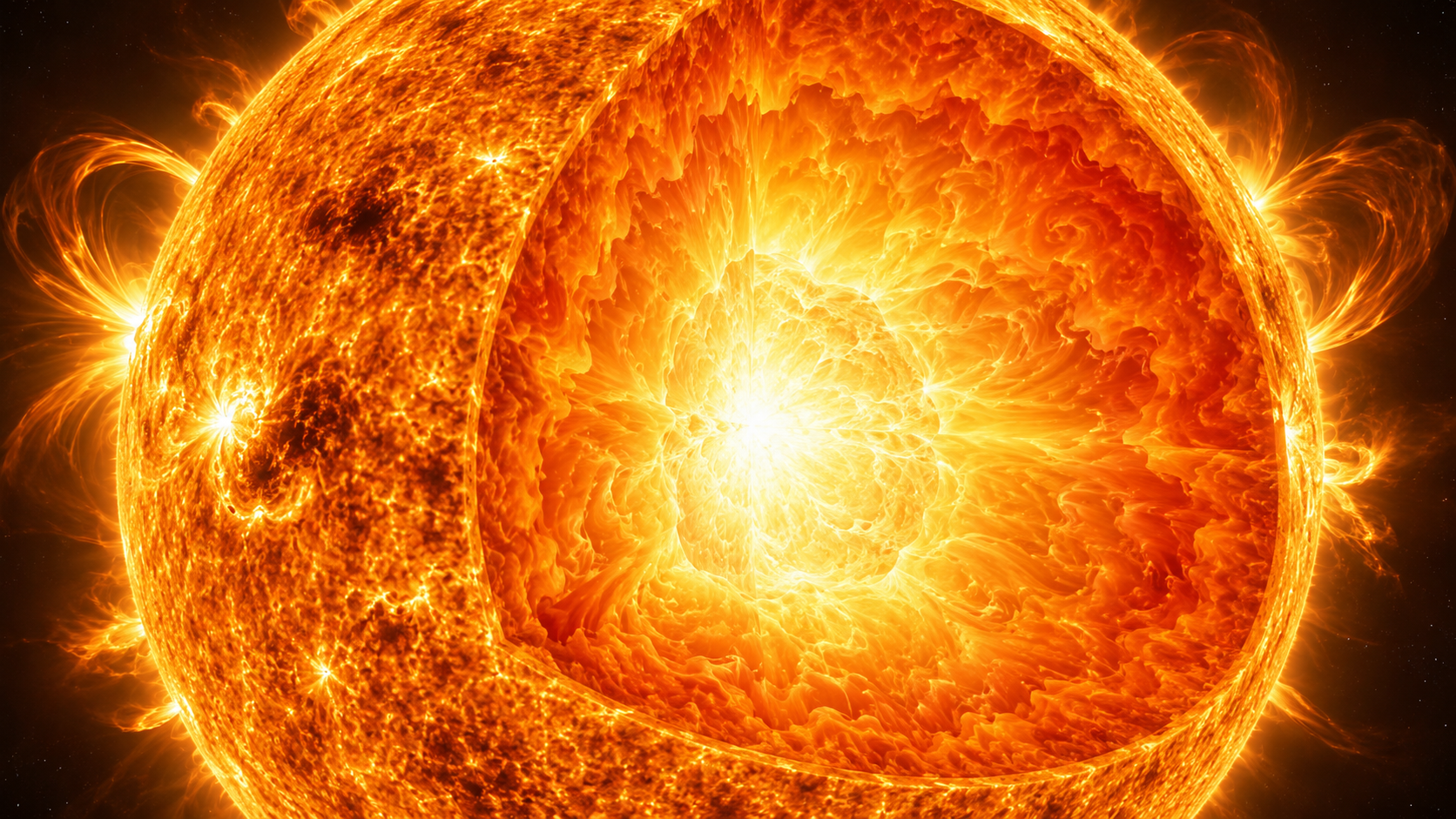
How Nuclear Fusion Powers Stars Explainer
A star shines because gravity compresses its interior until the central gas becomes extraordinarily hot and dense. At millions of degrees, atoms are stripped into a plasma of nuclei and electrons. Nuclei repel one another electrically, but rapid collisions and quantum tunneling allow a tiny fraction to approach closely enough for the strong nuclear force to bind them.
In the Sun, the dominant sequence is the proton-proton chain. Through several reactions, four hydrogen nuclei are ultimately converted into one helium-4 nucleus, with positrons, neutrinos, and high-energy photons also produced. The intermediate steps are slow, especially the first conversion involving the weak nuclear force. That slowness helps the Sun burn steadily for billions of years.
The final products have slightly less mass than the original particles. The missing mass has become energy according to the mass-energy relation. Each individual reaction releases a tiny amount, but the solar core contains an immense number of reacting particles. Neutrinos escape quickly and provide a direct probe of fusion, while most photon energy takes a far longer route outward.
Energy moving away from the core is repeatedly absorbed and re-emitted in the radiative zone. Farther out, rising and sinking plasma carries energy through the convective zone. At the visible surface, radiation finally escapes into space. The sunlight reaching Earth therefore originates in fusion but has been transformed through many interactions inside the star.
Fusion also supports the star against collapse. If the core contracts, it heats and fusion tends to increase; the added pressure pushes back. If it expands and cools, fusion slows. This self-regulation maintains hydrostatic equilibrium for much of a star’s life. Mass determines the core temperature, reaction pathways, luminosity, lifetime, and which heavier elements can later form.
Fusion is different from fission, which releases energy by splitting heavy nuclei. Recreating stellar fusion on Earth requires confining extremely hot plasma or compressing fuel rapidly, while overcoming energy losses and material limits. Stars receive confinement from their enormous gravity. Their light is the visible result of nuclear binding energy released under those natural conditions.
Gravity compresses a star's core until high temperature and density make close nuclear encounters possible.
The Sun mainly uses the proton-proton chain to combine hydrogen into helium through several reactions.
A small mass difference between reactants and products appears as photons, particle energy, and neutrinos.
Radiation and convection carry energy outward before it leaves the photosphere as starlight.
Fusion pressure balances gravity and self-regulates during the long main-sequence stage.
Earth-based fusion must create and confine hot plasma without the enormous gravitational pressure available in stars.
Explore more "Explainers"
Discover additional explainers across politics, science, business, technology, and other fields. Each explainer breaks down a complex idea into clear, everyday language—helping you better understand how major concepts, systems, and debates shape the world around us.