

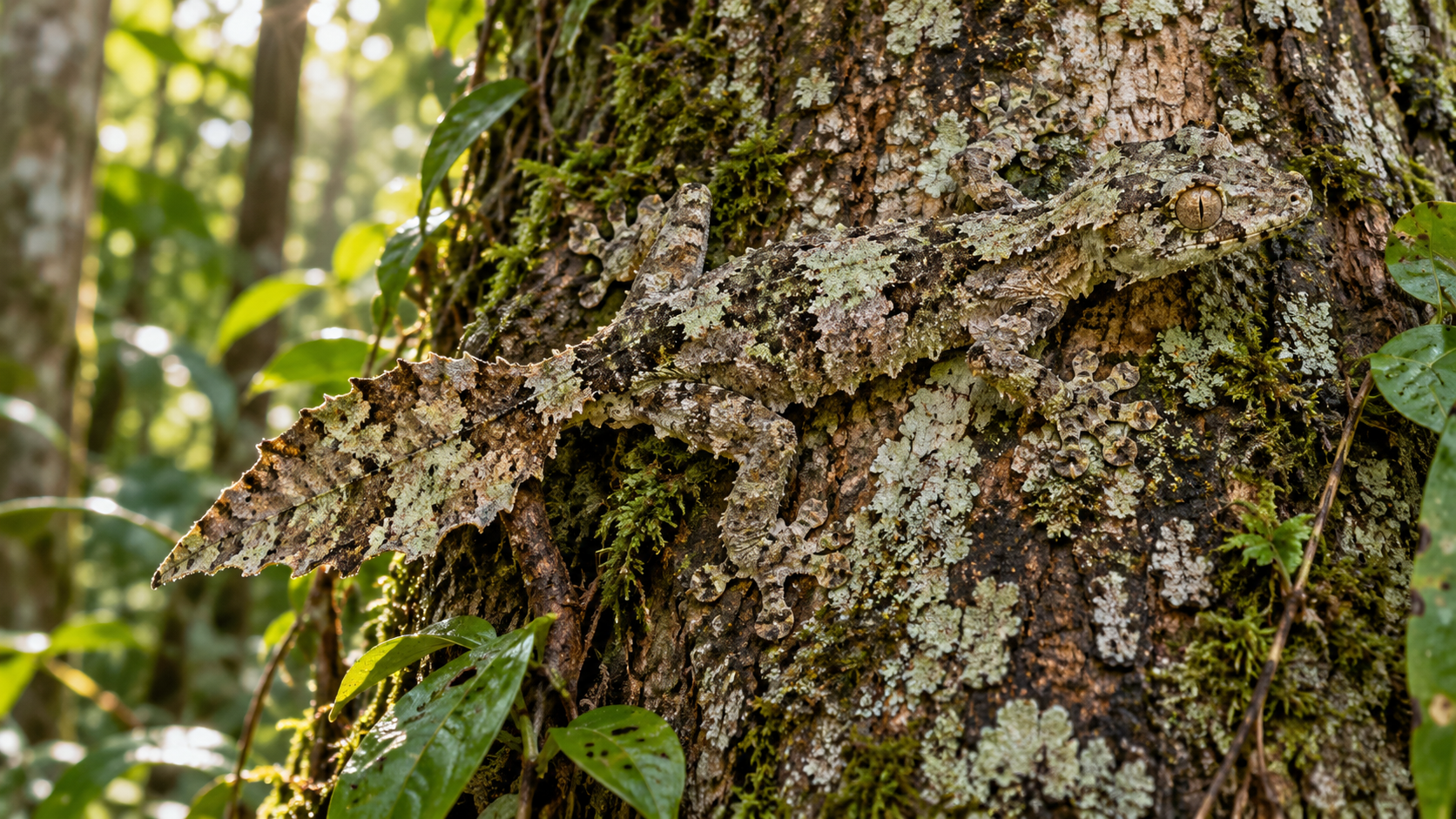
How Animal Camouflage Evolves Explainer
Camouflage is not an animal consciously redesigning itself to match a background. It evolves over generations when individuals differ in heritable appearance or behavior and those differences affect survival and reproduction. Predators remove some conspicuous prey, while prey avoid some conspicuous predators. Traits that reduce detection or delay recognition can therefore become more common.
Background matching makes an animal resemble the average colors, brightness, and pattern of its surroundings. A moth on bark, a flatfish on sand, or a white winter hare can be difficult to separate from the visual scene. The best match depends on habitat, season, viewing distance, and the visual system of the observer rather than on human perception alone.
Disruptive coloration uses contrasting patches that break up the outline or obscure recognizable body parts. Countershading reduces the normal pattern of light and shadow by making upper surfaces darker and lower surfaces lighter. Some species resemble leaves, twigs, stones, or other objects. Mimicry can instead make an organism look like a dangerous or unprofitable species.
Camouflage often includes behavior. An animal may choose a matching resting place, orient along a branch, freeze when approached, bury itself, or become active when light is favorable. Cephalopods, some fish, reptiles, and other animals can change color or texture within seconds by controlling specialized cells, but the underlying mechanisms and behavioral rules are themselves evolved traits.
There are tradeoffs. A pattern effective in one habitat can fail after movement, seasonal change, wildfire, snow loss, or a shift in the predator community. Color can also serve communication, temperature control, or mate choice. Natural selection balances these demands, and genetic drift or developmental constraints can prevent a theoretically perfect match.
Scientists test camouflage with field experiments, artificial prey, calibrated photography, genetic analysis, and models of animal vision. A trait is not proved adaptive merely because it looks hidden to people. Evidence is strongest when the trait changes detection, attack, survival, or reproduction under realistic conditions and when its inheritance and ecological context are understood.
Camouflage spreads when heritable differences in appearance or behavior change survival and reproductive success.
Background matching depends on habitat and on the sensory system of the predator or prey doing the viewing.
Disruptive patterns, countershading, object resemblance, and mimicry reduce detection in different ways.
Resting orientation, movement, habitat choice, and rapid color change can work together with body pattern.
Environmental change and competing functions create tradeoffs, so no pattern is universally optimal.
Experiments must measure effects on detection or survival rather than assuming that human-visible resemblance is adaptive.
Explore more "Explainers"
Discover additional explainers across politics, science, business, technology, and other fields. Each explainer breaks down a complex idea into clear, everyday language—helping you better understand how major concepts, systems, and debates shape the world around us.