

On This Day in Science: April 5, 1973
On the evening of April 5, 1973, local time in Florida, NASA launched Pioneer 11 from Cape Canaveral aboard an Atlas-Centaur rocket. The official universal-time date was April 6, a difference created by the midnight time-zone boundary. The spin-stabilized probe was sent toward Jupiter, whose gravity would redirect it onward to the first close reconnaissance of Saturn.
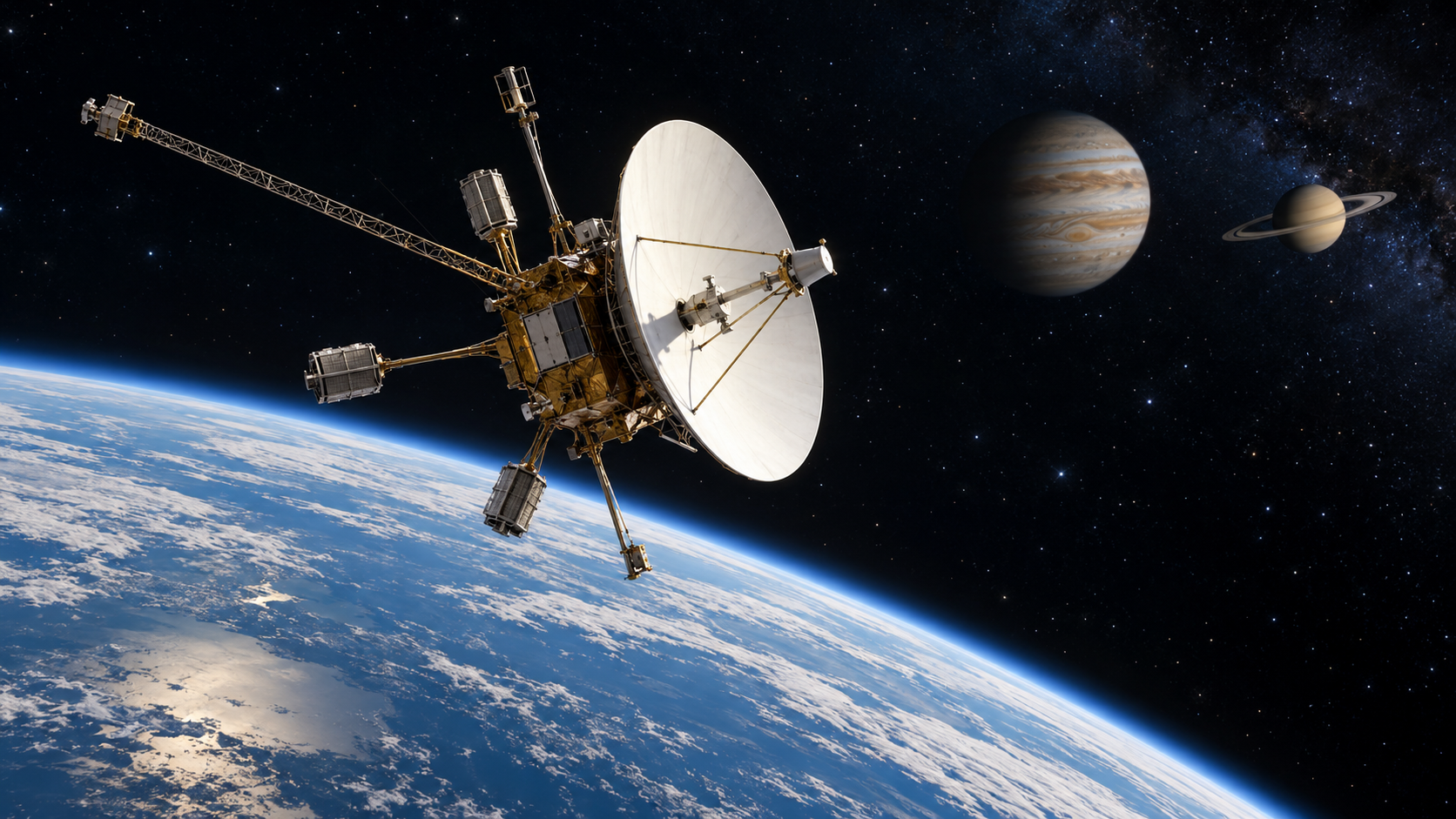
Pioneer 11 carried a large dish antenna, four radioisotope generators, and instruments for magnetic fields, plasma, charged particles, cosmic rays, meteoroids, infrared and ultraviolet radiation, and imaging. Its design emphasized reliability and modest power across billions of kilometers. Controllers had to protect the spacecraft from Jupiter’s severe radiation while aiming for a trajectory that could continue to Saturn.
The probe passed Jupiter in December 1974, returning the first views of the planet’s polar regions. On September 1, 1979, it crossed Saturn’s ring plane and flew within about 21,000 kilometers of the cloud tops. It measured a magnetic field, studied the rings and moons, and discovered a small additional moon. The encounter also provided navigation knowledge for the Voyagers.
Pioneer 11 continued transmitting until 1995 and is now leaving the Solar System. Its launch opened a path that combined planetary gravity, long-lived power, radio tracking, and compact instruments into a multi-world mission. The date is a reminder that exploration routes are engineered years before the famous close-up pictures arrive. For science history, the event also shows how evidence moves from an observation or engineered test into a durable body of knowledge. Instruments supplied measurements, specialists debated interpretation, and later work refined what the first result could mean. Archives preserve the early record while new methods let researchers ask different questions of it. That continuing revision is the process through which a dated milestone remains scientifically useful. Seen across a longer timeline, scientific milestones are junctions rather than isolated beginnings. Earlier experiments, tools, and institutions made the work possible, while later teams tested its limits and carried the result into new settings. What survives is a traceable chain of evidence, correction, and application that allows one moment to remain relevant as knowledge and technology continue to change. The anniversary highlights the difference between a first result and a finished understanding. A successful observation can settle one question while opening several harder ones, and even a failed objective can reshape later designs. Preserved data, specimens, photographs, and hardware allow new generations to revisit the work with better tools. Science advances through that continuity rather than stopping on a memorable date.
Pioneer 11 used Jupiter's gravity to bend its trajectory toward Saturn.
The launch occurred on April 5 in Florida and April 6 in Universal Time.
The spacecraft measured fields, particles, radiation, meteoroids, atmosphere, rings, and moons.
Radioisotope power and spin stabilization supported the long mission far from the Sun.
Pioneer 11 became the first spacecraft to fly past Saturn in September 1979.
Its results and navigation experience helped prepare the Voyager encounters that followed.
Explore more of "On This Day ..."
Discover more events from the same date across news, politics, technology, sports, and other fields. Each link highlights significant moments that shaped history on different fronts.