

On This Day in Science: April 9, 1959
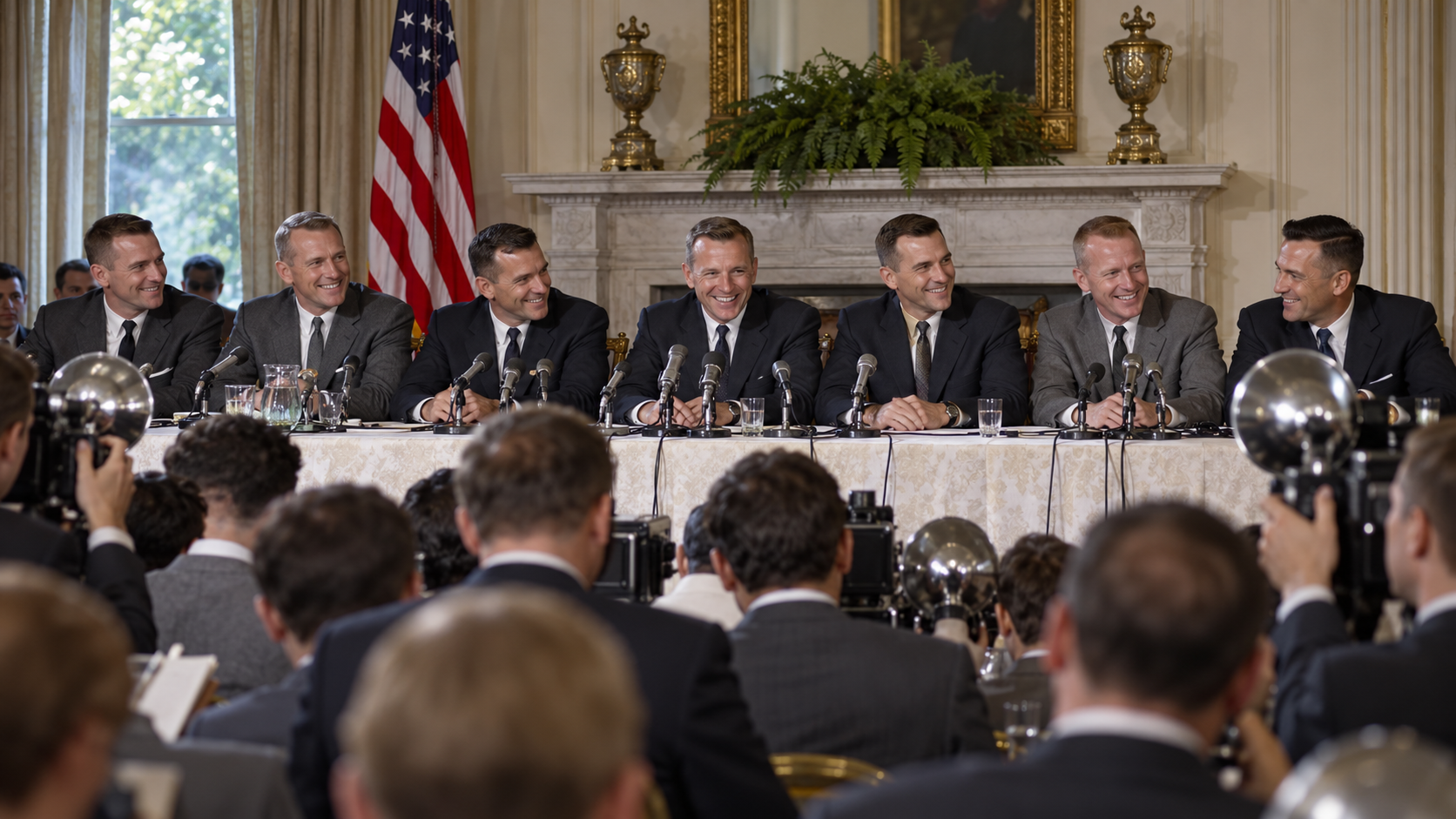
On April 9, 1959, NASA introduced its first seven astronauts at a press conference in the Dolley Madison House in Washington, D.C. Scott Carpenter, Gordon Cooper, John Glenn, Gus Grissom, Wally Schirra, Alan Shepard, and Deke Slayton sat together before reporters as the new agency described the human participants in Project Mercury. All were military test pilots selected through demanding medical, psychological, and technical screening.
Mercury’s objectives were to place a person in orbit, observe human performance in space, and recover both astronaut and spacecraft safely. Engineers still had to answer basic questions about launch acceleration, weightlessness, manual control, life support, heat-shield performance, and ocean recovery. The astronauts did more than ride the capsules; they argued for windows, controls, and the ability to influence the spacecraft.
Shepard made the first American human spaceflight in 1961, Glenn became the first American to orbit Earth in 1962, and the others flew across Mercury, Gemini, and later Apollo-Soyuz. Slayton was medically grounded during Mercury but became a central crew manager before finally flying in 1975. Their public introduction also created a powerful astronaut image that sometimes obscured the thousands of engineers and technicians supporting each flight.
The press conference turned an experimental program into a human story while the science and engineering remained uncertain. It established a working relationship among crews, designers, physicians, and mission controllers that shaped later programs. The event mattered not because seven people alone made spaceflight possible, but because human performance became a formal part of the system being tested. For science history, the event also shows how evidence moves from an observation or engineered test into a durable body of knowledge. Instruments supplied measurements, specialists debated interpretation, and later work refined what the first result could mean. Archives preserve the early record while new methods let researchers ask different questions of it. That continuing revision is the process through which a dated milestone remains scientifically useful. Seen across a longer timeline, scientific milestones are junctions rather than isolated beginnings. Earlier experiments, tools, and institutions made the work possible, while later teams tested its limits and carried the result into new settings. What survives is a traceable chain of evidence, correction, and application that allows one moment to remain relevant as knowledge and technology continue to change. The anniversary highlights the difference between a first result and a finished understanding. A successful observation can settle one question while opening several harder ones, and even a failed objective can reshape later designs. Preserved data, specimens, photographs, and hardware allow new generations to revisit the work with better tools. Science advances through that continuity rather than stopping on a memorable date.
NASA selected Carpenter, Cooper, Glenn, Grissom, Schirra, Shepard, and Slayton from military candidates.
Medical and technical screening reflected the unknown demands of early human spaceflight.
The astronauts pressed for windows, controls, and meaningful pilot authority.
Their feedback linked spacecraft design with human physiology and decision-making.
The Washington press conference made the new astronauts national figures.
Their missions depended on a much larger network of engineers, physicians, technicians, and controllers.
Explore more of "On This Day ..."
Discover more events from the same date across news, politics, technology, sports, and other fields. Each link highlights significant moments that shaped history on different fronts.