

On This Day in Science: April 8, 1911
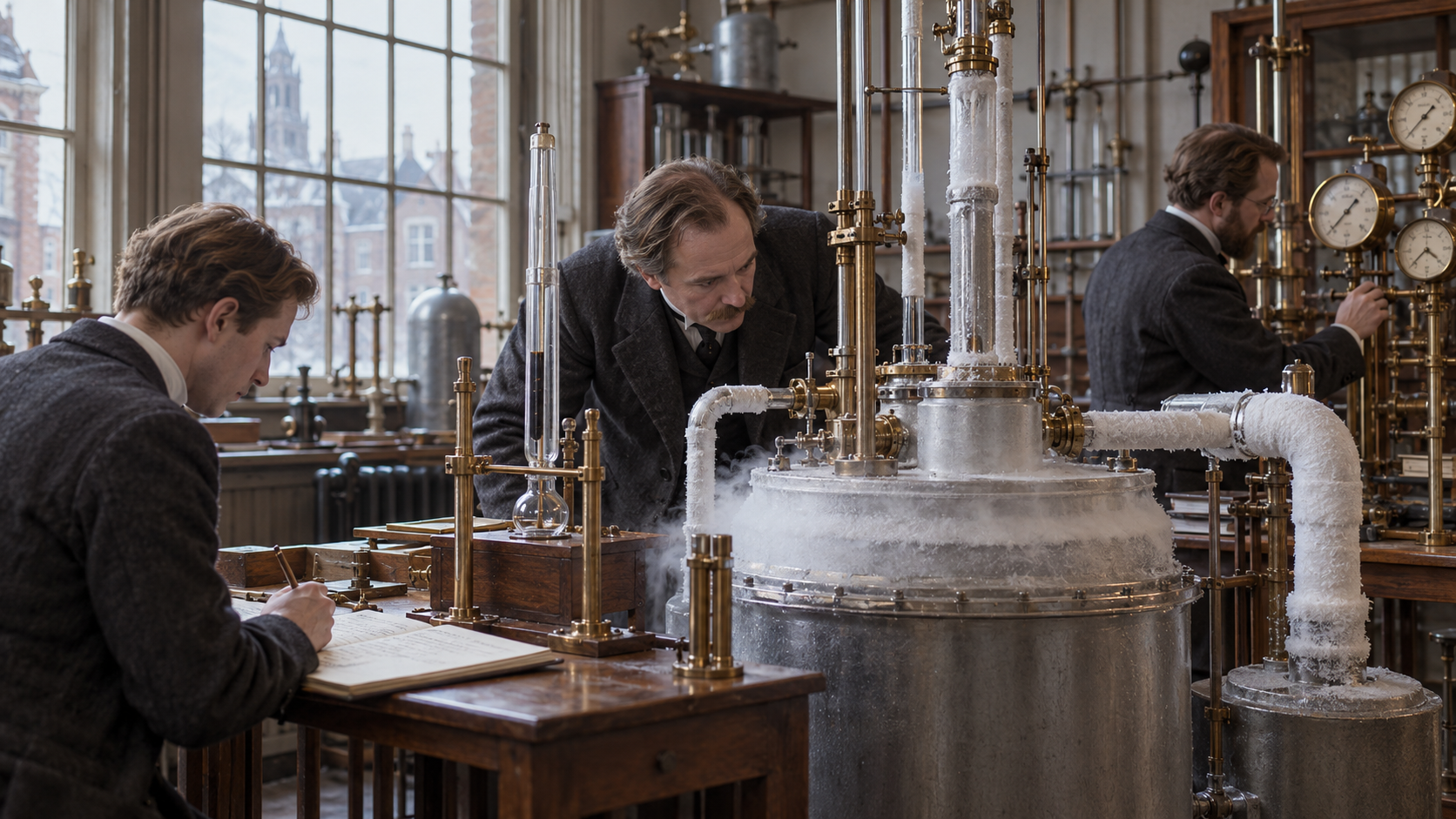
On April 8, 1911, a team in Heike Kamerlingh Onnes’s low-temperature laboratory at Leiden measured the resistance of mercury while cooling it with liquid helium. Near 4.2 kelvin, the resistance dropped so abruptly that it became effectively unmeasurable. The result revealed superconductivity, a new state in which electric current can flow without the ordinary resistance that turns electrical energy into heat.
The experiment depended on an achievement made three years earlier: the Leiden laboratory had learned to liquefy helium and reach temperatures only a few degrees above absolute zero. Mercury was enclosed in narrow glass capillaries with electrical leads for precise measurement. The team had to distinguish a real change in the metal from broken contacts, a short circuit, temperature error, or unstable cryogenic equipment.
Later experiments found superconductivity in lead, tin, and many other materials. In 1933 the Meissner effect showed that superconductors also expel magnetic fields, establishing that the phenomenon was more than perfect conductivity. The Bardeen-Cooper-Schrieffer theory eventually explained conventional superconductivity through paired electrons, while high-temperature materials opened additional questions.
Superconductors now operate in MRI magnets, particle accelerators, quantum devices, and specialized power systems, though most require demanding cooling. The discovery mattered because a simple resistance curve crossed into a qualitatively new form of matter. Extreme temperature did not merely change a value; it reorganized collective electronic behavior. Its calendar date is an entry point, not an endpoint. The people involved worked with the instruments, assumptions, and social conditions of their time, and later research has both extended and corrected their conclusions. Separating what was known that day from what became clear afterward protects the history from myth and shows how cumulative evidence turns an episode into lasting scientific knowledge. For science history, the event also shows how evidence moves from an observation or engineered test into a durable body of knowledge. Instruments supplied measurements, specialists debated interpretation, and later work refined what the first result could mean. Archives preserve the early record while new methods let researchers ask different questions of it. That continuing revision is the process through which a dated milestone remains scientifically useful. Seen across a longer timeline, scientific milestones are junctions rather than isolated beginnings. Earlier experiments, tools, and institutions made the work possible, while later teams tested its limits and carried the result into new settings. What survives is a traceable chain of evidence, correction, and application that allows one moment to remain relevant as knowledge and technology continue to change.
Mercury's electrical resistance dropped abruptly near 4.2 kelvin.
The team had to rule out broken contacts and measurement artifacts before accepting the result.
Leiden's cryogenic equipment reached temperatures unavailable to ordinary laboratories.
That technical capability opened a new region of experimental physics.
Later work connected zero resistance with magnetic-field expulsion and paired electrons.
Superconductors became essential components in magnets, accelerators, sensors, and quantum technology.
Explore more of "On This Day ..."
Discover more events from the same date across news, politics, technology, sports, and other fields. Each link highlights significant moments that shaped history on different fronts.