

On This Day in Science: April 20, 1972
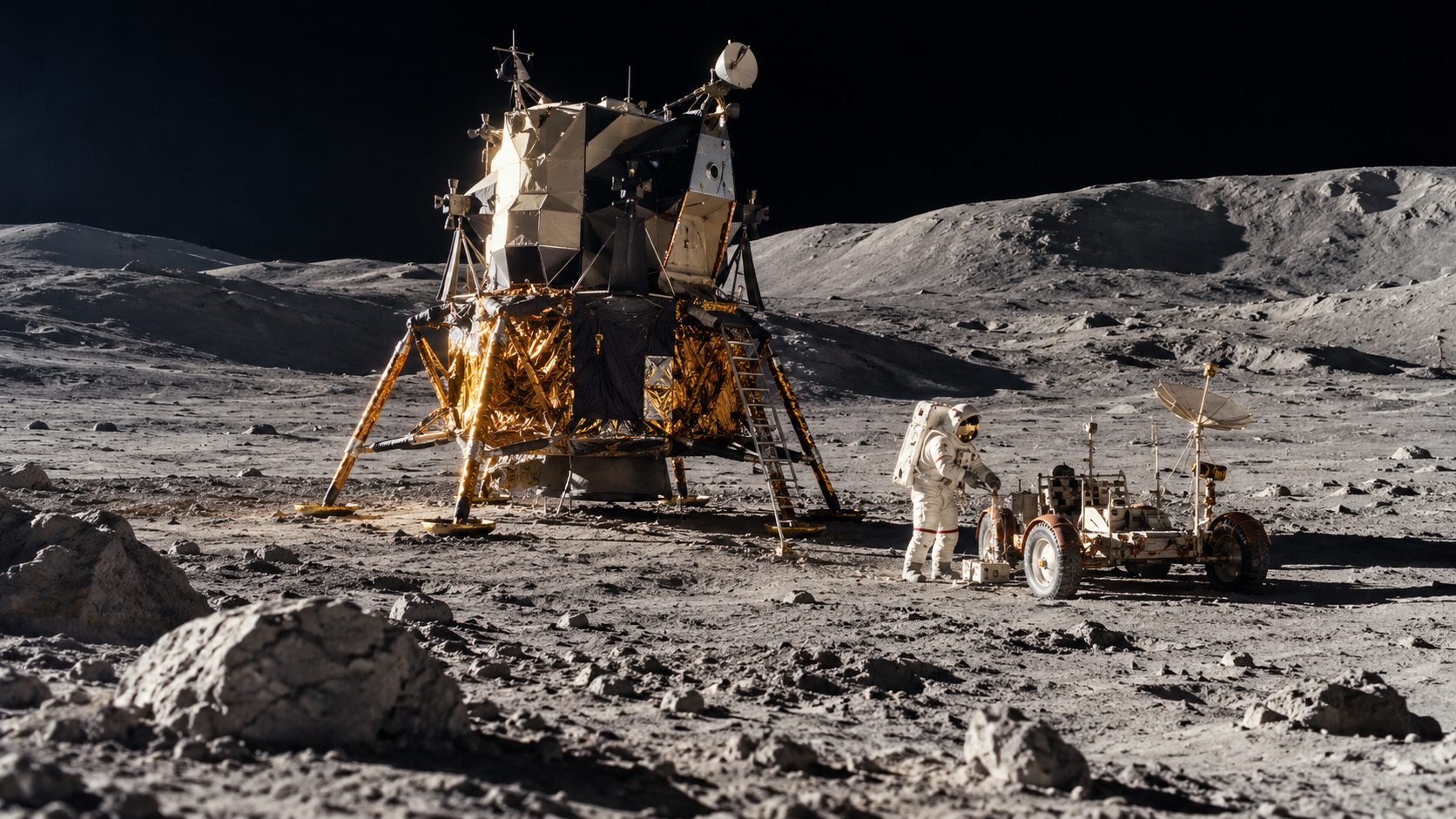
On April 20, 1972, the Apollo 16 lunar module Orion touched down in the Descartes highlands with John Young and Charles Duke. The landing occurred at 9:24 p.m. Eastern time, April 21 in Universal Time, after engineers delayed descent to investigate oscillations in the command module’s backup engine-control circuit. Ken Mattingly remained in lunar orbit aboard Casper.
Scientists selected the site because remote images suggested that some highland features might be volcanic. The landing brought trained observers, a rover, cameras, sampling tools, and geophysical experiments into terrain far from the mare basalts explored by earlier crews. Young and Duke had to navigate among craters and ridges while preserving enough oxygen, battery power, cooling water, and time for a safe return.
Across three moonwalks they drove more than sixteen miles and collected about 209 pounds of samples. The rocks showed that impact processes, not the expected volcanism, dominated the local history. That conclusion corrected an influential interpretation and strengthened the role of large impacts in shaping ancient lunar crust. Surface experiments also measured seismic, magnetic, and heat-related conditions.
The landing mattered because it placed a mobile field team where orbital evidence was ambiguous. Samples could be dated and examined with instruments far beyond what fit aboard the spacecraft. Descartes became an example of exploration doing exactly what science requires: testing a plausible model and changing it when the ground evidence disagrees. Its calendar date is an entry point, not an endpoint. The people involved worked with the instruments, assumptions, and social conditions of their time, and later research has both extended and corrected their conclusions. Separating what was known that day from what became clear afterward protects the history from myth and shows how cumulative evidence turns an episode into lasting scientific knowledge. For science history, the event also shows how evidence moves from an observation or engineered test into a durable body of knowledge. Instruments supplied measurements, specialists debated interpretation, and later work refined what the first result could mean. Archives preserve the early record while new methods let researchers ask different questions of it. That continuing revision is the process through which a dated milestone remains scientifically useful. Seen across a longer timeline, scientific milestones are junctions rather than isolated beginnings. Earlier experiments, tools, and institutions made the work possible, while later teams tested its limits and carried the result into new settings. What survives is a traceable chain of evidence, correction, and application that allows one moment to remain relevant as knowledge and technology continue to change.
Mission Control held Orion in orbit while engineers assessed a command-module steering problem.
The landing proceeded only after the engine system was judged usable.
Remote images had suggested volcanic origins for parts of the Descartes terrain.
Samples instead showed that impact processes dominated the highland geology.
Young and Duke drove more than sixteen miles and collected about 209 pounds of material.
Mobility let the crew compare several locations rather than one patch around the lander.
Explore more of "On This Day ..."
Discover more events from the same date across news, politics, technology, sports, and other fields. Each link highlights significant moments that shaped history on different fronts.