

On This Day in Science: April 19, 1971
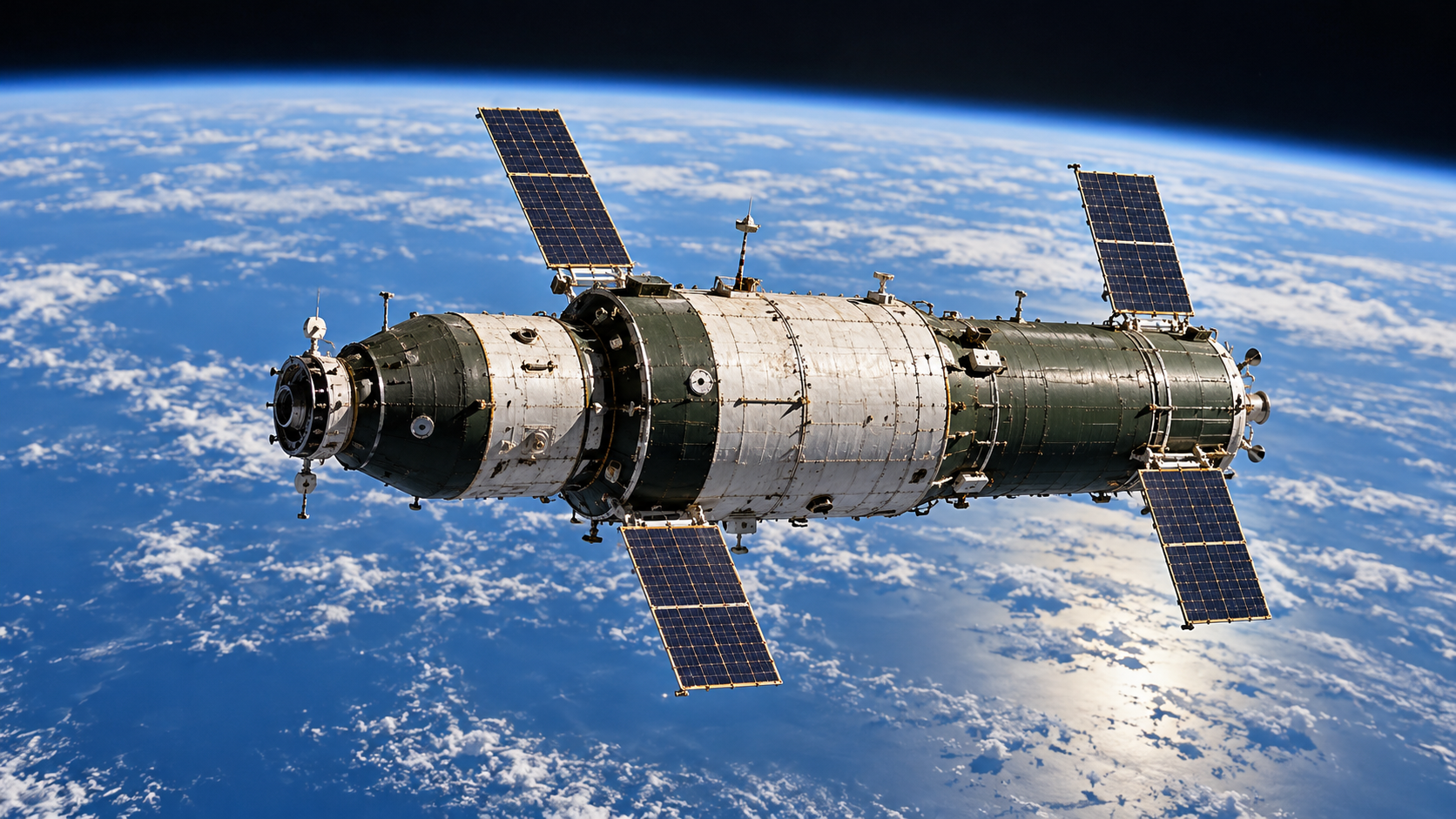
On April 19, 1971, the Soviet Union launched Salyut 1 from Baikonur on a Proton rocket. The cylindrical spacecraft became the world’s first space station, a place where crews could live and conduct work for weeks rather than days. Solar arrays and antennas deployed after orbit insertion, although a protective cover over part of the scientific equipment failed to release.
Salyut combined a docking section, living and working compartments, propulsion, life support, and scientific instruments. A visiting Soyuz spacecraft would provide transportation and the only return vehicle. Soyuz 10 reached the station in April but could not complete a secure docking. Soyuz 11 later docked successfully, and its three cosmonauts lived aboard for twenty-four days.
The resident crew conducted medical observations, Earth photography, astronomical work, and tests of long-duration operations. The mission ended tragically when a valve opened during Soyuz 11’s return preparations and the crew died from depressurization. Salyut itself remained in orbit until a controlled reentry in October, after engineers had learned from both achievement and failure.
The station established a design lineage leading through later Salyuts, Mir, and the Russian segment of the International Space Station. It showed that orbital science could become continuous habitation, with laboratories repaired, supplied, and revisited. The launch opened a form of exploration defined by endurance rather than a single flight. The anniversary highlights the difference between a first result and a finished understanding. A successful observation can settle one question while opening several harder ones, and even a failed objective can reshape later designs. Preserved data, specimens, photographs, and hardware allow new generations to revisit the work with better tools. Science advances through that continuity rather than stopping on a memorable date. Its calendar date is an entry point, not an endpoint. The people involved worked with the instruments, assumptions, and social conditions of their time, and later research has both extended and corrected their conclusions. Separating what was known that day from what became clear afterward protects the history from myth and shows how cumulative evidence turns an episode into lasting scientific knowledge. For science history, the event also shows how evidence moves from an observation or engineered test into a durable body of knowledge. Instruments supplied measurements, specialists debated interpretation, and later work refined what the first result could mean. Archives preserve the early record while new methods let researchers ask different questions of it. That continuing revision is the process through which a dated milestone remains scientifically useful.
Salyut 1 provided living space, life support, propulsion, power, and laboratories in one orbital complex.
Visiting Soyuz spacecraft carried crews and served as their return vehicles.
The Soyuz 11 crew lived and worked aboard for twenty-four days.
Their program included medical studies, Earth observations, and astronomical experiments.
The crew died during Soyuz reentry after a depressurization unrelated to station operation.
Lessons from the program shaped later Salyut, Mir, and International Space Station designs.
Explore more of "On This Day ..."
Discover more events from the same date across news, politics, technology, sports, and other fields. Each link highlights significant moments that shaped history on different fronts.