

On This Day in Science: April 25, 1953
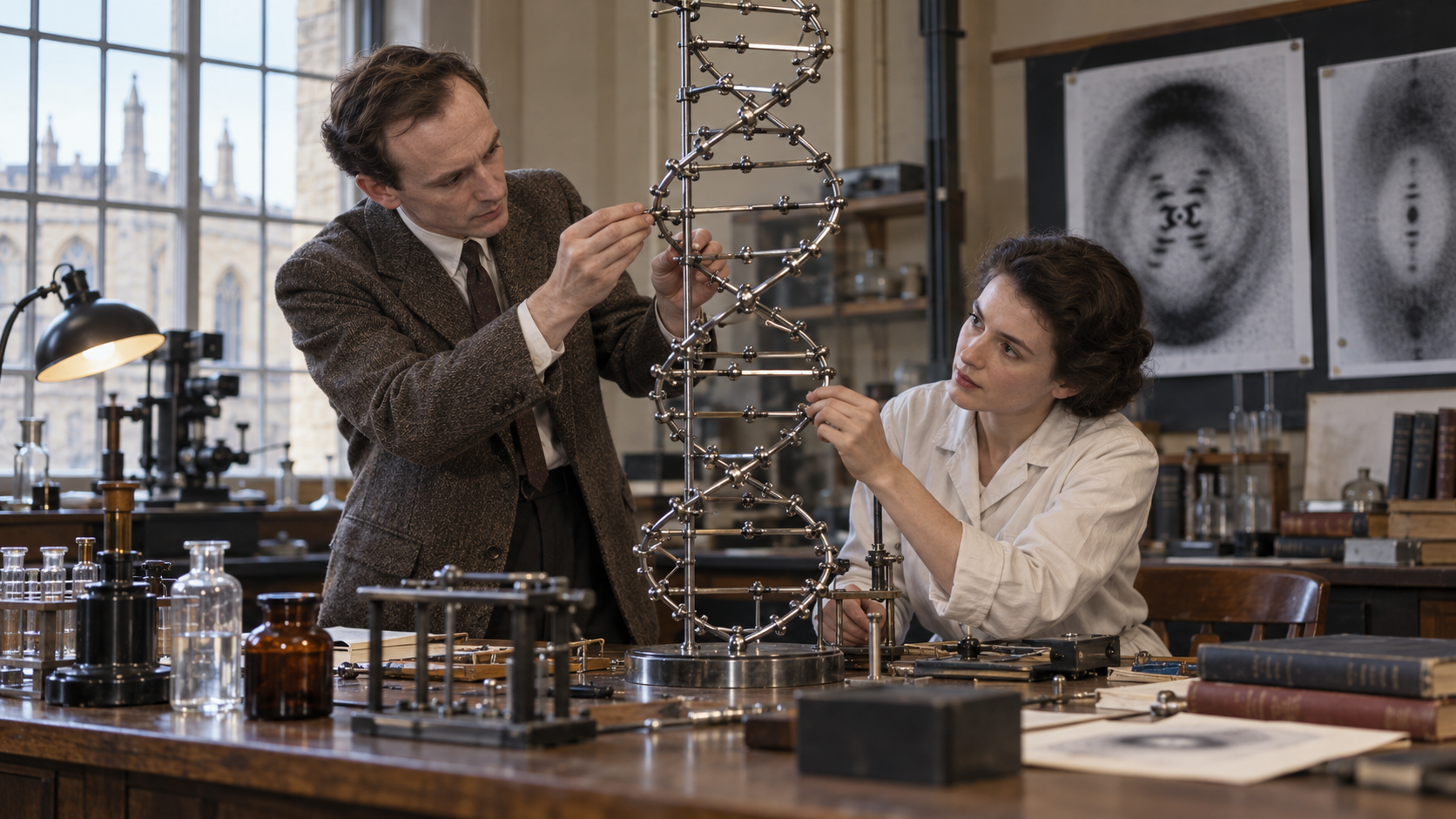
On April 25, 1953, Nature published three papers on the structure of DNA. James Watson and Francis Crick proposed a double helix with paired bases, while papers by Rosalind Franklin and Raymond Gosling and by Maurice Wilkins, Alexander Stokes, and Herbert Wilson presented X-ray evidence from DNA fibers. Together, the work connected a molecular model with measurements of spacing, symmetry, and form.
The double-helix model placed sugar-phosphate backbones outside and complementary bases inside. Pairing between adenine and thymine and between guanine and cytosine gave the structure a regular width and suggested how sequence information could be copied. Chemical constraints, Chargaff’s base ratios, model building, and X-ray diffraction all contributed to the proposed arrangement.
The history includes important questions of credit and data access. Franklin’s exceptionally clear diffraction work and quantitative analysis were essential, yet her role was long underrecognized. The model also required further experiments before DNA’s replication mechanism and genetic coding were established. A persuasive structure was a powerful hypothesis, not the completion of molecular biology.
The papers redirected genetics toward molecules and provided a framework for sequencing, biotechnology, evolutionary analysis, and modern medicine. Their legacy is strongest when the discovery is treated as collaborative evidence rather than a single flash of insight. Publication made the model available for testing, criticism, and extension. For science history, the event also shows how evidence moves from an observation or engineered test into a durable body of knowledge. Instruments supplied measurements, specialists debated interpretation, and later work refined what the first result could mean. Archives preserve the early record while new methods let researchers ask different questions of it. That continuing revision is the process through which a dated milestone remains scientifically useful. Seen across a longer timeline, scientific milestones are junctions rather than isolated beginnings. Earlier experiments, tools, and institutions made the work possible, while later teams tested its limits and carried the result into new settings. What survives is a traceable chain of evidence, correction, and application that allows one moment to remain relevant as knowledge and technology continue to change. The anniversary highlights the difference between a first result and a finished understanding. A successful observation can settle one question while opening several harder ones, and even a failed objective can reshape later designs. Preserved data, specimens, photographs, and hardware allow new generations to revisit the work with better tools. Science advances through that continuity rather than stopping on a memorable date.
Nature published the model alongside X-ray diffraction studies from the King's College teams.
The combined evidence linked molecular geometry with measured patterns.
Complementary bases explained the helix's regular width and implied a replication mechanism.
Later experiments established how cells actually copy and use genetic information.
Franklin's diffraction data and analysis were central but underrecognized for many years.
The history now emphasizes multiple laboratories, methods, and unresolved questions.
Explore more of "On This Day ..."
Discover more events from the same date across news, politics, technology, sports, and other fields. Each link highlights significant moments that shaped history on different fronts.