

On This Day in Science: April 24, 1990
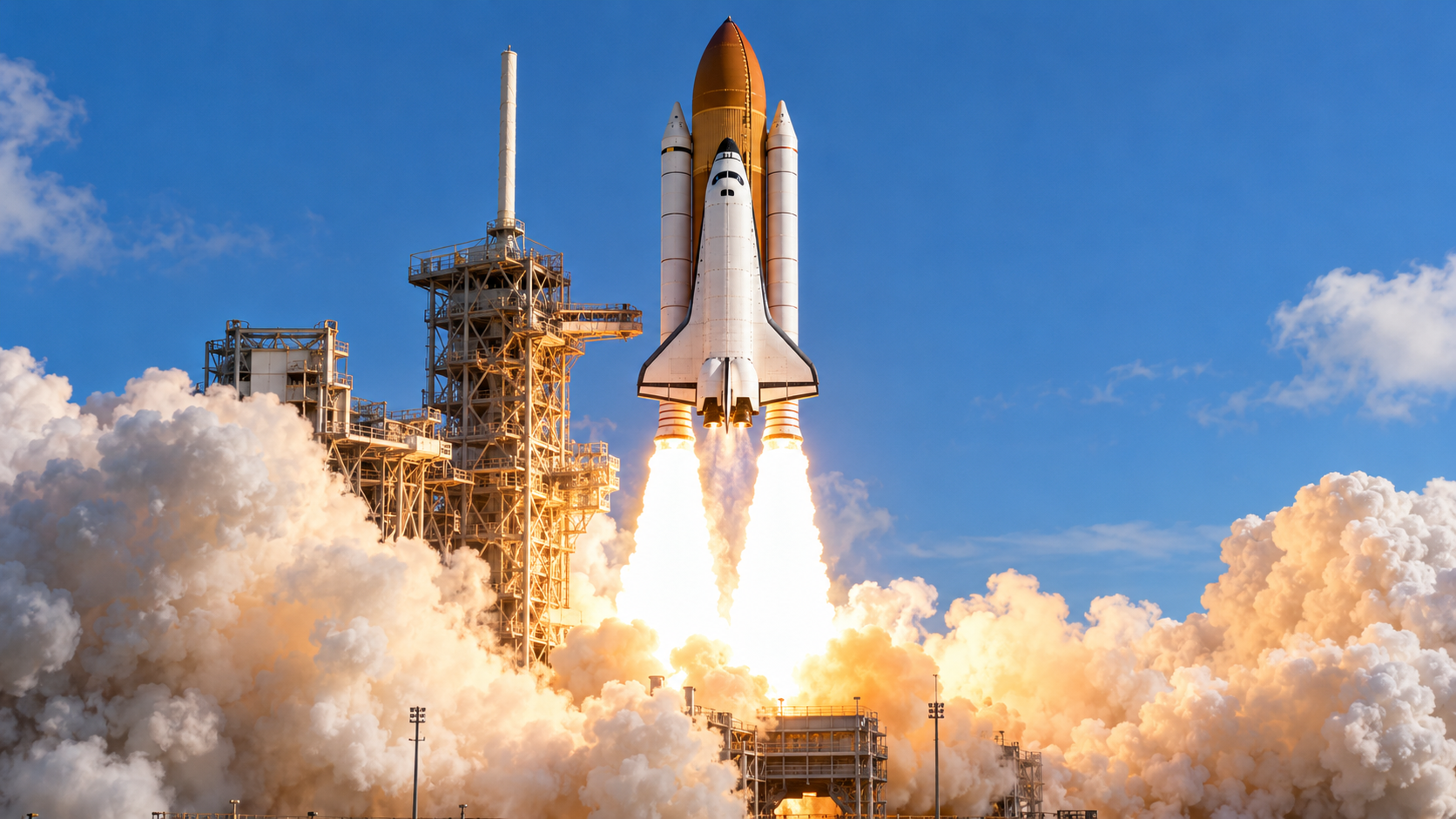
On April 24, 1990, Space Shuttle Discovery lifted off from Kennedy Space Center carrying the Hubble Space Telescope and the five-member STS-31 crew. The 24,000-pound observatory rode in the payload bay to an unusually high low-Earth orbit. The next day, the shuttle’s robotic arm released Hubble with its solar arrays and antennas deployed.
Operating above atmospheric turbulence and absorption, Hubble could obtain stable high-resolution images and ultraviolet spectra unavailable to most ground observatories. Its original package included cameras, spectrographs, and a photometer. Engineers also designed the telescope for servicing, allowing astronauts to replace instruments, computers, solar arrays, gyroscopes, and other components during shuttle missions.
The first images revealed that the primary mirror had been ground to the wrong shape by a tiny amount, producing spherical aberration. Hubble could still do useful science, but its pictures were blurred. In 1993 astronauts installed corrective optics and a camera with built-in compensation, turning a public engineering failure into a successful repair.
Hubble went on to measure the expansion of the universe, examine galaxies, stars, planets, black holes, and exoplanet atmospheres, and create an immense public archive. Its observations repeatedly linked nearby cosmic detail with the history of the wider universe. The launch began not a flawless instrument but a renewable observatory whose scientific life depended on diagnosis, maintenance, and continually improved detectors. Its calendar date is an entry point, not an endpoint. The people involved worked with the instruments, assumptions, and social conditions of their time, and later research has both extended and corrected their conclusions. Separating what was known that day from what became clear afterward protects the history from myth and shows how cumulative evidence turns an episode into lasting scientific knowledge. For science history, the event also shows how evidence moves from an observation or engineered test into a durable body of knowledge. Instruments supplied measurements, specialists debated interpretation, and later work refined what the first result could mean. Archives preserve the early record while new methods let researchers ask different questions of it. That continuing revision is the process through which a dated milestone remains scientifically useful. Seen across a longer timeline, scientific milestones are junctions rather than isolated beginnings. Earlier experiments, tools, and institutions made the work possible, while later teams tested its limits and carried the result into new settings. What survives is a traceable chain of evidence, correction, and application that allows one moment to remain relevant as knowledge and technology continue to change.
Hubble avoided much atmospheric blurring and gained access to ultraviolet wavelengths.
Its original instruments combined imaging, spectroscopy, and precise brightness measurements.
Astronauts could replace instruments and essential spacecraft components in orbit.
That design later made it possible to correct the flawed primary mirror.
Five servicing missions upgraded Hubble's cameras, computers, power, and pointing systems.
The resulting archive continues to support discoveries long after individual observations were made.
Explore more of "On This Day ..."
Discover more events from the same date across news, politics, technology, sports, and other fields. Each link highlights significant moments that shaped history on different fronts.